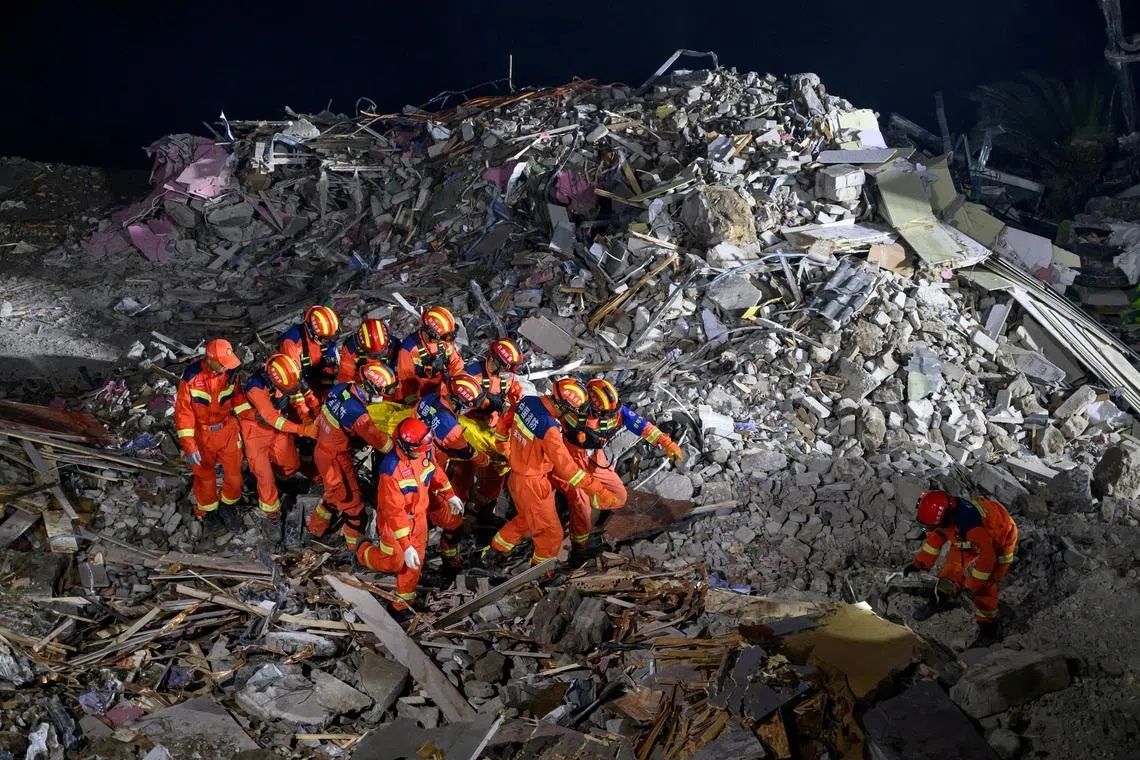
Rescue operations in southwestern China escalated dramatically on Monday when teams deployed controlled explosives to dislodge enormous boulders that were preventing access to 34 people unaccounted for following a catastrophic landslide. The affected area, Penghui County situated roughly 270 kilometres from Chongqing, experienced the disaster during intense rainfall on Friday, resulting in at least eight confirmed deaths. State television broadcast footage of the blasting operation successfully shattering a substantial rock formation, signalling what officials described as entry into a "deep rescue phase" of the operation.
The urgency surrounding the rescue effort reflects China's vulnerability to such natural disasters. The country ranks among the world's most landslide-prone nations, a consequence of its vast mountainous terrain and susceptibility to geological instability. Mountains, hills, and plateaus constitute approximately two-thirds of China's total landmass, creating inherent geographic challenges. Throughout the previous decade, major landslides have claimed roughly 294 lives nationwide, with particularly catastrophic incidents drawing international attention. The most severe example occurred in December 2015 when the collapse of an enormous stockpile of construction waste in Shenzhen's industrial sector killed over 70 people, highlighting the devastating potential of such events.
President Xi Jinping personally directed rescue and investigation efforts, emphasising the importance of applying scientific methodologies in search operations while simultaneously demanding rapid clarification regarding the disaster's underlying causes. This presidential intervention underscores the political significance Beijing attaches to disaster response, particularly in regions with substantial populations dependent on stable conditions. The involvement of high-level leadership typically accelerates resource allocation and coordination among various government agencies.
Authorisation to evacuate more than 1,100 residents from the immediate vicinity demonstrates the authorities' acknowledgment of ongoing danger in the region. Penghui County, which hosts approximately 500,000 inhabitants, features geography where numerous residential communities are precariously positioned along steep hillsides directly adjacent to the Wujian river. The initial collapse visibly altered the landscape, with portions of the mountainside documented in photographs and video footage plunging directly into the waterway, thereby severing the principal thoroughfare connecting the hillside township's fragmented communities.
Beyond the immediate rescue operation, government agencies have launched investigations into secondary geological hazards that frequently accompany primary landslides. Teams systematically survey the terrain to identify additional vulnerable locations and establish monitoring systems capable of detecting further instability. Xinhua, the state news agency, reported that such preventive measures have become standard protocol following major incidents, reflecting accumulated experience and procedural refinement over successive disasters.
The broader meteorological context intensifies anxiety among officials responsible for disaster prevention. Weather forecasts predicted persistent heavy to torrential rainfall extending through Monday across numerous provinces, creating conditions that typically trigger multiple cascading landslides. Eight smaller and medium-sized rivers distributed across Yunnan, Guangxi, Guangdong, Anhui, and Shanghai were already exceeding designated flood warning thresholds at the time of the Penghui incident, creating a nationwide environment of heightened vulnerability.
Three principal factors converge to generate landslide conditions throughout contemporary China. Intense summer monsoon rainfall delivers enormous volumes of precipitation that saturates soil and destabilises slopes. Rapid urbanisation has fundamentally altered landscape hydrology through construction practices, infrastructure development, and modification of groundwater patterns. Additionally, frequent tectonic activity—reflecting China's position along significant geological fault zones—continuously weakens rock structures and creates fracture lines susceptible to failure during precipitation events. Authorities consequently emphasise strengthening protective mechanisms in high-risk regions characterised by excessive groundwater and intensive construction activity.
For Malaysia and other Southeast Asian nations, the Penghui incident carries instructive significance regarding disaster preparedness. The region shares comparable geographic features with southwestern China, particularly the presence of steep topography, tropical rainfall patterns, and increasingly intensive development. The Malaysian peninsula, Sarawak, and Sabah have experienced comparable landslide events, particularly during monsoon seasons. Understanding China's evolving response strategies—from scientific rescue methodologies to secondary hazard identification—provides valuable reference points for regional governments enhancing their own disaster management frameworks.
The incident exemplifies how natural disasters transcend purely environmental concerns to become matters of governance and institutional capacity. The deployment of explosives, while dramatic, represents the culmination of logistical planning, technical expertise, and coordination among multiple agencies. Success in such operations depends fundamentally on preparedness, pre-positioned resources, and trained personnel capable of functioning effectively under extreme time pressure. The televised broadcasting of rescue efforts also reflects modern disaster communication strategies, wherein transparent documentation of rescue operations builds public confidence while potentially attracting international expertise and resources.
As recovery efforts proceed and investigations progress, the Penghui landslide will likely inform policy adjustments across southwestern China's disaster prevention framework. Historical precedent suggests that major incidents typically generate increased funding allocations, enhanced building code enforcement, and expanded monitoring networks. For surrounding regions experiencing comparable hazard exposure, the lessons learned—whether successful techniques or identified shortcomings—circulate through professional networks and government channels, gradually elevating regional disaster management standards across the broader geographic area.

