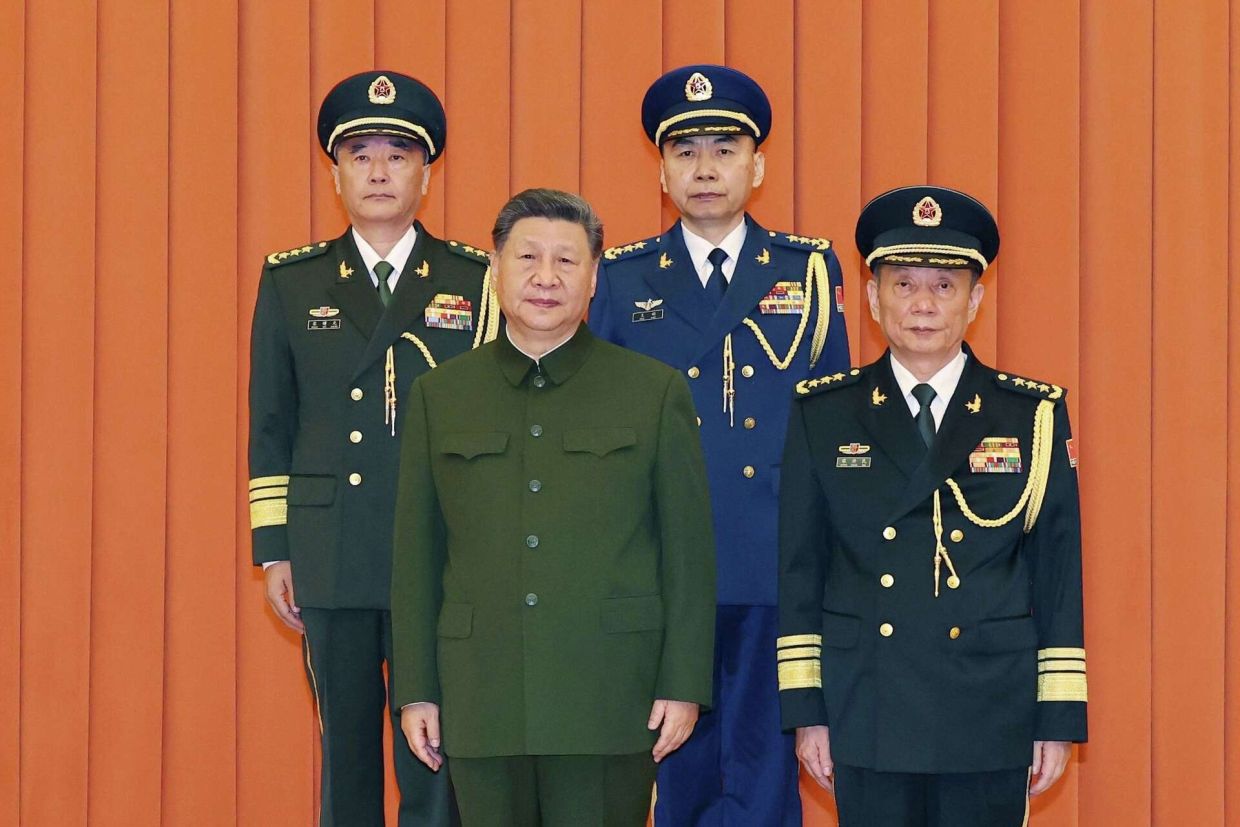
China's military has elevated two senior officers to the rank of general, marking a significant personnel shift within the armed forces as the ruling Communist Party continues its sweeping anti-corruption campaign that has fundamentally altered the military's command structure. The promotions of Zhang Shuguang and Air Force Commander Wang Gang, announced at a ceremony on Friday, July 3, signal efforts to rebuild the decimated senior echelon while simultaneously ensuring the military's institutional loyalty to Party leader Xi Jinping, who maintains direct control over the armed forces as chairman of the Central Military Commission.
The timing and scope of these elevations underscore the scale of the anti-corruption purge that has convulsed China's military establishment over the past several years. The Central Military Commission, which serves as the apex body overseeing all military operations and policy, has been effectively gutted by corruption investigations. Of the seven-member commission, only two positions remain actively filled: Xi himself in his capacity as chairman and Vice Chair Zhang Shengmin. This represents an extraordinary departure from normal institutional functioning, with several former vice chairs either removed from office or effectively sidelined, including the military's former top-ranking general. The vacancy crisis has created an urgent need to identify and promote qualified officers who can assume leadership positions while maintaining alignment with Xi's vision for military modernization and Party control.
Zhang Shuguang's dual promotion carries particular significance beyond his elevation to general status. His appointment as head of the division investigating corruption within the Central Military Commission itself positions him at the epicentre of an ongoing institutional reckoning. This role grants him substantial investigative authority and places him within the Party's confidence network, suggesting the leadership views him as politically reliable and committed to rooting out purported malfeasance. The concentration of prosecutorial and command authority in his hands reflects Xi's approach to military governance: centralizing power among trusted lieutenants while maintaining direct oversight of anti-corruption efforts.
The anti-corruption campaign targeting China's military must be understood within the broader context of Xi's consolidation of power since assuming leadership in 2012. The campaign has served multiple strategic objectives simultaneously. Ostensibly directed at eliminating graft and misconduct within officer ranks, it has functionally removed potential political rivals and eliminated military figures who might harbour alternative visions for Party-military relations or military modernization strategy. The timing of promotions such as these, arriving as the corruption investigations continue, suggests the Party is transitioning from a purge phase to a reconstruction phase, identifying and elevating officers whose loyalty is beyond question.
For Malaysia and Southeast Asian observers, these developments carry implications that extend beyond internal Chinese governance. The restructuring of China's military command has direct bearing on regional security dynamics and Beijing's capacity to project power throughout the Indo-Pacific. A military leadership that has been substantially reorganized may experience temporary operational disruptions or shifts in strategic prioritization. The elevation of figures committed to Xi's modernization agenda could signal renewed emphasis on technological advancement and power projection capabilities in areas of strategic concern to ASEAN nations. Additionally, the demonstrated willingness to dramatically alter military command structures illustrates the degree to which the Communist Party maintains supremacy over the military apparatus—a balance that shapes China's foreign policy orientation and military assertiveness in regional disputes.
The expected announcement of a reconstituted Central Military Commission in autumn of next year represents a crucial inflection point for China's military governance. The new composition will likely include the recently promoted generals alongside other officers who have navigated the anti-corruption gauntlet successfully. This fresh leadership cohort will inherit responsibility for managing China's strategic challenges, including defence modernization, cybersecurity, and regional military posturing. The individuals selected will reflect Xi's preferences for military leadership, ensuring ideological alignment with Party priorities extending into the next five-year cycle.
The promotions also reflect practical necessities within military administration. Creating a two-person active commission simply cannot sustain the operational demands of commanding one of the world's largest military establishments. Everyday decisions regarding personnel deployment, weapons procurement, strategy formulation, and international military engagement require a functioning command structure. The elevation of Zhang and Wang addresses immediate staffing shortages while the broader anti-corruption investigation continues, allowing the military to maintain essential functions during what constitutes a period of transition and institutional vulnerability.
What distinguishes this round of promotions from standard military advancement is the explicitly political context surrounding them. In many defence establishments, promotions rest primarily on operational competence, seniority, and technical expertise. In contemporary China, political reliability to Xi Jinping and the Communist Party stands as an equally decisive criterion. The individuals promoted must demonstrate not only military capability but also ideological commitment to Party supremacy and willingness to execute Xi's strategic vision. This prioritization of political loyalty over pure meritocratic advancement carries long-term implications for military effectiveness and decision-making quality, though Chinese official discourse frames such arrangements as necessary for maintaining institutional cohesion.
The broader anti-corruption drive itself warrants closer examination for Southeast Asian analysts. While corruption undoubtedly exists within any large bureaucratic institution, the scale and intensity of military investigations under Xi suggest political dimensions beyond simple rectification of misconduct. Multiple senior commanders have been detained or removed under corruption charges, creating unprecedented turbulence within the officer corps. This thoroughness in investigating military leadership has few historical parallels within the People's Liberation Army and underscores the depth of Xi's commitment to establishing unquestioned control over the armed forces—an essential prerequisite for implementing major strategic reorientations or responding to perceived security threats without institutional resistance.
Looking forward, the autumn announcement of the reconstituted Central Military Commission will provide crucial signals regarding the military's future direction and the types of leaders Xi envisions guiding strategic policy. The composition of this commission will influence defence budgeting priorities, international military engagement patterns, and the pace of technological modernization efforts. For regional observers, attention should focus not merely on which individuals receive commission seats but also on what their backgrounds and prior positions suggest about Xi's strategic priorities and his assessment of emerging security challenges confronting China.

