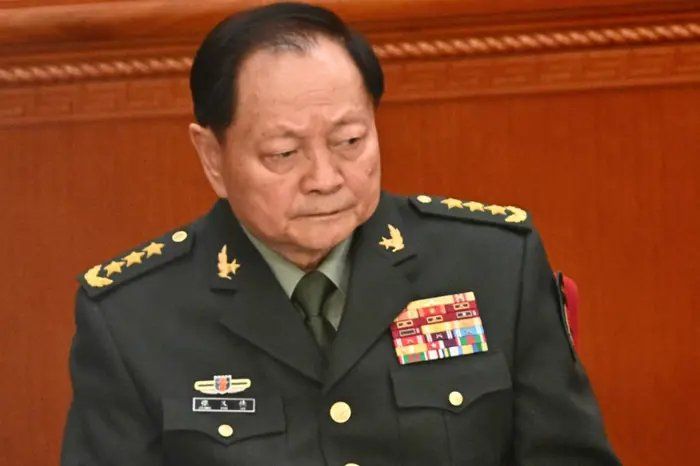
Beijing has formally dismissed Zhang Youxia from his position as vice chairman of the Central Military Commission, China's paramount military decision-making body, state media reported on Friday. The removal marks the culmination of a seven-month investigation into accusations of serious legal and disciplinary breaches that were publicly disclosed in January. The announcement came through an official statement by the standing committee of China's parliament, delivered via state news agency Xinhua, signalling the conclusive end of a high-profile internal inquiry that has reverberated across China's military establishment.
Zhang's departure represents a significant reshuffling at the uppermost echelons of China's armed forces. As the more prominent of two vice chairmen serving on the Central Military Commission, Zhang held the rank of China's highest-ranking general, placing him among the nation's most powerful military figures. His seniority and perceived proximity to President Xi Jinping had led many observers to view him as insulated from the kinds of personnel purges that have periodically swept through the People's Liberation Army. The removal of someone of Zhang's stature therefore underscores the unpredictability of China's internal power dynamics and the reach of anti-corruption efforts that spare no rank or favour.
The investigation into Zhang's conduct was formally announced in January when the defence ministry simultaneously revealed that Liu Zhenli, another high-ranking official and Central Military Commission member, was also under scrutiny. Liu served as chief of staff of the commission's joint staff department, a crucial position responsible for overseeing combat planning and military operations. The ministry's statement employed the characteristic bureaucratic language typical of Chinese official pronouncements, describing both men as suspected of "serious violations of discipline and the law"—a euphemistic formulation that has become standard terminology for corruption allegations within the communist party system.
This development unfolds within the context of Xi Jinping's comprehensive anti-graft campaign, a defining feature of his tenure as China's paramount leader since 2012. The sweeping initiative has ensnared officials across civilian government, the military, and the ruling Communist Party, projecting an image of impartial enforcement against wrongdoing while simultaneously consolidating Xi's control over key institutions. Yet Zhang's case carries particular weight given his military prominence and the historical precedent it sets regarding accountability at the highest levels. The removal signals that no position, however elevated, provides immunity from investigation when accusations of serious violations emerge.
The significance of Zhang's fall extends beyond mere personnel management. Military reshuffles in China carry profound implications for national policy direction, defence spending priorities, and strategic decision-making. The Central Military Commission serves as the apex body for military command and authority, wielding influence over defence doctrine, force modernisation, and responses to regional security challenges. Changes in its composition can therefore reflect shifts in strategic thinking or alterations in the balance of influence among competing factions within the military-political elite.
For regional observers, particularly in Southeast Asia, the removal of high-ranking military officials carries particular relevance. Zhang Youxia's previous roles and the PLA's modernisation priorities under his watch had implications for military capabilities, force posture, and China's approach to maritime security in areas like the South China Sea. The transition in leadership may therefore carry subtle but significant consequences for regional military dynamics and the management of territorial disputes involving multiple claimants.
The parallel removal of Liu Zhenli carries its own importance, given his operational role overseeing joint staff functions. The joint staff department coordinates military operations and strategic planning across service branches, making it a critical node in China's military command structure. Liu's dismissal may necessitate adjustments in ongoing operational planning and could reflect broader reforms to military organisation and governance under Xi's continued tenure.
Zhang's case also illuminates the ongoing transformation of China's military system under Xi Jinping. The past decade has witnessed substantial reorganisation, including the creation of new command structures, emphasis on joint operations, and recruitment of technically skilled personnel. Within this context of institutional change, corruption investigations serve multiple purposes—addressing genuine disciplinary issues while simultaneously removing officials who may resist reorganisation or represent competing centres of influence.
The investigation's duration and formal conclusion suggest a methodical approach to gathering evidence and building a case against individuals of Zhang's stature. Seven months represents a substantial period for Chinese standards, implying that authorities undertook comprehensive inquiries before moving to removal. This measured pace contrasts with occasional rapid purges and may reflect the sensitivity surrounding actions against individuals with significant networks and historical prominence within military circles.
The removals also underscore the continuing tension between Xi's anti-corruption rhetoric and the practical challenges of investigating senior figures embedded within institutional power structures. The successful removal of both Zhang and Liu indicates that Xi's administration retains sufficient institutional capacity and political will to pursue cases against heavyweight figures despite their seniority and potential connections to influential patrons. This reinforces a pattern whereby corruption investigations serve as tools for both genuine enforcement and strategic repositioning within China's elite structures.

