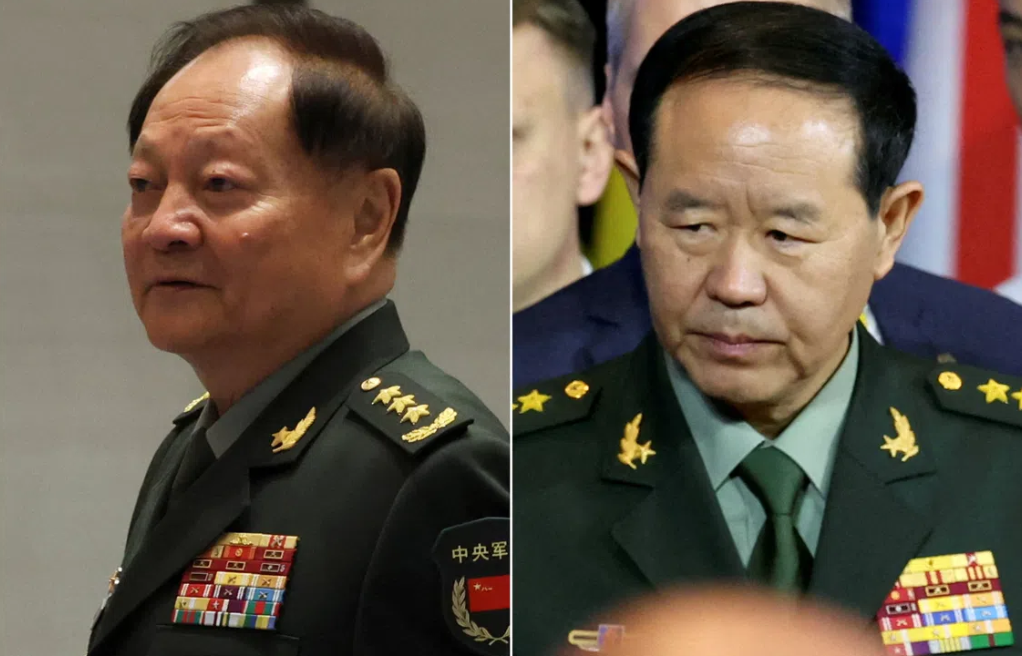
China removed two of its most senior military commanders from the Central Military Commission on Friday, the state's supreme military decision-making body, following investigations into alleged serious breaches of discipline and law. The action represents another significant escalation in President Xi Jinping's multiyear purge of the military establishment, which has reshaped China's defence leadership and consolidated power in the hands of the president and his trusted allies.
Zhang Youxia, who held the position of vice-chairman of the Central Military Commission and ranked among the most powerful figures in the Chinese military hierarchy, has been removed along with Liu Zhenli, a senior officer who served as chief of staff of the CMC's Joint Staff Department. Their departures have left the commission with merely two active sitting members besides Xi himself, a dramatic reduction from its previous seven-member structure and an indication of the thoroughness with which the purge has proceeded.
Zhang's removal carries particular significance given his standing as second-in-command in the military structure under Xi. His position in the Communist Party's elite Politburo, which includes only the highest-ranking leaders of the regime, underscores how the anti-corruption drive has penetrated to the uppermost echelons of power. Liu's role overseeing the CMC's joint operational planning apparatus likewise represents a loss of institutional continuity at a critical juncture in China's military modernisation efforts.
The military establishment has consistently served as a primary focus for Xi's anti-corruption initiative, which commenced in 2012 following his assumption of power. This sustained campaign has fundamentally transformed the composition of China's defence leadership, with scores of senior commanders and officials facing investigation, removal, or formal purges. Last month, Xi himself called upon senior Communist Party leaders to intensify efforts to root out corruption within military ranks, signalling that the cleansing process remains far from completion despite more than a decade of intensive scrutiny.
China operates a parallel structure whereby both the Communist Party and the state maintain separate Central Military Commissions that function as a unified institution in practice. Friday's action by the Standing Committee of the National People's Congress addressed Zhang and Liu's positions within the state apparatus; however, neither individual has yet been formally or publicly stripped of their positions in the Communist Party's CMC, suggesting that further actions may follow. This dual removal process has become characteristic of how China handles high-level departures, allowing the regime to phase out officials gradually while maintaining a veneer of procedural regularity.
Beyond Zhang and Liu, the National People's Congress published an updated roster of deputy members on Friday that reflected the removal of ten additional lawmakers from parliamentary positions. Among these were Lieutenant General Zhong Shaojun, a former director of the CMC's General Office, and General Ju Qiansheng, previously commanding the military's Strategic Support Force. Their inclusion in the purge demonstrates that the investigation network has extended well beyond the highest tier of the command structure to encompass senior officers across multiple service branches and specialised commands.
The removals also touched civilian defence infrastructure, with Gao Shiwen, former mayor of Nanchang in southern China, losing his parliamentary seat. Gao's previous career at China Aerospace Science and Technology Corporation, a state-owned defence and aerospace conglomerate of strategic importance, indicates that the anti-corruption scrutiny spans both military and civilian defence sectors. Such cross-sector accountability efforts suggest a coordinated approach to rooting out suspected misconduct across the entire defence establishment.
In a parallel action, China's top political advisory body stripped Zhao Zongqi, a former commander of the Western Theatre Command, of his advisory body membership this week. Zhao gained prominence during the 2020 border clash between Chinese and Indian forces in the Ladakh region, commanding the military theatre responsible for that volatile frontier. His removal at this particular moment may carry geopolitical implications, though official statements have remained silent on the rationale for his departure.
For Malaysian and Southeast Asian observers, these developments carry several implications for regional stability and the nature of China's military posture. The continuing instability within China's senior military leadership, reflected in this succession of purges, raises questions about institutional continuity and decision-making processes at the highest levels of command. While Xi's anti-corruption drive has strengthened his personal authority over the military, the removal of experienced commanders and the resulting uncertainty about succession and command relationships could influence how China projects power and pursues strategic objectives in Southeast Asia and the broader Indo-Pacific region.
The depleted composition of the Central Military Commission—reduced to just three active members—underscores the degree to which Xi has concentrated military authority within an extraordinarily small circle. This centralisation model, while potentially enhancing the coherence of strategic decision-making, may also create vulnerability through excessive reliance on a narrow group of trusted individuals. For neighbours and partners tracking China's military developments, this leadership configuration suggests that major defence policy shifts would require consensus among an exceptionally small number of decision-makers, potentially affecting the speed and predictability of strategic responses to regional developments.
The scope and persistence of the anti-corruption campaign within Chinese military ranks also reflects deeper institutional challenges that may extend beyond mere disciplinary concerns. Corruption within defence establishments typically involves not only financial impropriety but also questions of loyalty, factional alignment, and organisational effectiveness. The fact that investigations have continued to target senior figures despite years of scrutiny suggests that the regime perceives either widespread systemic problems or remains unsatisfied with the progress of earlier phases of reform. This ongoing process of institutional reconstruction within the military adds a layer of uncertainty to the strategic environment that nations throughout Southeast Asia continue to navigate in their engagement with China.

