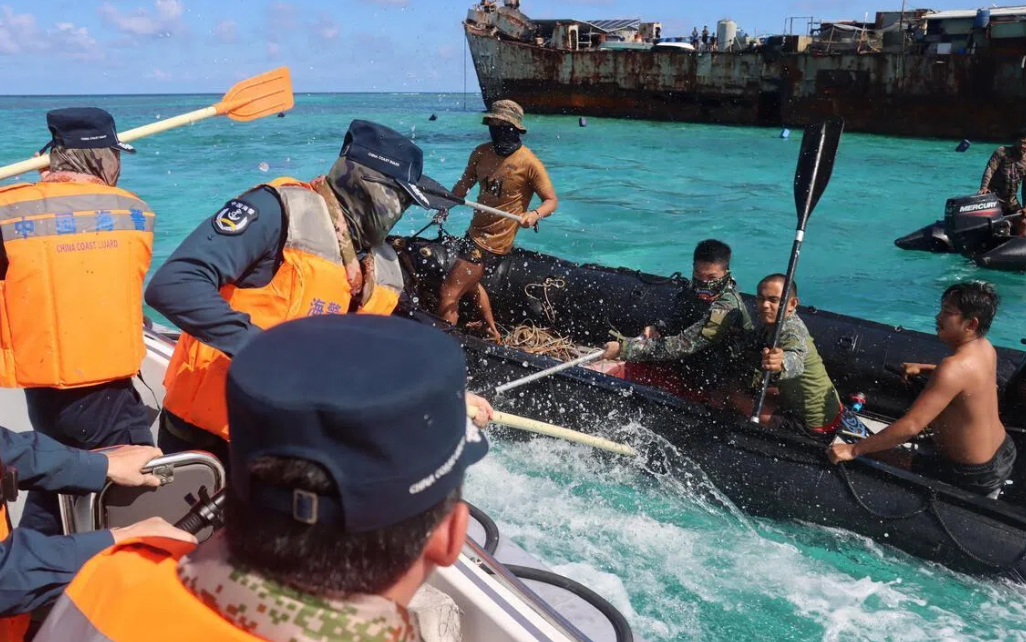
China formally called in the Philippine ambassador on Tuesday to lodge a formal protest over an altercation that erupted the previous day at a disputed shoal in the South China Sea, escalating tensions in one of Asia's most contested waterways. The diplomatic summons came after allegations that personnel from the China Coast Guard used batons to strike a Filipino sailor near a grounded vessel that has long functioned as a Philippine military outpost. The confrontation has reignited international concern about maritime security in the region and triggered sharp responses from Washington and other Western capitals aligned with Manila.
Beijing's response was swift and unyielding, with Chinese foreign ministry officials characterising the incident as a deliberate provocation by the Philippines. In its official statement, China accused Manila of fabricating an account of events, arguing that Philippine forces had initiated the clash and subsequently misrepresented what transpired. The Chinese government specifically rejected what it viewed as attempts by Manila to distort the factual record and weaponise the dispute for diplomatic advantage. This rhetorical posturing reflects the hardened positions on both sides, each nation maintaining fundamentally incompatible narratives about responsibility for the confrontation.
The flashpoint in question, known internationally as the Second Thomas Shoal and called Ren'ai Reef by Beijing, represents a microcosm of the broader South China Sea dispute. China maintains expansive territorial claims over approximately 90 percent of the waterway, asserting historical rights that extend back centuries. However, an international arbitral tribunal in 2016 ruled that China's claims lack any valid legal foundation under international law, effectively rejecting the basis upon which Beijing grounds its sovereignty assertions. Despite this authoritative ruling, China has essentially disregarded the finding and continued to enforce its claims through enhanced military and coast guard presence throughout the region.
The South China Sea remains one of the world's most economically vital maritime corridors, with trillions of dollars in annual trade flowing through its waters. Multiple nations bordering this body of water, including the Philippines, Vietnam, Malaysia, and Brunei, maintain competing territorial claims that directly overlap with China's assertions. These overlapping jurisdictions create a volatile environment where maritime incidents occur with disturbing regularity, each one carrying potential for escalation. The combination of strategic importance, natural resource abundance, and unresolved territorial disputes has transformed the waters into a persistent source of regional friction and international concern.
Manila's allies moved quickly to issue statements condemning China's alleged conduct. Australian Foreign Minister Penny Wong characterised the incident as reflective of destabilising and dangerous behaviour, signalling that countries beyond the immediate region view developments in the South China Sea as relevant to their own security interests. Washington similarly condemned what it termed the dangerous and aggressive actions of Chinese personnel, reinforcing its long-standing position that freedom of navigation constitutes a core American strategic priority. These expressions of solidarity with the Philippines underscore the broader geopolitical dimension underlying what might appear to be a localised maritime dispute.
The timing of these developments coincided with the arrival in Manila of US Secretary of State Marco Rubio for an Association of Southeast Asian Nations (Asean) summit involving representatives from the eleven-member regional bloc. Rubio's presence at the gathering underscored Washington's commitment to maintaining engagement with Southeast Asian capitals at the highest diplomatic level, particularly during moments of heightened tension in the South China Sea. The secretary of state's attendance also signalled American readiness to coordinate with Asean members on shared concerns regarding maritime security and the rules-based international order that Washington has championed throughout the Indo-Pacific region.
While no formal bilateral meeting between Rubio and Chinese Foreign Minister Wang Yi had been publicly announced at the time of reporting, speculation circulated about the possibility of such an encounter on the margins of the summit. Both officials were scheduled to attend the Asean gathering, creating opportunities for engagement. Their previous interactions, including meetings in Kuala Lumpur last year and in Munich in February, suggest that diplomatic channels remain open despite broader tensions between Washington and Beijing. The potential for high-level dialogue could provide space for managing escalating rhetoric, though substantive breakthrough on core disagreements appears unlikely in the near term.
Rubio used an opinion piece published in Philippine newspapers to articulate the American strategic perspective on regional developments. The secretary of state reiterated Washington's fundamental commitment to protecting freedom of navigation throughout Southeast Asia, framing this commitment as essential to the security architecture that has underpinned prosperity and stability. His characterisation of the stakes involved an implicit warning that if a single power willing to weaponise trade relations gained control over these critical waterways, both American interests and those of Asean members would face unprecedented vulnerabilities. This framing strategically elevated the South China Sea dispute beyond a bilateral Philippine-Chinese matter into a broader question about regional order and the distribution of power.
The incident at Second Thomas Shoal exemplifies how maritime confrontations in the South China Sea have become vehicles for expressing deeper geopolitical competition. For the Philippines, maintaining control of grounded vessels at key locations serves as a mechanism for asserting territorial claims and demonstrating administrative presence in disputed areas. For China, preventing or harassing Philippine resupply missions represents a means of challenging Manila's presence and gradually asserting de facto control over contested spaces. Neither side shows signs of substantially modifying its approach, suggesting that such incidents will likely recur despite growing international pressure and mediation efforts.
Regional observers from Southeast Asia face the uncomfortable reality that the South China Sea continues trending toward greater militarisation and more frequent confrontations. The involvement of major powers including the United States complicates potential resolution, as the dispute increasingly reflects broader strategic competition between Washington and Beijing rather than merely reflecting legitimate territorial disagreements among littoral states. For countries like Malaysia, Indonesia, and Singapore, which maintain economic relationships with both superpowers, navigating these tensions requires diplomatic sophistication and careful calibration of public statements. The unfolding crisis at Second Thomas Shoal underscores how localised maritime incidents can rapidly internationalise and acquire significance far exceeding their immediate factual content.

