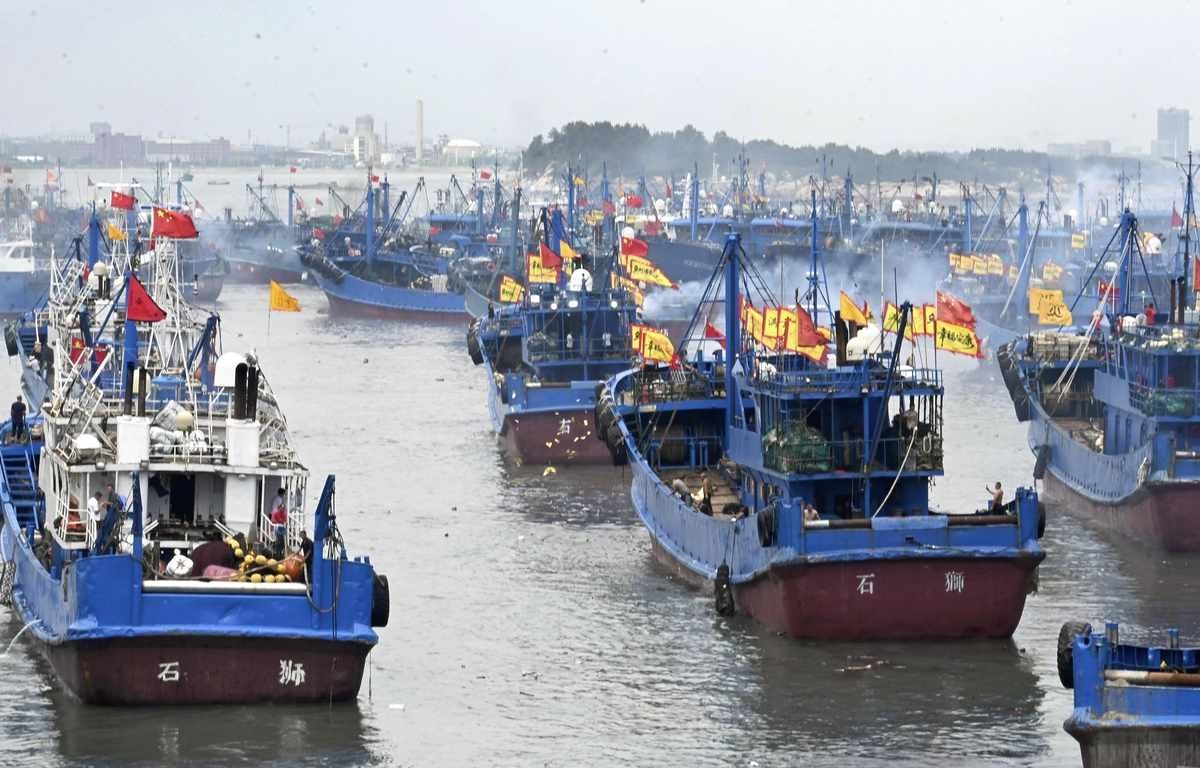
China's lifting of its seasonal fishing ban in the East China Sea has reignited concerns in Japan about potential maritime confrontations in one of Asia's most contentious flashpoints. Starting Saturday, August 15, hundreds of Chinese fishing vessels began departing from ports across Fujian Province, including the strategic city of Shishi, where local media reported 654 boats set sail on the morning of August 16 alone. The resumption of fishing activity carries particular significance given the vessels' likely trajectories toward the disputed Senkaku Islands, which lie within Japan's exclusive economic zone but are claimed by China as the Diaoyu Islands, a sovereignty dispute that remains unresolved after decades of diplomatic wrangling.
The seasonal ban, a recurring feature of China's fishing calendar, typically restricts maritime activities during peak breeding seasons to conserve fish stocks. However, the timing and scale of this year's resumption occur against a backdrop of deteriorating bilateral relations between Tokyo and Beijing, prompting Japanese authorities to treat the situation with heightened vigilance. The lifting of restrictions encompasses not only the Senkaku area but also the Taiwan Strait, another geopolitically sensitive waterway where Chinese fishing activities routinely intersect with Japanese security interests and international shipping lanes critical to regional commerce.
Historical precedent underscores why Japan's concerns are substantive rather than speculative. In August 2016, Chinese Coast Guard vessels and between 200 to 400 fishing boats converged on waters surrounding the Senkaku Islands in what observers characterized as a coordinated operation, resulting in documented incursions into Japanese territorial waters. The Japan Coast Guard subsequently lodged formal protests, asserting that Beijing had deliberately escalated regional tensions through what many analysts viewed as a coordinated show of force. That incident occurred in the aftermath of the Arbitral Tribunal's July 2016 ruling in The Hague, which rejected China's expansive sovereignty claims across the South China Sea, and some diplomatic observers interpreted the fishing boat surge as a retaliatory gesture against Japan's demands that China respect international arbitration.
Since that 2016 episode, however, the dynamics have shifted in ways that suggest both deliberate restraint and underlying calculation on the Chinese side. Local government authorities in Fujian Province have instructed fishing communities to exercise caution in sensitive waters, effectively creating informal boundaries without resorting to explicit prohibitions that might appear heavy-handed or politically contentious. This approach allows Beijing to maintain plausible deniability regarding coordination while still exercising substantial influence over maritime behavior. The statistical evidence reflects this calibrated strategy: the number of warnings issued by the Japan Coast Guard to Chinese fishing vessels that ventured into Senkaku territorial waters declined dramatically from 81 in 2021 to just four in 2025, suggesting either increased Chinese restraint or improved compliance with unofficial guidance.
Yet the signals emanating from Chinese authorities contain ambiguities that complicate interpretation. On August 7, officials in Quanzhou, the municipality overseeing Shishi, issued a call for strengthened surveillance of sensitive waters, language that could indicate either tighter control mechanisms or contingency preparations for potential incidents. More significantly, the government's annual fishing guidance notices have undergone subtle but revealing revisions. Last year's directive explicitly mentioned Japan alongside South Korea and North Korea as regions where cross-border fishing was strictly prohibited. This year's April 30 notice, however, omitted any reference to Japan while retaining restrictions on the interim measures area between China and South Korea, a conspicuous deletion that diplomatic sources have flagged as potentially significant.
Interviews conducted with fishing communities reveal the practical realities underlying these governmental maneuvers. A fisherman in his fifties acknowledged the commercial attractions of waters surrounding the Senkaku Islands, characterizing them as exceptionally productive fishing grounds where catches remain substantially larger than in alternative locations. He indicated that while local authorities conducted surveillance to prevent violation of Chinese restrictions, no explicit prohibition against venturing toward Japanese waters had been communicated, creating a permissive environment where individual operators might push boundaries without technical violation of official rules. This gray zone between tacit discouragement and explicit prohibition allows maximum operational flexibility for the fishing fleet while preserving Beijing's capacity to disavow orchestrated provocations.
The broader context for these maritime activities extends beyond bilateral Japan-China relations to encompass China's regional strategic posture. The resumption of fishing in the East China Sea occurs amid sustained Chinese pressure across multiple maritime boundaries, including the South China Sea where Beijing continues constructing artificial islands and militarizing features despite the 2016 Hague arbitration award. The apparent softening of China's official language regarding Japanese waters may reflect Beijing's calculation that Japan's current political and economic preoccupations leave limited capacity for robust pushback, or alternatively, it could indicate confidence that economic interdependence and Japan's internal constraints will prevent escalation even if fishing incidents multiply.
For Japan, the situation demands careful navigation between deterrence and restraint. Japan Coast Guard operations continue monitoring Senkaku waters, but Tokyo faces pressure to avoid incidents that could be weaponized diplomatically by Beijing as evidence of Japanese aggression or militarization of civilian disputes. Meanwhile, the deterioration in Tokyo-Beijing relations has made compartmentalization increasingly difficult, with maritime flashpoints becoming intertwined with broader disputes over regional leadership, technology competition, and security alignments involving the United States, the Philippines, and Southeast Asian nations with their own maritime claims.
Southeast Asian observers and policymakers are monitoring this development with considerable interest, recognizing that patterns established in the East China Sea and Senkaku waters influence Chinese behavior across the broader Asia-Pacific maritime domain. The demonstrated willingness to operate vessels in disputed waters, combined with increasingly sophisticated techniques for managing such operations through unofficial guidance rather than explicit coordination, represents a model that could be replicated in other contested areas. The approach also tests the limits of international law enforcement and the capacity of individual nations to protect claimed territories without international backup, a particular concern for smaller Southeast Asian claimants to features in the South China Sea.
The coming weeks and months will prove critical in determining whether the resumption of Chinese fishing activities represents a temporary seasonal pattern or signals a shift toward more assertive maritime behavior. Japan's monitoring posture reflects an attempt to gather data on Chinese intentions while avoiding the miscalculation that could trigger escalatory spirals. The Japanese government has established clear red lines regarding territorial incursions, yet the ambiguity surrounding China's guidance to fishing communities means that determining deliberate provocation from routine fishing activity remains analytically challenging. What remains certain is that the East China Sea, far from being a stable maritime domain, continues functioning as an arena where maritime disputes, economic interests, and great power competition intersect in ways that affect regional stability and the security calculations of all Asia-Pacific nations.

