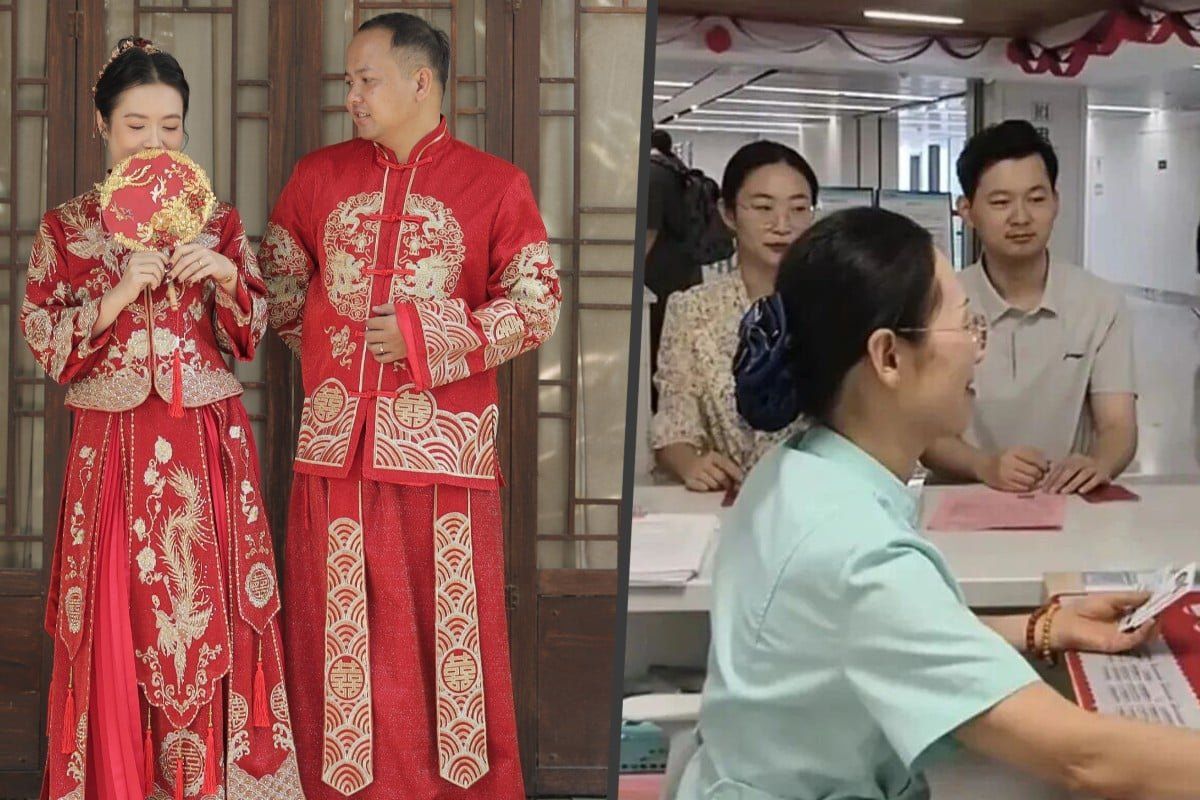
China's government is deploying an unconventional strategy to combat plummeting marriage rates, turning unexpected venues into registration hubs. The latest addition to this expanding network is the Maternal and Child Health Hospital of Linzi District in Zibo City, Shandong province, which launched marriage registration services on August 20 during the Qixi Festival, China's Valentine's Day. The hospital joins a Postal Savings Bank branch in Tianjin—the country's first bank to offer such services in August—in an escalating push that has transformed marriage registration from a purely bureaucratic function into a public health and lifestyle convenience.
The phenomenon reflects fundamental shifts in how Beijing approaches demographic challenges. Following regulatory reforms enacted in May last year, couples gained unprecedented flexibility in China's marriage registration system. Husbands and wives no longer require household registration documents, known as hukou booklets, to formalize their unions, and they can register outside their official residence jurisdiction. These changes dismantled decades-old administrative barriers that had complicated the process, essentially removing legitimate logistical obstacles to marriage. Yet authorities recognized that regulatory simplification alone would not arrest the decline, prompting them to reimagine where and how couples could marry.
The resulting ecosystem of registration venues has mushroomed across China's urban landscape. Guangzhou Baiyun International Airport became the nation's first aviation hub to issue marriage certificates, enticing couples with complimentary observation deck access to watch aircraft operations. In Beijing and Nanjing, centuries-old temples now solemnize unions conducted in traditional ceremonial dress, blending spiritual significance with administrative formality. Shanghai's nightclub partnership with local civil affairs authorities represents perhaps the most striking cultural pivot, transforming spaces traditionally associated with entertainment and nightlife into sites of state-sanctioned commitment. By May this year, merely twelve months after regulatory changes took effect, China had established over 500 dedicated marriage registration sites separate from traditional civil affairs bureaus, with a further 1,300 outdoor locations operating through collaborative arrangements.
Industrial expansion accelerated through transport infrastructure and public spaces. Hefei's metro station became the first transportation facility nationwide to provide marriage services this August, while numerous parks, temples, and tourist attractions integrated registration capabilities into their visitor facilities. The hospital model gains particular appeal because it streamlines what the Linzi facility describes as a unified pathway: couples can register their marriage, undergo mandatory premarital medical examinations, and receive preconception health guidance without navigating multiple institutions. This integration responds to practical anxieties surrounding fertility and genetic screening that remain culturally significant in contemporary China.
Statistical momentum initially validated the strategy. During the third quarter of last year, 1.61 million couples registered marriages nationwide, marking a robust 22.5 percent year-on-year surge. Full-year figures for the previous calendar showed 6.76 million registrations, substantially exceeding the preceding year by 657,000 unions. The numbers suggested that convenience-driven expansion of registration venues, combined with simplified administrative procedures, could meaningfully reverse demographic decline. Government officials and policymakers pointed to these figures as evidence that removing friction from the marriage process would naturally increase participation.
Yet this optimism collapsed within months. The first half of this year revealed a sharp reversal: marriages contracted by 7.5 percent year-on-year, with only 3.28 million couples formalizing unions during the period. The dramatic swing undermined assumptions that infrastructure and accessibility alone could reverse cultural and economic anxieties driving marriage avoidance among younger Chinese cohorts. The data suggested that opening hospitals and nightclubs as registration sites, while symbolically revealing government commitment, did not address fundamental impediments shaping individual decisions about matrimony.
Online discourse quickly crystallized skepticism about the entire initiative. Social media users questioned whether procedural convenience could overcome structural obstacles to marriage formation. One commenter sarcastically suggested that difficulty locating registration facilities hardly explained matrimonial reluctance, implying that the government was addressing symptoms rather than causes. Another mocked the absurdity of expanding registration venues, jesting that establishing divorce services atop Mount Everest would represent logical extension of current strategy. These critiques identified a conceptual gap between administrative solutions and lived reality for young adults navigating marriage decisions.
Deepler anxieties emerged in sociological analysis. Commentators emphasized that young people's hesitation toward marriage stemmed from fundamental apprehensions about future life challenges rather than bureaucratic inconvenience. The financial burdens of establishing households, navigating complex family dynamics, and surrendering personal autonomy constituted genuine deterrents that no registration venue could address. Economic pressures, including housing affordability crises in major cities and wage stagnation relative to living costs, created material conditions discouraging family formation. These structural factors operated independently of whether couples could register marriages at banks or nightclubs.
Culturally, younger Chinese increasingly reject marriage as an obligatory life milestone, representing a philosophical rupture from previous generational assumptions. This shift reflects broader patterns evident across East Asia, where prolonged education, career investment, and expanded opportunities for women have decoupled marriage from social legitimacy and personal fulfillment narratives. The proliferation of registration venues implicitly assumes that modernizing access fundamentally changes individual calculus, yet it overlooks how demographic transformation operates through value systems rather than infrastructure.
For Southeast Asian observers, China's experience illuminates how government interventions addressing supply-side factors prove insufficient when demand-side impediments remain unaddressed. Malaysia and other regional economies face comparable pressures from aging populations and declining fertility rates, yet the Chinese case demonstrates that bureaucratic simplification, while necessary, cannot substitute for tackling underlying economic insecurity, gender dynamics, and philosophical reorientation toward marriage. The hospital and nightclub registration initiatives represent creative policymaking, yet their modest ultimate impact suggests that demographic challenges require comprehensive social and economic strategies rather than ceremonial venue expansion.
China's marriage registration experiment ultimately reveals the limits of administrative solutions to demographic crises. While opening hospitals and banks demonstrates apparent commitment to facilitating unions, it cannot manufacture desire or confidence among populations rationally appraising marriage's costs against uncertain benefits. As the second-half decline suggests, young Chinese have calculated that convenience is irrelevant to decisions shaped by deeper anxieties about economic sustainability, family obligation, and personal autonomy. The government's unconventional venues may streamline procedures, but they cannot address why fewer young people believe marriage remains viable or desirable within China's contemporary economic and social landscape.

