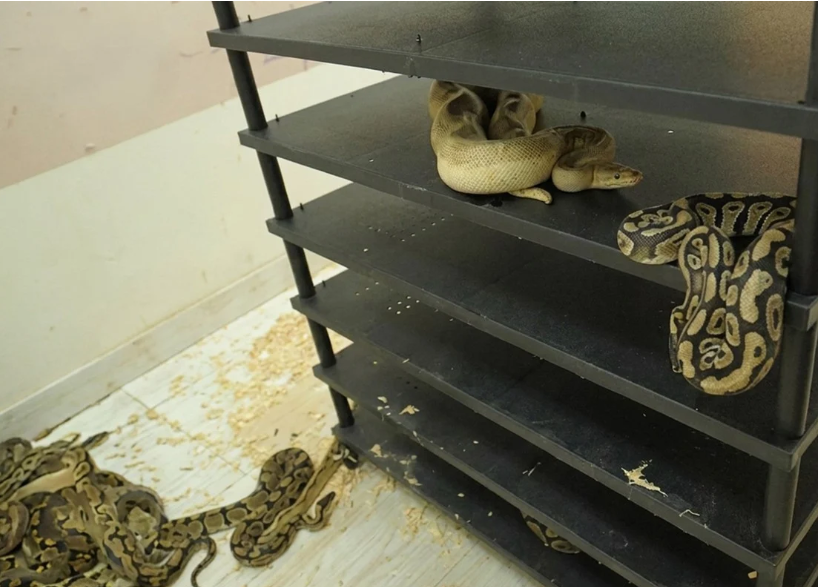
A residential flat in Zhejiang province became an unlikely breeding ground for an elaborate and illegal python operation, resulting in criminal charges against multiple individuals and the seizure of more than 400 protected reptiles. The case, first reported by state broadcaster CCTV in late June, highlights how routine utility usage patterns can expose wildlife trafficking schemes and demonstrates the effectiveness of modern investigative techniques in combating ecological crimes.
The operation came to light in March 2024 when a local resident in Taizhou discovered a large python near a mountainside, an unusual find that prompted them to alert authorities immediately. The snake, described as unusually thick for the region and inactive despite being early spring when snakes should naturally be stirring, suggested an artificial origin. Detectives reasoned that pythons require strictly controlled environments to thrive and breed, meaning whoever maintained this colony would necessarily consume substantial electricity to maintain temperatures between 20 and 30 degrees Celsius year-round.
China classifies pythons as Grade Two protected animals, placing them under stringent legal protection that prohibits breeding, sale, purchase, or transport without explicit government authorization. This regulatory framework exists because the species faces genuine conservation pressures and uncontrolled capture threatens wild populations. The illegal breeding market, however, remains lucrative across Asia, with wealthy collectors and pet traders willing to pay premium prices for rare colour morphs and genetic variants. Understanding this context explains why authorities treated the case with particular seriousness and pursued it with determination.
Investigators employed an ingenious strategy to identify the breeder. Rather than relying solely on traditional surveillance, they systematically reviewed electricity consumption records of residents living near where the escaped python was discovered. This approach proved devastatingly effective, ultimately identifying a man surnamed Guo who lived alone in the area and maintained an unusually elevated power usage pattern consistent with maintaining an indoor reptile breeding facility. His social and economic profile—unmarried, unemployed, and living in relative isolation—made him a logical suspect.
Once police began examining Guo's background more thoroughly, a clearer picture emerged. He regularly purchased small white mice in bulk through online retailers, deliveries coordinated by an associate named Di who frequently collected packages from courier stations. When questioned, the mouse sellers confirmed that their customers typically used such quantities exclusively for feeding carnivorous reptiles. Guo had moreover posted snake photographs on social media platforms, sometimes with oblique references to selling specimens. These digital breadcrumbs collectively pointed toward large-scale breeding operations rather than casual pet ownership.
The financial dimension of the scheme revealed itself when police discovered transaction records showing that Guo and Di had already sold approximately 80 pythons, with at least one documented sale of two specimens to another buyer for 1,000 yuan. A third conspirator, a shop owner named Deng who had originally sold Guo four pythons in 2014, was implicated after police found an additional 47 pythons in Deng's residence. The entire network, encompassing breeder, middleman, and supplier, represented a sophisticated commercial enterprise disguised within ordinary urban residential settings.
When police executed a search warrant on Guo's apartment, they encountered a scene of remarkable dedication to the breeding programme. The suspect had methodically restructured his living arrangements, confining himself to a single bedroom while converting two additional bedrooms and the entire living room into a reptile facility. Numerous plastic boxes stacked throughout these spaces each contained individual pythons, creating a dense breeding colony that required constant environmental monitoring and feeding. Officers seized a total of 309 pythons from Guo's flat alone, with all specimens subsequently transferred to a local zoo for proper care and long-term housing.
Guo himself displayed no remorse during interviews, instead expressing pride in his achievement. He disclosed that his interest in snakes stretched back a full decade, beginning in 2014 when he first acquired four specimens. Over the subsequent years, he had dedicated himself to mastering reptile genetics and colour breeding, describing himself with striking confidence as capable of "cultivating snakes of various colours" and feeling "like a creature creator." This psychological profile—a intelligent individual driven by obsessive passion and a sense of creative mastery—suggests motivations extending beyond simple profit maximization, though the substantial revenues certainly provided financial incentive.
The complete scope of the operation proved staggering when all locations were fully investigated. Across Guo, Di, and Deng's residences and facilities, authorities recovered a combined 436 pythons valued at over 30 million yuan, equivalent to approximately 4.4 million US dollars. This valuation underscores the genuine economic stakes involved in illicit reptile trafficking and explains why sophisticated individuals risk serious legal consequences to participate. The captured specimens represented years of selective breeding work focused on developing colour mutations that command premium prices among collectors across East and Southeast Asia.
All three individuals—Guo, Di, and Deng—received prison sentences from a local court in Taizhou, though the precise terms remain undisclosed in available reports. However, China's Criminal Law establishes a maximum penalty of five years imprisonment for violations involving Grade Two protected animals, providing an upper boundary for potential sentences. The fact that courts processed all three conspirators simultaneously, rather than charging only the primary breeder, signals official commitment to dismantling the entire supply chain rather than merely punishing the most visible offender.
For Southeast Asian readers familiar with wildlife trafficking networks, this case illustrates an important principle: illegal animal operations often generate detectable signatures through legitimate utilities and commercial systems. The electricity consumption pattern that exposed Guo's operation represents just one of multiple investigative vectors available to determined law enforcement. As countries throughout the region strengthen cooperation on environmental crime, similar investigative techniques—examining financial transactions, customs records, and utility usage patterns—increasingly expose trafficking networks that would otherwise remain concealed within urbanized landscapes.
The incident also reveals the intersection between individual passion and environmental harm. Guo's genuine fascination with reptile genetics and breeding aesthetics, while perhaps sympathetic on a personal level, channelled into activities that removed hundreds of protected animals from legal oversight and contributed to broader conservation pressures. The case serves as a cautionary reminder that hobby enthusiasm, however intellectually engaging, cannot justify circumventing wildlife protection frameworks designed to preserve species survival.