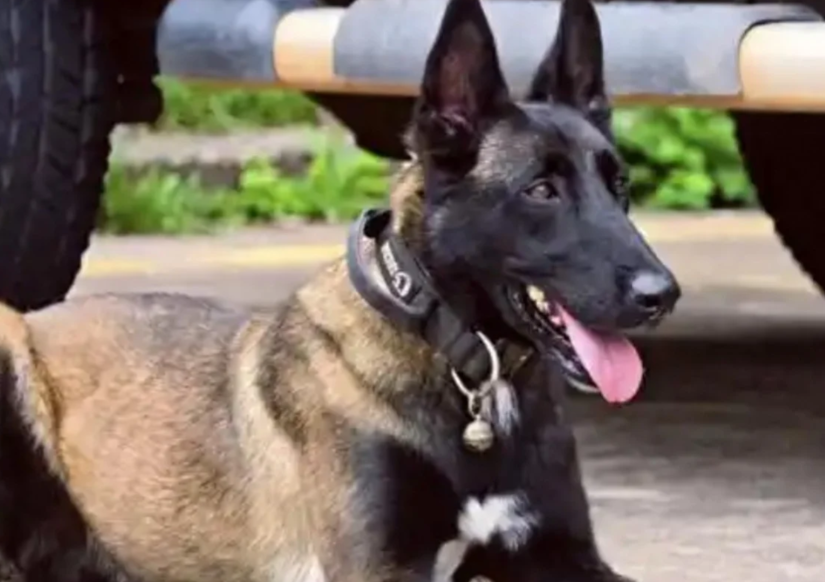
A touching story of loyalty has gripped millions of social media users across China after a narcotics detection dog spent half a year in quiet anticipation of his handler's return following a workplace tragedy. The incident unfolded in November when handler Awei and his four-year-old German shepherd Bulu, both based in Chuxiong in Yunnan province, were deployed to an abandoned building as part of a drug-related operation. The partnership between the two had been forged through rigorous specialized training, with Bulu equipped to locate suspects and narcotics in high-risk, complex environments. During the operation, Bulu's acute senses led the team to fleeing suspects, and Awei pursued the dog through debris-strewn corridors in poor lighting conditions.
The pursuit took a catastrophic turn when Awei lost his footing in the darkness and plummeted from the second storey. Colleagues who discovered him found him in critical condition, convulsing and coughing blood, his consciousness flickering in and out. Bystander footage captured one officer desperately urging the injured man to hold on, invoking their shared mission and the battles yet to be fought together. Meanwhile, Bulu remained at Awei's side, pacing anxiously and attempting to rouse his handler through nuzzling and concerned gestures that revealed the depth of their bond. The severity of Awei's injuries—including multiple fractures to the head and chest—necessitated immediate hospitalization, where he would remain unconscious for five days before slowly regaining awareness.
While Awei began his difficult recovery process, Bulu was transferred to a training base to await his return. What followed was an extended period of separation that visibly affected the dog's wellbeing and behavior. For approximately six months, Bulu's usual vitality diminished noticeably. The dog stopped engaging with routine work assignments, became increasingly restless, and most tellingly, consumed minimal food and water despite the availability of nourishment. Surveillance cameras installed around the training facility documented Bulu's coping mechanisms during this prolonged absence. The footage revealed a pattern of searching behavior, with the dog repeatedly visiting locations where Awei might plausibly reappear: the dormitory quarters, the base entrance gates, and the familiar training routes they had traversed countless times together.
On one particularly poignant occasion captured on camera, Bulu heard an approaching police vehicle and bolted toward it with evident hope, only to be disappointed when officers confirmed that his handler was not aboard. These repeated episodes of anticipation and letdown painted a portrait of a dog grappling with separation and loss in ways that resonated deeply with viewers who recognized the emotional complexity of such bonds. The viral documentation of this vigil reflected broader public recognition of the internal lives and emotional capacities of working animals, challenging simplistic notions of animals as purely functional units.
Awei's return to active duty marked the long-awaited moment both handler and dog had endured. When finally reunited at the training facility, the emotional response was immediate and overwhelming. Bulu's excitement manifested in frantic barking and a rapid sprint toward his handler, while Awei, overcome with emotion, abandoned his luggage and dropped to his knees to embrace the dog he had feared he might never see again. The moment was captured on video and uploaded to mainland Chinese social media platforms, where it rapidly accumulated over 10 million views and surpassed 580,000 likes. The overwhelming response underscored a universal resonance that transcended national borders—the power of loyalty and the transformative bonds between humans and animals working in partnership.
Beyond the emotional narrative, the incident also highlighted the broader context of operational success. While Awei recuperated, his fellow officers pressed forward with the investigation that had precipitated his injury. Through sustained effort over the subsequent months, the team successfully apprehended 11 suspects connected to the drug trafficking network and seized 4.4 kilos of narcotics along with more than 500,000 yuan—approximately US$75,000—in illicit proceeds that had been generated through criminal activity. The successful conclusion of the case represented professional closure and vindication of the operation's original objectives, providing meaningful context to the personal sacrifices made by both handler and dog.
The story's resonance in Chinese public discourse has extended into broader conversations about the working animals embedded within law enforcement structures. Comments from viewers reflected sophisticated understandings of the relationships involved, with one observer noting that Bulu's extended wait was not merely for an individual handler but for a comrade-in-arms, recognizing the military-style partnership that characterizes such operational relationships. This framing elevated the narrative beyond sentimentality into the realm of professional interdependence and mutual reliance. The timing of the story's viral emergence coincided with growing awareness in Chinese society about the contributions of police dogs to national security and public safety operations.
According to reporting from CCTV News, China maintains an active force of more than 29,000 police dogs as of 2024, representing a significant institutional commitment to canine-assisted law enforcement. These animals undergo extensive training protocols and shoulder considerable responsibility in detecting narcotics, explosives, and suspects across the country's diverse jurisdictions. The average service life spans approximately eight years, though dogs deployed in high-intensity operational environments frequently suffer accelerated wear on their physical systems, particularly affecting joints and the spine. The occupational hazards faced by these animals receive less public attention than the dramatic moments of apprehension or detection, yet constitute a meaningful aspect of their professional burden.
The retirement pathway for police dogs reflects institutional considerations about their welfare and future quality of life. Upon completing their service terms, the majority of retired police dogs remain with their original units, continuing to live with their primary handlers in what amounts to a pensioned existence. This arrangement acknowledges the bond forged during years of working partnership and ensures continuity of care from handlers who intimately understand each animal's needs and temperament. However, some police dogs become available for public adoption through structured programs, allowing them to transition into civilian households and experience life beyond operational demands. These post-service arrangements demonstrate an evolving consciousness within Chinese law enforcement institutions regarding their obligations to working animals.
The Bulu and Awei story carries particular significance for Southeast Asian readers and observers because it illuminates the human dimensions of security operations that often remain obscured in official narratives focused solely on arrest tallies and seizure quantities. The region faces ongoing challenges related to drug trafficking and transnational crime networks that necessitate sophisticated law enforcement responses. Police dogs play an instrumental role in these efforts across Southeast Asia, and the emotional authenticity of handler-animal partnerships provides insight into the personal costs and emotional investments underlying public safety operations. The story also raises important questions about occupational health and safety considerations for working animals across the region's law enforcement agencies.
Moreover, the viral nature of this particular incident reflects broader shifts in how security narratives circulate and resonate in the digital public sphere. Where previous generations might have encountered such stories only through official police publications or selected media coverage, contemporary social media platforms enable direct distribution of raw footage and authentic documentation of events. This democratization of narrative has the potential to humanize law enforcement personnel and acknowledge the sacrifices inherent in security work, while simultaneously creating pressure on institutions to maintain ethical treatment standards for working animals, knowing that welfare concerns can rapidly become subject to public scrutiny and commentary.
The international attention garnered by Bulu's story also underscores the universal appeal of narratives centered on loyalty, sacrifice, and emotional authenticity. These themes transcend cultural and linguistic boundaries, resonating with audiences across diverse contexts who recognize in the dog's vigil something fundamentally true about commitment and devotion. For Malaysian observers particularly, the story invites reflection on the working animals embedded within domestic law enforcement and security structures, and the extent to which their contributions and welfare receive appropriate institutional and public recognition. The implications extend beyond sentiment into considerations of training standards, health protocols, and post-service care arrangements that merit ongoing attention and improvement across regional law enforcement agencies.

