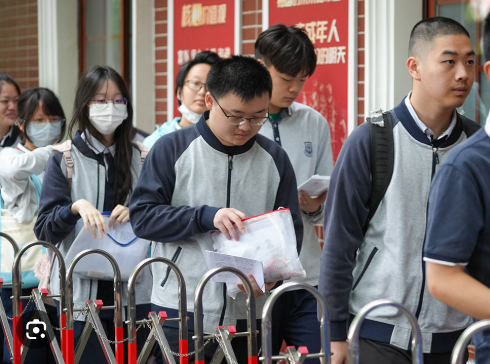
Academic integrity is under unprecedented pressure in China's universities as students deploy increasingly sophisticated wearable technology to circumvent examination security. Over the past month, multiple institutions across the country have announced sweeping prohibitions on smart devices—from wireless earbuds to fitness trackers—and implemented advanced artificial intelligence monitoring systems in response to a surge in high-tech cheating incidents.
The crackdown reflects an escalating arms race between educators and technology-savvy test-takers. South China Agricultural University in Guangdong province issued formal notice on July 1 prohibiting any device capable of communication, storage, photography or wireless transmission from entering examination halls. The university acknowledged that it had recently discovered and prosecuted multiple cheating cases involving electronic devices brought into testing venues. Under its disciplinary framework, simply possessing such equipment during an exam—whether activated or not—results in automatic failure of the subject, plus a demerit that bars students from awards, scholarships and Communist Party membership, with potential for harsher penalties.
Other institutions have reported similar enforcement actions. Xuchang University in Henan province disclosed on June 29 that three students attempted to smuggle devices containing exam materials into examination halls, while two others tried to use communication-capable equipment to receive answers in real time. Hubei University of Technology publicised a case in late June involving a student who received a ten-month demerit for bringing an electronic device with study materials into an English final examination. These incidents underscore how wearable technology has become the medium of choice for exam cheating, replacing traditional methods that proved easier for proctors to detect.
The sophistication of available technology explains the urgency of institutional responses. Zhongnan University of Economics and Law in Hubei specifically warned students against using smart glasses, which can wirelessly transmit answers, record examination papers through built-in cameras and store reference materials—all functions that make detection extraordinarily difficult. The technology has advanced rapidly enough that commercially available smart glasses modified to connect with advanced artificial intelligence language models can enable students to achieve high scores with minimal effort. A December 2025 trial conducted by Hong Kong University of Science and Technology demonstrated that a wearer using smart glasses connected to the GPT-5.2 model completed a Computer Network Principles examination in just thirty minutes, achieving 92.5 per cent.
In response to these technological threats, universities are deploying their own advanced countermeasures. South China Agricultural University has installed artificial intelligence-powered proctoring systems that conduct real-time monitoring of examination halls, flagging suspicious behaviours including unidentified objects on desks, passing items between candidates, excessive head turning and hands kept hidden beneath desk surfaces. These systems represent an escalation from traditional human proctoring, introducing algorithmic surveillance into examination venues—a development that raises questions about privacy and the boundaries of institutional oversight in educational settings across the region.
China's Ministry of Education has reinforced institutional efforts through national policy. Under its regulations governing misconduct in state education examinations, bringing devices capable of transmitting or receiving information into an examination venue constitutes cheating, with penalties including invalidation of all examination results for affected candidates. The ministry issued a specific advisory on June 2 ahead of the 2026 gaokao national college entrance examination, reminding candidates that possessing smart devices in examination venues—regardless of intent or activation status—violates examination rules and constitutes formal cheating.
Industry observers suggest the problem will intensify without intervention from technology manufacturers themselves. Lin Che, a veteran product manager in the smart eyewear sector, told China Newsweek that universities have been slower to update regulations than manufacturers have been to advance wearable capabilities. He pointed out that smart glasses continue to become smaller and more visually indistinguishable from ordinary eyewear, making detection increasingly difficult for even vigilant proctors. Lin proposed that manufacturers voluntarily incorporate conspicuous design elements—such as visible camera indicators—that would make devices readily identifiable to examination supervisors.
The broader implications extend beyond individual universities or even China's education system. As wearable artificial intelligence technology becomes more accessible and affordable globally, other educational institutions in Southeast Asia and beyond may face similar challenges. The pattern visible in China suggests that technological advancement in consumer electronics can outpace institutional safeguards, creating vulnerabilities that determined actors can exploit. Malaysian universities and examination boards should monitor developments closely and begin proactively updating security protocols before smart device cheating becomes endemic in regional examination venues.
The tension between technological innovation and examination integrity reveals fundamental questions about the purpose of education assessment. If wearable devices can eliminate the cognitive challenge that examinations are designed to measure, the credibility of qualifications and the fairness of competition for academic advancement come into question. Universities face pressure to adopt increasingly invasive monitoring technologies to maintain examination validity, creating a surveillance infrastructure that some may view as antithetical to educational values. Yet without such measures, the degrees and certificates issued lose meaning as reliable indicators of student knowledge and capability.
For Malaysian policymakers and education administrators, the Chinese experience offers both cautionary lessons and practical guidance. The speed with which smart device cheating has spread suggests that by the time problems become visible, they are already systemic. Proactive engagement with technology manufacturers, clear communication with students about examination rules, and measured implementation of detection technologies could help Malaysian institutions stay ahead of emerging threats. However, balancing security with student privacy and institutional culture requires careful consideration rather than reactive panic-driven measures adopted only after cheating scandals surface.

