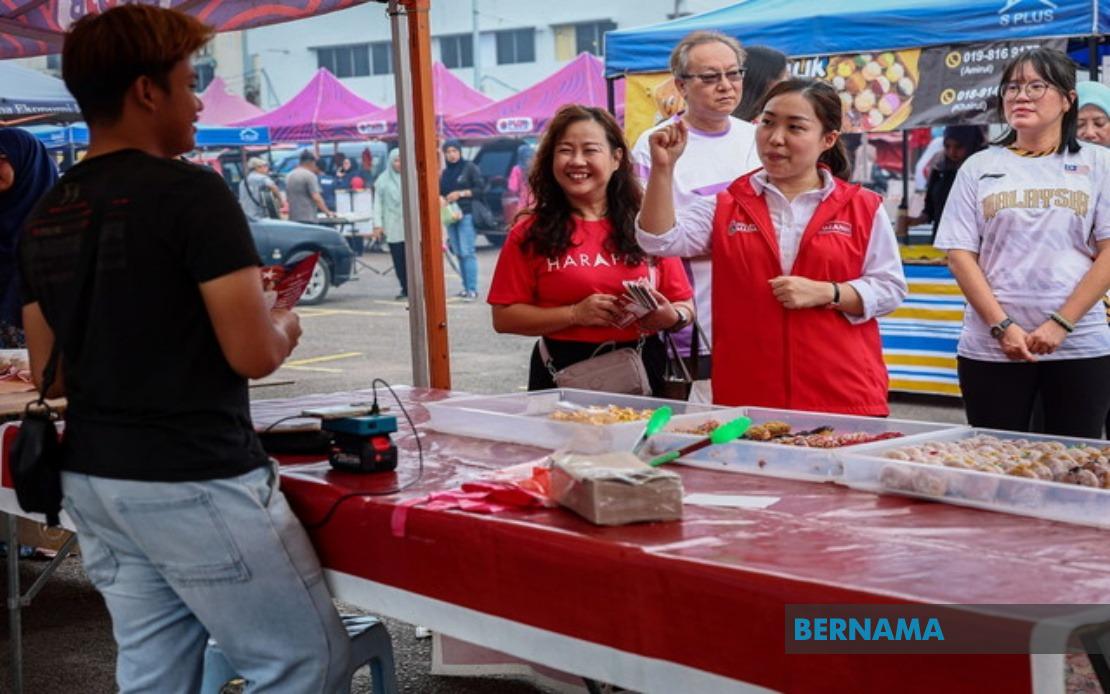
Chu Poh Yee, a young legal practitioner and Pakatan Harapan candidate contesting the Mengkibol state seat, has staked her campaign on a comprehensive three-part platform designed to address the immediate and long-term needs of her constituency. Speaking during campaigning in Kluang, the lawyer outlined how infrastructure enhancement, economic revitalisation, and social support systems would form the cornerstone of her agenda should voters grant her the mandate in the forthcoming Johor state election scheduled for July 11.
The infrastructure pillar of Chu's campaign focuses on tangible improvements that residents interact with daily. Beyond generic promises, her team has identified road quality as a critical area requiring urgent intervention, reflecting widespread complaints from commuters and business operators about deteriorating conditions across the district. Complementing these physical upgrades, the candidate has proposed expanding urban agriculture initiatives through community farming projects, a strategy that simultaneously addresses food security concerns and creates opportunities for residents to generate supplementary income while strengthening communal bonds.
On the economic front, Chu identifies Kluang as possessing untapped potential within its existing business ecosystem. Rather than proposing wholesale transformation, her approach emphasises creating additional entrepreneurial platforms and generating quality employment pathways that retain young professionals within the district. Youth migration has long plagued rural and semi-urban constituencies across Malaysia, as talented individuals seek opportunities in major metropolitan centres, thereby draining local talent pools and weakening community institutions. Chu's economic strategy directly confronts this challenge by arguing that properly incentivised local employment can stem this brain drain.
The candidate has pointed to the Kluang Rail Festival as evidence that her constituency possesses the foundation for sustainable economic activity. This annual event, which celebrates the district's railway heritage, has successfully generated secondary spending throughout the community by attracting visitors and creating platforms for local entrepreneurs. Chu argues that similarly conceived cultural and creative tourism initiatives, if properly resourced and promoted, could become reliable revenue generators that benefit the broader population beyond a narrow band of commercial operators.
A notable dimension of Chu's campaign addresses gender and family-related concerns, an increasingly important focus in Malaysian electoral politics. She has committed to strengthening women's workforce participation by advocating for workplace arrangements that genuinely accommodate dual responsibilities of career advancement and family care. This commitment extends beyond rhetorical endorsement to specific policy proposals, particularly the establishment of well-equipped and appropriately staffed childcare facilities. Such infrastructure, she argues, removes a significant barrier that forces many capable women to curtail professional ambitions or exit the workforce entirely, representing both a social loss and an economic inefficiency.
The campaign has not proceeded without friction. Chu has acknowledged incidents involving provocation and vandalism targeting her party's campaign materials across multiple locations within the constituency. These disruptions, whilst frustrating, have not succeeded in dampening the campaign team's resolve or diverting focus from substantive policy messaging. The candidate's public response—emphasising continuity of effort and unwavering commitment despite opposition tactics—serves to reinforce her messaging about determination and resilience, qualities potentially valued by voters assessing candidacy.
Mengkibol represents one of fourteen constituencies in this election cycle where only two candidates will contest, creating a direct bilateral contest with no three-way competition to fragment opposition votes. Chu faces Barisan Nasional candidate Yap Zhi Peng in this straight fight, a configuration that eliminates strategic voting considerations and renders the choice starker for constituents. Such straight contests often generate higher stakes and more intense campaigns, as victory margins tend to be narrower and neither side possesses the luxury of expecting vote-splitting among opposition candidates.
The broader electoral context involves 172 candidates competing across 56 state seats in Johor, Malaysia's second-most populous state and a significant bellwether for national political trends. Early voting has been scheduled for July 7, allowing registered voters in certain circumstances to cast ballots before the main polling day, a development that typically benefits better-organised parties with efficient mobilisation machinery. The compressed campaign period demands efficient deployment of resources and messaging, placing premium on candidates' ability to communicate priorities clearly and repeatedly within available time constraints.
For Malaysian voters in comparable constituencies throughout the country, Chu's campaign agenda reflects broader trends in how younger candidates, particularly those with professional credentials, approach electoral contests. Rather than relying solely on party machinery or name recognition, candidates like Chu articulate specific, implementable solutions to identifiable local problems—a approach that differs from traditional personality-centred or ideologically abstract campaigning. Whether such policy-focused campaigns resonate sufficiently with voters to overcome incumbent advantages and structural party support remains a central question shaping outcomes in closely contested seats throughout the federation.

