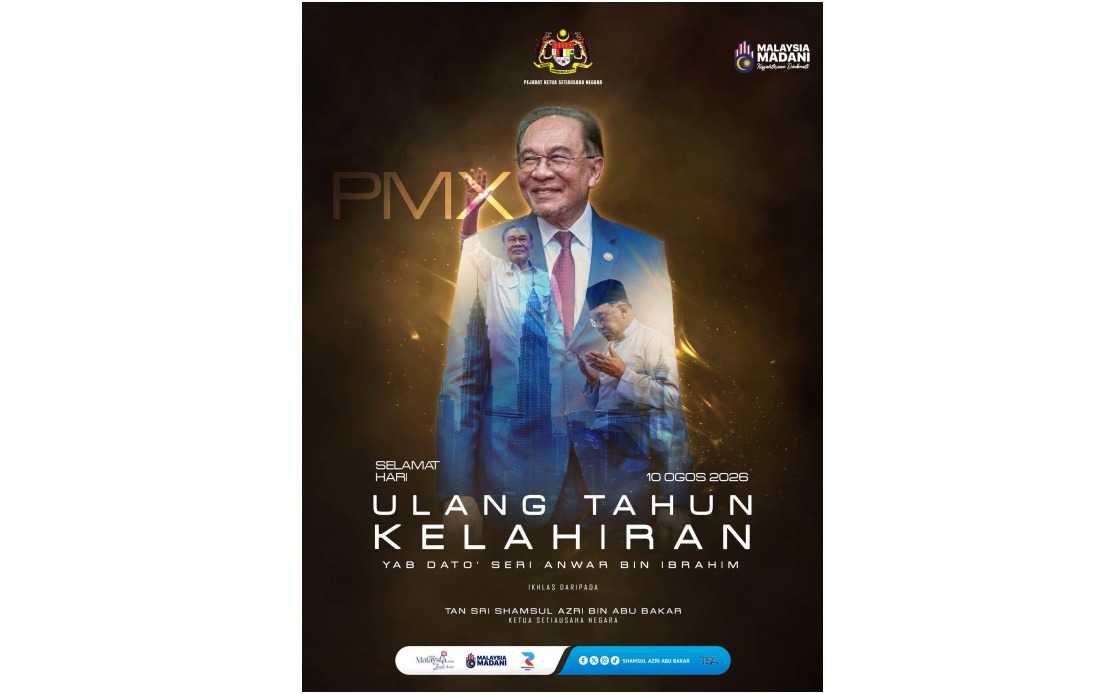
Chief Secretary to the Government Tan Sri Shamsul Azri Abu Bakar marked Prime Minister Datuk Seri Anwar Ibrahim's 79th birthday on Saturday with formal wishes expressing hope that the nation's leader will continue to enjoy robust health and clarity of judgment while steering the country through its contemporary challenges. The gesture reflects the conventional protocol observed by senior government officials on such occasions, underscoring the ceremonial bonds that connect Malaysia's administrative hierarchy with its political leadership.
In his Facebook statement, Tan Sri Shamsul Azri articulated sentiments extending beyond mere pleasantries, specifically invoking divine blessings for the Prime Minister's wellbeing and accentuating the personal qualities—strength, wisdom, and fortitude—deemed essential for the demands of high office. The Chief Secretary's remarks sought to position the civil service as a steadfast institutional pillar, reassuring that government machinery remains aligned with the administration's broader objectives. This framing holds particular significance given that Anwar's tenure has been characterised by emphasis on institutional reform and modernisation of public sector practices.
The Chief Secretary's pledge that the civil service will "steadfastly support the aspirations and reform agenda of the public service for the people and the country" carries substantive meaning within Malaysia's governance context. Over recent years, the administrative establishment has undergone considerable scrutiny regarding efficiency, accountability, and service delivery standards. By articulating this commitment on a high-profile occasion, Tan Sri Shamsul Azri was effectively reaffirming institutional alignment with executive priorities, signalling to public sector personnel that reform initiatives enjoy leadership backing at the highest bureaucratic levels.
The Prime Minister's Office itself contributed to the birthday tributes through a video message that employed carefully chosen language suggesting continuity and purpose. The phrase "Efforts continue, the trust is fulfilled, and to Allah SWT we place our trust" appeared crafted to resonate with Malaysia's Muslim-majority population while simultaneously conveying a sense of resolute commitment to ongoing governance responsibilities. The invocation of divine providence alongside references to institutional trust reflected the manner in which Malaysian political discourse frequently interweaves religious sensibility with matters of state.
The Malaysia MADANI initiative, a cornerstone of Anwar's policy framework emphasising prosperity, dignity, and sustainability, also extended greetings through its official social media channels. The programme represents a reimagining of national development philosophy, and its public acknowledgement of the Prime Minister's birthday served as a subtle reinforcement of the narrative that MADANI principles continue to animate government action. By framing birthday wishes within this context, the communication reinforced that the initiative remains central to the administration's identity and trajectory.
At 79 years old, Anwar represents one of the longest-serving political figures in contemporary Malaysian politics, having navigated multiple phases of the nation's democratic evolution. His current tenure as Prime Minister, which began in November 2022 following the general election, has focused on stabilising coalitional politics and advancing an economic reform agenda amid challenging macroeconomic conditions. The birthday observations, while ceremonial in nature, implicitly acknowledged both his tenure's longevity and the ongoing demands his position entails.
For Malaysian observers and regional analysts, such symbolic acknowledgements from the bureaucratic apparatus carry meaning beyond surface courtesies. The explicit mention of the civil service's commitment to supporting public sector reform suggests that implementation of administrative modernisation initiatives remains a priority, even as the government manages competing fiscal pressures and political considerations. The institutional messaging conveyed through birthday greetings thus functions as a form of governance communication, reinforcing organisational direction to both internal and external audiences.
The convergence of wishes from multiple government entities—the Chief Secretary's office, the Prime Minister's Office proper, and the MADANI platform—illustrated the coordination mechanisms through which Malaysian government messaging typically operates. Such orchestrated expressions of institutional support, released across official channels within a compressed timeframe, serve to project an image of governmental unity and purposefulness, particularly important during periods when coalition politics introduce elements of institutional fragmentation.
As Anwar continues his tenure amid regional geopolitical shifts and domestic economic complexities, these birthday observations represented one modest dimension of the broader narrative surrounding his leadership. The emphasis placed by officials on his health, wisdom, and capacity for continued service implicitly acknowledged that his personal wellbeing carries implications for governmental stability and policy continuity. In Malaysia's political system, where personalised leadership remains significant, such concerns transcend mere courtesies to touch upon substantive matters of institutional functioning.

