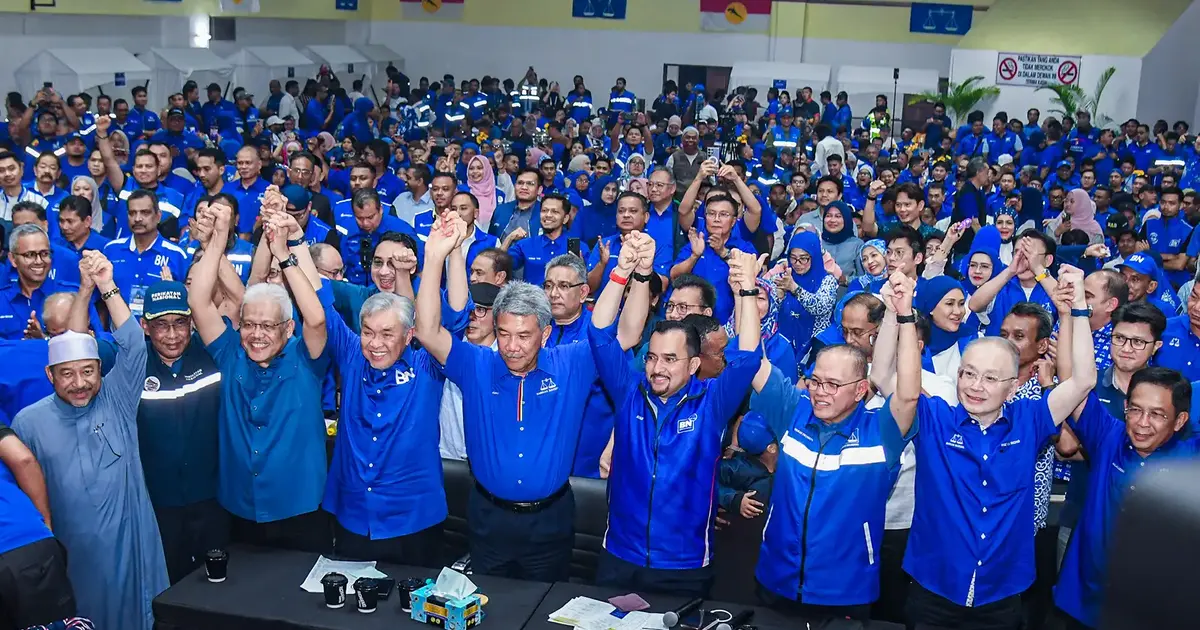
Malaysia's political landscape faces a critical test as the Barisan Nasional and Perikatan Nasional coalitions contemplate deeper integration ahead of the next general election. According to analyst Tawfik Yaakub, the success of this ambitious partnership hinges on one fundamental requirement: settling all outstanding disputes well in advance rather than allowing them to fester into the campaign period.
The complexity inherent in orchestrating a general election in Malaysia demands meticulous planning and consensus-building among coalition partners. General elections require coordination across multiple layers of government, from federal to state to constituency levels, with each tier presenting distinct strategic interests. When two coalitions of the scale and internal diversity of BN and PN attempt to work in tandem, the logistical and political challenges multiply exponentially. Tawfik's assertion that "whatever issues should be settled early" reflects a pragmatic understanding of electoral mechanics that goes beyond mere coordination.
The question of seat allocation represents perhaps the most sensitive negotiation point. Both Barisan Nasional and Perikatan Nasional comprise multiple constituent parties, each with geographic strongholds, historical claims to certain constituencies, and expectations regarding representation. In the 2022 general election and subsequent state elections, disputes over seat distribution proved destructive to coalition unity, sometimes leading to parallel candidates that split opposition votes or weakened overall performance. Any new combined arrangement must avoid repeating these costly mistakes.
Equally critical is the determination of a prime ministerial candidate. This decision carries symbolic weight and practical consequences for both the coalition's public messaging and its internal power dynamics. The candidate serves as the face of the alliance, shapes policy direction, and influences which partner parties gain prominence in a potential government. Historical precedent in Malaysian politics shows that ambiguity surrounding the top leadership position creates vulnerabilities—opposition parties can exploit divisions, and grassroots support becomes difficult to mobilize when voters remain uncertain about the coalition's true leadership.
The contemporary Malaysian electorate has demonstrated increasing sophistication in punishing political parties for internal squabbling and perceived dishonesty. Recent election cycles have seen significant swings in voter preference, with urban voters and younger demographics particularly inclined to punish coalitions perceived as faction-ridden or indecisive. A clear, early agreement between BN and PN on fundamental matters—including seat distributions, leadership hierarchy, and policy framework—would signal stability and seriousness to voters concerned about political instability.
From a regional perspective, Malaysia's political developments carry implications for broader Southeast Asian dynamics. Stable, coherent coalitions that can deliver clear electoral mandates and functional governments serve to reinforce democratic norms across the region. Conversely, coalitions marked by internal conflict and last-minute negotiations undermine public confidence in democratic institutions and can create openings for extra-institutional actors. Other Southeast Asian democracies monitor Malaysian political developments closely, viewing them as benchmarks for coalition-building and democratic resilience.
Tawfik's emphasis on early resolution also reflects the reality that campaign periods themselves become periods of intense scrutiny and pressure. Once campaigning begins, coalition partners face heightened partisan demands from their respective support bases, making compromise more difficult. Media attention intensifies, and any perceived slight or unfair arrangement receives magnification. By contrast, negotiations conducted in the quieter pre-campaign environment allow for more nuanced discussions and creative solutions to seemingly intractable problems.
The BN-PN combination represents a significant realignment of Malaysia's political landscape. Barisan Nasional, which ruled for nearly seven decades before 2018, encompasses the United Malays National Organisation alongside parties representing Chinese and Indian communities. Perikatan Nasional, a newer grouping, includes the Malaysian Islamic Party alongside other parties. Their convergence, should it materialize fully, would reshape electoral mathematics and governance possibilities. However, such a combination only functions effectively if internal mechanisms for decision-making are firmly established beforehand.
Practical questions abound: How will seat allocation disputes between BN component parties and PN component parties be adjudicated? What happens if parties disagree on candidacy in particular constituencies? How will policy differences between the more secular-oriented BN parties and the more Islam-focused PN elements be managed? These operational details require thorough hammering out before ballots are cast, not after.
The stakes extend beyond electoral victory. A well-prepared, internally cohesive coalition that wins decisively can govern effectively and implement a clear mandate. Conversely, a coalition that scraped together electoral victory through last-minute deals and compromises faces perpetual instability in government, as partners continue jockeying for advantage. Malaysian voters have witnessed this pattern repeatedly, understanding intuitively that election outcomes matter less than whether the resulting government can actually function.
Tawfik Yaakub's counsel represents accumulated wisdom about Malaysia's specific political context and the perennial challenges of coalition politics globally. For Barisan Nasional and Perikatan Nasional, the clock is ticking. Early agreement on seats and leadership may feel like surrendering negotiating leverage, but it actually represents the most strategic approach available. The alternative—allowing these fundamental questions to drift into the campaign period—risks fracturing the alliance entirely and squandering the electoral opportunity that their combined strength might present.

