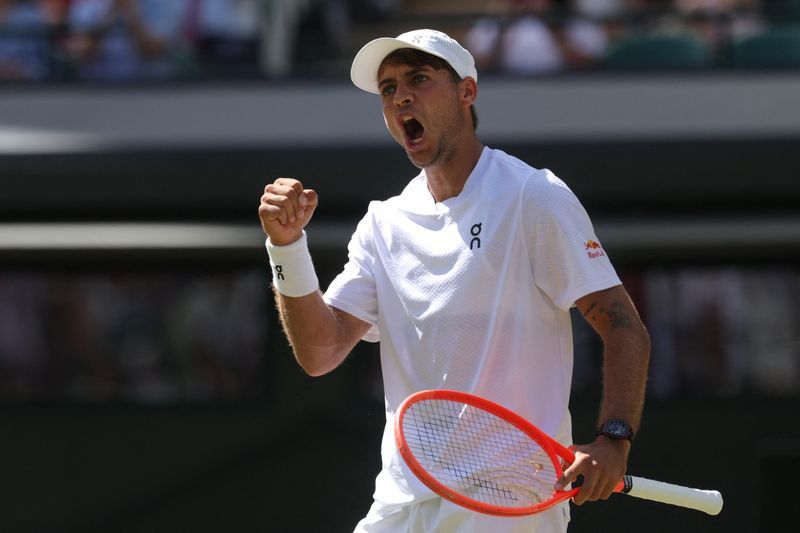
Flavio Cobolli has extended his remarkable run at the Grand Slams, dispatching Australian fifth seed Alex de Minaur with a composed 7-5 7-6(4) 6-3 victory on Court One at Wimbledon on Monday to secure his spot in the quarter-finals for a second consecutive year. The Italian ninth seed's performance represents a significant milestone in his career trajectory, coming merely weeks after his runner-up finish at the French Open, which signalled his emergence as one of the circuit's most consistent performers on the biggest stages.
The 24-year-old's progression through Wimbledon speaks to a rapidly evolving game and mental fortitude uncommon in players still establishing themselves at elite level. Cobolli's path to the last eight was neither straightforward nor inevitable; it required him to wrestle control from an opponent known for relentless baseline pressure and tactical acumen. The breakthrough moment arrived in the opening set's 11th game, where Cobolli capitalised on De Minaur's forced backhand error to secure the decisive break that allowed him to close out the set in fifty minutes of controlled tennis.
Conditions at the All England Club presented an unexpected challenge beyond the traditional complexities of facing a top-ten opponent. Extreme heat forced multiple interruptions to play, with spectators succumbing to the temperature during the second set, transforming the match into a trial of physical endurance as much as competitive skill. These stoppages, while necessary for player and spectator welfare, disrupted rhythm and required Cobolli to recalibrate his mental approach repeatedly. The Italian handled these disruptions with remarkable equanimity, even engaging in cordial conversation with his opponent during the breaks.
De Minaur's struggles in the second set proved particularly instructive. Having taken a 5-2 lead, the Australian found himself unable to convert his advantage when Cobolli orchestrated a remarkable three-game sequence to level the set. The subsequent tiebreak saw Cobolli's superior big-hitting and aggressive court positioning prevail decisively, extending his dominance into the decider where he recovered from an early 0-2 deficit with clinical precision. These comebacks demonstrated a psychological resilience that underpins his recent Grand Slam success.
Cobolli's next opponent represents either a straightforward encounter or a significant test, depending on the outcome of Arthur Fery's fourth-round clash against Bulgarian veteran Grigor Dimitrov. Either possibility offers the Italian genuine opportunities to advance further. Fery, a British player energised by home support throughout the championships, brings youthful enthusiasm and the intangible advantages of crowd backing. Conversely, Dimitrov's experience navigating major tournaments and proven ability to perform in Wimbledon's particular conditions could present a sterner examination of Cobolli's current form.
The Italian's own assessment of his physical condition suggests he views the quarter-final match as a welcome opportunity to preserve energy for subsequent rounds. Speaking after his victory, Cobolli acknowledged the mounting fatigue that accumulates across a demanding tournament schedule, expressing satisfaction that he had completed his fourth-round assignment in straight sets. This pragmatic perspective reflects the wisdom of a player learning to manage the competing demands of consecutive Grand Slam tournaments at the highest competitive level.
Cobolli's comments revealing mutual respect with De Minaur provided insight into the camaraderie that persists among players even during intense competition. The Australian's candid warning about expecting additional heat-related stoppages was accepted with grace, while Cobolli's candour about both his appreciation and disinclination to face De Minaur regularly conveyed the complexity of professional relationships on tour. Such moments humanise the competition and acknowledge the shared experience of elite athletes pushing their bodies to extremes.
Regarding his preparation for the quarter-final encounter, Cobolli's unassuming plans revealed the grounded perspective of a player still adjusting to unexpected success. Rather than meticulously analyse his potential opponent, he intended to seek respite through gelato and enjoy home-cooked Italian cuisine prepared by his father. This refreshing approach to tournament tennis reflects a philosophy prioritising recovery and mental freshness over obsessive preparation. His mention of watching the Spain-Portugal World Cup fixture also underscored how top athletes maintain balance by engaging with sports beyond their primary discipline.
Cobolli's emergence as a consistent Grand Slam performer carries implications for tennis globally and particularly for Italian tennis, which has produced Jannik Sinner as another top-ten prospect. The succession of competitive Italian men on the major stage has reinvigorated the nation's tennis culture. For Southeast Asian readers, Cobolli's trajectory demonstrates how sustained excellence at multiple Grand Slams can establish a player's credentials rapidly, a pattern increasingly common as the sport's depth grows stronger.
The significance of reaching consecutive Wimbledon quarter-finals should not be understated for a player still establishing his career identity. Many talented prospects stall at the fourth-round barrier for years; Cobolli has cleared this hurdle in successive visits, suggesting his recent French Open success was not a fortuitous anomaly but rather the beginning of a sustained period of competitive excellence. His ability to maintain focus and execution despite environmental adversities and the mounting pressure of expectation will ultimately determine whether this year's Grand Slam performances represent merely a strong season or the foundation for genuine career eminence.

