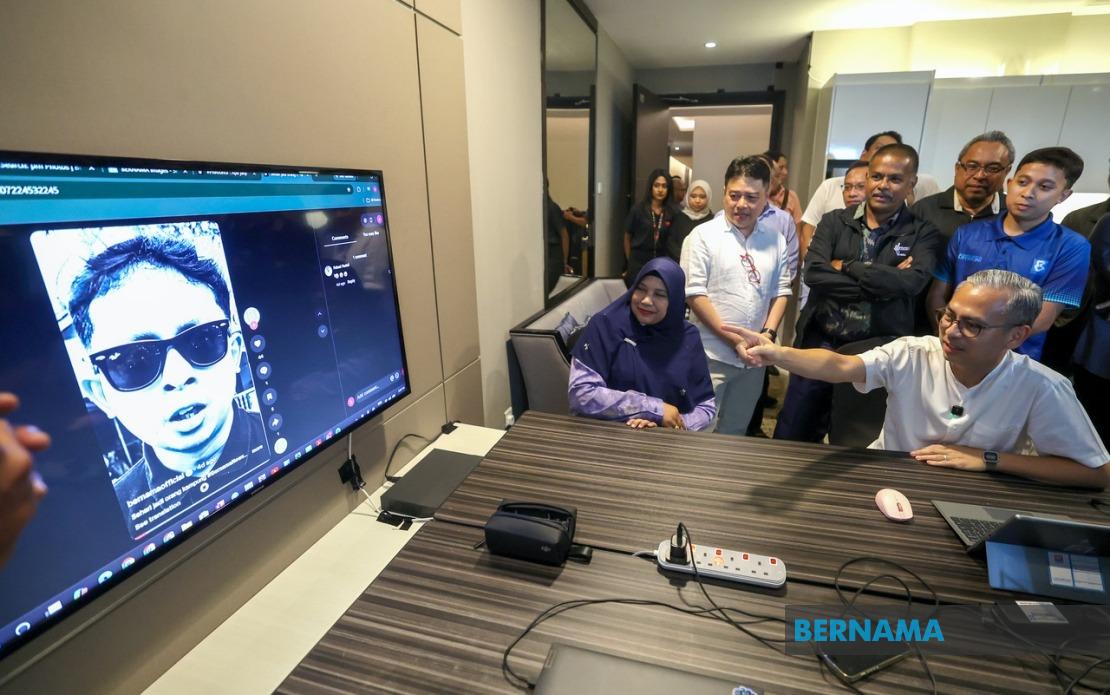
Communications Minister Datuk Fahmi Fadzil has publicly acknowledged the Malaysian National News Agency's (Bernama) substantial efforts in delivering reliable electoral coverage during the Johor state election, recognising the institutional commitment required to maintain information flow to the public during a significant political event. His remarks came following an on-site inspection of Bernama's dedicated operations centre established for the poll, underscoring the government's appreciation for the national news agency's role in sustaining transparent, factual reporting during elections—a critical function in Malaysia's democratic processes.
The minister's visit to the Bernama Operations Centre revealed a well-coordinated infrastructure supporting comprehensive electoral journalism. The facility housed journalists, sub-editors, editors and television personnel working in integrated teams to process and disseminate information across multiple platforms. This centralised approach, increasingly standard in modern newsrooms, enabled Bernama to maintain consistent editorial oversight while scaling coverage to reach all corners of the state, demonstrating how institutional coordination enhances reporting reliability during high-pressure news cycles.
Fahmi highlighted the logistical scope of Bernama's assignment, noting that 44 personnel—comprising reporters, camera operators and photographers—were systematically deployed across Johor's 56 state constituencies. This deployment stretched from the southern parliamentary enclave of Endau through central regions to Tanjung Surat on the western coast, extending into the northern districts. Such geographic distribution underscores the resource intensity of state-level electoral coverage, where simultaneous campaign events, rally dynamics and voting procedures across dispersed constituencies demand proportionate journalistic presence and mobility.
The infrastructure and support systems available to Bernama's working journalists met the minister's assessment of satisfactory standards. Adequate workstations, communications equipment, filing systems and broadcast facilities enable journalists to file stories and footage without delays that might compromise news currency. For election coverage specifically, where time-sensitive developments and rapid-turnaround requirements define the news cycle, such operational adequacy directly translates to public benefit through timely, complete information access. The minister's inspection effectively validated that Bernama's backend operations matched the frontline reporting effort.
Fahmi extended formal recognition to Bernama's senior leadership for orchestrating these preparations. Chief Executive Officer Datin Paduka Nur-ul Afida Kamaludin and Editor-in-Chief Arul Rajoo Durar Raj received commendation for coordination and logistical planning that enabled smooth operations. This institutional acknowledgment reflects broader Malaysian government practice of publicly recognizing Bernama's editorial role, particularly during elections when the agency's reach and credibility significantly influence public information access alongside commercial and digital media outlets.
The minister's extended presence—over one hour—at the operations centre represented more than ceremonial recognition. By directly engaging with journalists and technical staff on duty, Fahmi's visit conveyed political validation for newsroom work, a meaningful gesture during demanding assignment periods. Electoral coverage demands sustained intensity, tight deadlines and compressed decision-making cycles; such ministerial recognition provides institutional morale reinforcement for news teams working under pressure to maintain standards across multiple platforms simultaneously.
Contextualising this commendation within Malaysia's media landscape reveals important dimensions. Bernama remains a state news agency with statutory responsibilities for national news collection and distribution, complementing private sector news organisations. During elections, where information accuracy and neutrality carry constitutional significance, Bernama's role becomes particularly salient. The agency's institutional mandate and professional standards make its coverage patterns influential on how electoral narratives develop across regional and international coverage. Fahmi's public endorsement of operational excellence thus carries implications beyond mere institutional praise, reinforcing expectations for media professionalism during democratic processes.
The 2023 Johor state election, for which these operations were established, carried political weight as an early test of electoral dynamics following Malaysia's 15th general election. With 172 candidates contesting 56 seats, the poll represented a substantial undertaking requiring comprehensive journalistic coverage. Early voting had been conducted on the ministerial visit date, with main polling scheduled for July 11, creating a compressed news cycle where Bernama's operations centre would face peak demand during final candidate positioning, voter engagement and procedural coverage immediately preceding election day.
Bernama's operational expansion for state elections reflects a broader pattern in Malaysian electoral journalism where the national news agency assumes coordinating responsibility for reliable coverage. This institutional role complements rather than competes with other news organisations, as Bernama's wire service capacity makes its coverage foundational to information distribution across secondary outlets lacking direct political reporters in all constituencies. The agency's commitment to geographic comprehensiveness—reaching from rural southern constituencies to developing urban areas—ensures electoral information reaches diverse population segments regardless of media consumption patterns.
The minister's emphasis on public access to accurate and comprehensive information articulates a governance principle increasingly central to Malaysian political discourse. Elections function as accountability mechanisms only when voters possess reliable, complete information about candidate positions, party platforms and electoral procedures. Bernama's systematic coverage contributes essential infrastructure for this information environment, functioning as a non-partisan reference source that other media outlets and the public consult for factual baseline information. In an era of information proliferation and fragmentation, such institutional news capacity becomes more rather than less valuable.
Fahmi's commendation also reflects administrative awareness of election-cycle media challenges. Covering dispersed constituencies simultaneously requires sophisticated logistical coordination, rapid information synthesis and editorial judgement under time pressure. The ministerial recognition effectively acknowledged these professional demands, validating the resource commitment required for state-level electoral journalism. For Malaysian newsrooms contemplating coverage strategies for future state elections, Bernama's model—centralised operations centre supporting distributed field reporting—offers replicable methodology for maintaining quality while achieving geographic comprehensiveness.

