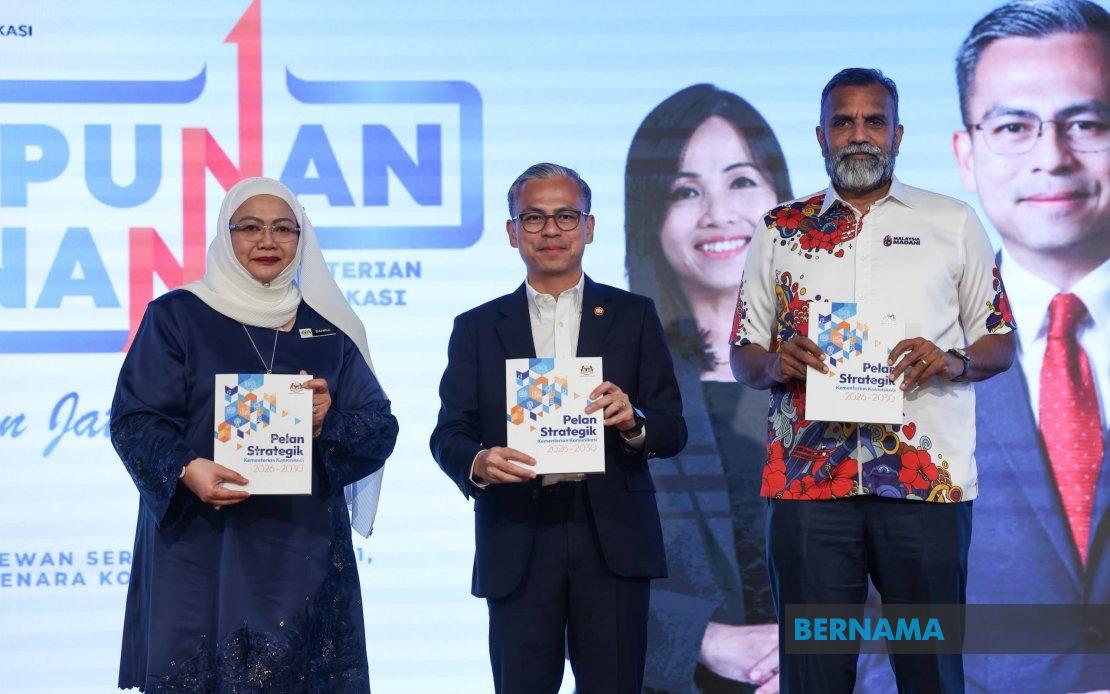
Communications Minister Datuk Seri Fahmi Fadzil launched the Communications Ministry Strategic Plan 2026-2030 in Putrajaya on July 20, establishing a comprehensive framework that will direct departmental efforts through the coming five years. The initiative aligns closely with the broader aspirations embedded in the 13th Malaysia Plan and the Malaysia MADANI development agenda, serving as the operational blueprint for the ministry and its subordinate agencies.
The strategic plan crystallises three fundamental priorities that Fahmi identified as the most pressing concerns consistently brought to the ministry's attention. These centre on enhancing internet access across the nation, expanding the volume and quality of locally produced creative content, and bolstering the reliability and accuracy of information available to Malaysians. The minister expressed confidence that this focused approach will directly tackle the concerns citizens and stakeholders have repeatedly raised with his ministry and related organisations.
Underpinning these priorities is an overarching vision articulated as 'A Connected, Informed and Creative Malaysia', an aspirational end-state that the ministry intends to realise through coordinated implementation across three distinct missions. These missions address different dimensions of the communications ecosystem: establishing robust connectivity infrastructure and regulatory mechanisms; ensuring information dissemination remains authentic and broadly representative; and nurturing a sustainable creative industries sector capable of competing regionally and globally.
To operationalise these missions, the ministry has identified four strategic thrusts that will guide resource allocation and programme development. The first involves consolidating the national communications infrastructure to ensure connectivity is inclusive, meets quality standards, and incorporates adequate security protections. The second thrust explicitly targets the competitive positioning of Malaysia's film and music sectors, recognising these industries' potential for economic growth and cultural influence.
The third strategic thrust encompasses transforming how government information reaches citizens, moving towards integrated delivery mechanisms that improve accessibility and coordination. The fourth thrust tackles the ministry's own operational effectiveness, requiring service delivery systems to become more responsive to policy objectives and attentive to customer needs. This internal modernisation reflects broader government service reform ambitions.
The comprehensiveness of the strategic plan is evident in its 94 constituent programmes, which collectively span the full breadth of the ministry's responsibilities. Rather than representing new departures, Fahmi indicated that many of these programmes are already underway, now operating within the formal strategic framework the plan provides. This continuity suggests the plan functions partly as a formalisation and coordination mechanism for existing initiatives.
For Malaysian readers and businesses, the strategic plan carries several implications. The emphasis on better internet access signals continued government commitment to digital infrastructure expansion, potentially affecting telecommunications sector investment and rural connectivity initiatives. The focus on authentic information represents a policy commitment to combating misinformation and maintaining information ecosystem integrity, a concern that has gained prominence across Southeast Asia.
The creative industries thrust carries economic significance for content creators, producers, and technology companies supporting film and music production. Government support channelled through this strategic plan could translate into funding opportunities, regulatory reforms, or infrastructure development benefiting these sectors. This positions Malaysia's creative output alongside traditional economic drivers.
The plan's alignment with Malaysia MADANI signals that communications policy operates as a pillar supporting broader national development aspirations. The MADANI agenda emphasises inclusivity and sustainability, suggesting that communications improvements will be evaluated partly on their contribution to these values. This framing indicates that digital divide reduction and equitable information access remain priority metrics.
Regionally, Malaysia's strategic communications planning contributes to Southeast Asia's broader digital transformation. As neighbouring countries pursue comparable connectivity and digital economy ambitions, Malaysia's experiences implementing this plan will likely influence regional peer learning. The emphasis on local creative industries also reflects ASEAN-wide efforts to develop knowledge economies and reduce dependence on commodity exports.
The ministry's public articulation of this strategic framework through press conference announcement underscores communications policy's visibility in Malaysian governance. Unlike technical ministry functions that operate with limited public attention, communications initiatives directly affect citizen experiences with information, entertainment, and digital connectivity. The transparent presentation of strategic objectives demonstrates accountability and invites stakeholder engagement.
Implementing this ambitious five-year plan will require sustained coordination across the ministry's various agencies and departments, each bringing distinct expertise in telecommunications regulation, broadcasting, postal services, or content development. The strategic plan essentially functions as an integration mechanism, ensuring these diverse functions contribute coherently toward the three core priorities.
Success metrics for the 2026-2030 plan will likely become apparent through improvements in measurable connectivity indicators, growth in Malaysian creative content production and export, and public confidence in information availability and reliability. These dimensions will provide concrete benchmarks against which the plan's effectiveness can be assessed when the five-year period concludes.

