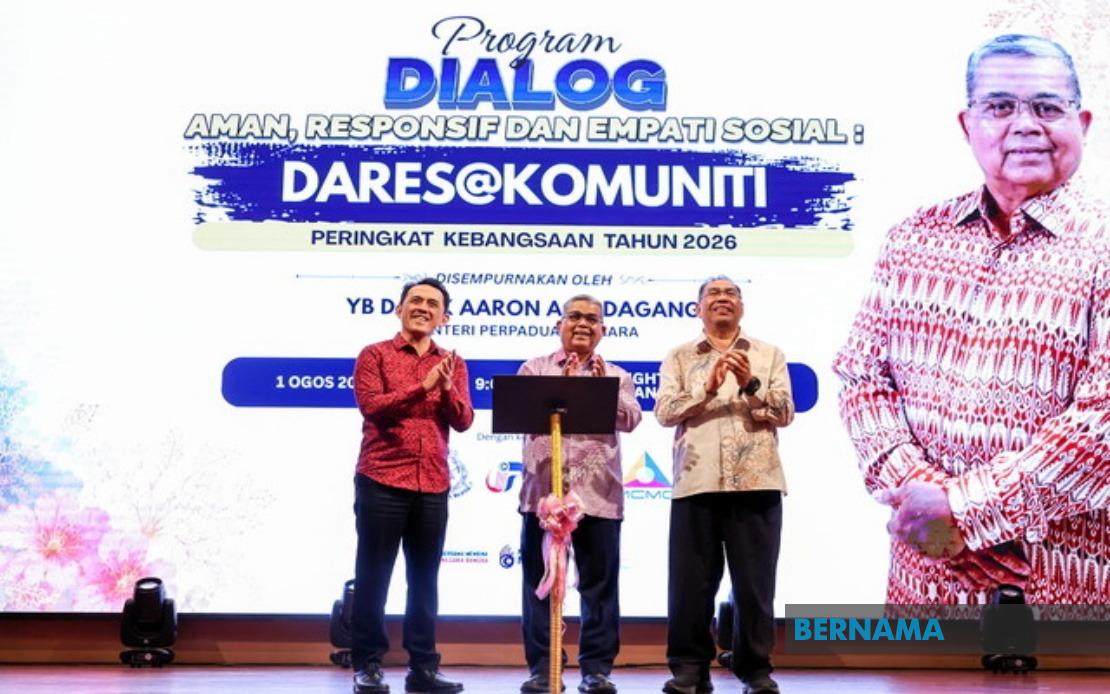
The Malaysian government's community mediation programme has emerged as a significant tool for conflict resolution, having successfully settled 1,273 cases between 2017 and 2025, according to National Unity Minister Datuk Aaron Ago Dagang. Speaking at the national-level DARES@Komuniti 2026 programme launch in Butterworth, the minister underscored the growing importance of alternative dispute resolution mechanisms in a diverse, multi-layered society increasingly strained by digital communication platforms.
The initiative operates through a network of 595 certified community mediators distributed across 10 Community Mediation Centres nationwide. This infrastructure enables residents to access dispute resolution services at no cost, offering an accessible pathway to peace that circumvents the formal court system. The approach reflects a broader policy shift toward community-based solutions, recognising that not every conflict requires judicial intervention and that many disputes can be resolved more swiftly and satisfactorily through dialogue facilitated by trained local figures.
Recognising the programme's potential, the government has identified 12 additional organisations for collaboration, signalling an expansion strategy aimed at deepening penetration into local communities. These partnerships with local authorities represent an effort to embed mediation services within existing community structures, making them more visible and accessible to ordinary Malaysians. The scaling approach acknowledges that current capacity, while functional, remains insufficient to address the full spectrum of neighbourhood disputes, workplace conflicts, and interpersonal grievances that might otherwise escalate into litigation or social tensions.
Minister Aaron emphasised that sustained investment in dialogue and community mediation infrastructure is essential for managing conflicts in Malaysia's plural society. He articulated a vision where understanding supersedes prejudice and mutual respect becomes the operating principle across diverse religious, ethnic, cultural and linguistic communities. This framing positions mediation not merely as a practical tool for case resolution but as a foundational practice for maintaining social cohesion in a nation where demographic diversity could theoretically generate friction if left unmanaged.
The minister's remarks reflected heightened concern about contemporary threats to national harmony that transcend traditional geographic boundaries. He highlighted that social division is no longer confined to physical interactions within neighbourhoods or workplaces but has migrated substantially into digital spaces. Smartphones and social media platforms have become vectors for spreading sectarian messaging, racial incitement, and religious provocation—phenomena that community mediators were never originally designed to address but which now demand policy attention.
The acceleration and scale of digital communication present particular governance challenges. Misinformation and inflammatory content can reach millions of Malaysians within minutes, yet correcting false narratives or damaging perceptions often requires sustained effort lasting days, weeks or longer. This asymmetry between the speed of harm and the pace of correction creates a persistent environment where unverified claims, prejudicial stereotypes, and divisive rhetoric can take root in public consciousness before fact-checkers and official responses can intervene effectively.
Responding to this reality, Aaron called for the development of "digital unity agents"—individuals who consciously choose factual accuracy over falsehoods, empathy over reactive emotion, and constructive dialogue over provocative engagement. This concept extends the mediation principle from formal dispute resolution into everyday digital citizenship, recognising that individual online choices accumulate into either social cohesion or fragmentation. The minister's framing suggests a whole-of-society approach where conflict prevention occurs at the grassroots level through conscious individual conduct rather than relying solely on government regulation or institutional mediation after harm has occurred.
Youth demographics warrant particular attention in this digital context. As the demographic most immersed in social media environments, young Malaysians exercise disproportionate influence over online discourse and digital culture. The minister explicitly appealed to this cohort to recognise the societal consequences of their online activities—every share, comment, reaction and engagement either reinforces or undermines national unity. This messaging attempts to cultivate individual responsibility and awareness of how routine digital behaviour contributes to broader social outcomes.
The community mediation programme's track record of resolving 1,273 cases demonstrates that alternative dispute resolution mechanisms function effectively when properly resourced and integrated into community life. However, the minister's broader remarks suggest that government strategists recognise the existing framework's limitations in addressing 21st-century conflict dynamics driven by digital communication. Expansion to 12 additional partner organisations may provide marginal capacity increases, but truly transforming Malaysia's approach to social harmony likely requires complementary investments in digital literacy, online platform governance, fact-checking infrastructure, and youth engagement in constructive digital citizenship.
The DARES@Komuniti 2026 programme launch itself represents an attempt to consolidate and expand this vision beyond mediation into broader community resilience initiatives. Malaysia's experience illustrates a pattern common across plural democracies: traditional conflict resolution mechanisms remain valuable but increasingly insufficient without corresponding attention to the digital environments where contemporary social tensions originate and amplify. The minister's emphasis on digital unity agents suggests recognition that maintaining harmony in ethnically and religiously diverse societies now requires active management of both physical community spaces and virtual information environments.

