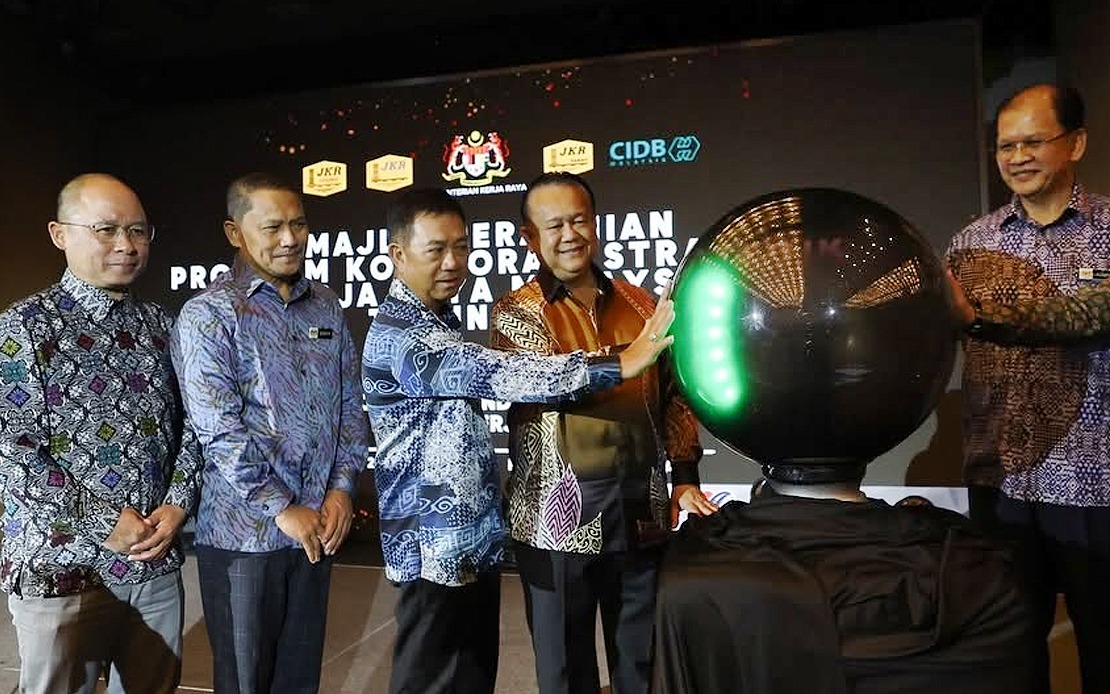
Works Minister Datuk Seri Alexander Nanta Linggi has identified coordinated action among Malaysia's three main public works implementing agencies as fundamental to resolving the infrastructure delays that have plagued major national projects. Speaking in Kota Kinabalu on July 19, Nanta emphasised that the Malaysian Public Works Department, JKR Sabah, and JKR Sarawak must function as a cohesive unit, pooling resources and expertise to tackle the logistical and administrative obstacles currently hampering project completion across the country.
The minister's comments came during the formal launch of a Strategic Collaboration Programme involving the Works Ministry, JKR Sabah, and the Construction Industry Development Board. The initiative represents a structured attempt to institutionalise problem-solving mechanisms among agencies that collectively oversee billions of ringgit in ongoing infrastructure work. By creating a dedicated platform for dialogue, officials aim to transform what has historically been fragmented decision-making into a unified approach that prioritises timely project delivery and quality outcomes.
Nanta acknowledged that despite earlier improvements resulting from initial collaborative efforts, persistent challenges continue to undermine project timelines. The minister stressed that agency heads across all three JKR entities have received clear directives to identify obstacles, evaluate solutions transparently, and implement coordinated fixes. This messaging represents a significant shift from compartmentalised management toward accountability for collective performance, signalling that individual agency failures now reflect on the broader infrastructure apparatus.
The scope of coordination challenges is substantial. Malaysia currently manages multiple major undertakings, most notably the Pan Borneo Highway, alongside extensive road networks and government building programmes. The scale of financial commitment and public expectation attached to these initiatives means that delays in one jurisdiction can create cascading consequences for interconnected projects. By establishing mechanisms for regular inter-agency consultation, the Works Ministry hopes to identify bottlenecks before they compound into major scheduling disruptions.
Nanta specifically addressed concerns regarding U-turn construction along the Pan Borneo Highway, clarifying that placement decisions stem from rigorous technical evaluations rather than arbitrary determinations. Each location undergoes assessment of road geometry, visibility distances, and safety considerations. This explanation reflects growing public scrutiny of infrastructure design choices and represents an attempt to restore confidence in engineering decisions made by implementing agencies. The emphasis on systematic review processes underscores official commitment to balancing efficiency with thoroughness.
Deputy Chief Minister I and Sabah's Works and Utilities Minister Datuk Seri Dr Joachim Gunsalam framed infrastructure investment as integral to broader economic development. Beyond immediate project outcomes, quality construction and timely delivery contribute to competitive advantage, community welfare, and government service effectiveness. Gunsalam's framing connects infrastructure policy to state-level development priorities, situating the collaboration initiative within Sabah's strategic growth agenda rather than treating it as merely a bureaucratic exercise.
Gunsalam emphasised that infrastructure investments must generate genuine value for citizens through transparent governance, efficient resource management, and sustained performance improvement. This articulation reflects international best-practice standards increasingly expected by Malaysian taxpayers and international development partners. By emphasising prudent resource use and continuous enhancement, state officials signal awareness that public tolerance for inefficiency and waste has diminished significantly.
The collaboration initiative includes tangible outputs designed to enhance operational capacity. Officials witnessed the signing of a road asset data declaration among the Works Ministry, Sabah's Works and Utilities Ministry, and Sabah's Local Government and Housing Ministry. This agreement establishes shared data frameworks for managing existing road infrastructure, theoretically enabling better maintenance planning and resource allocation. Additionally, memoranda of understanding were formalised for establishing MyBIM laboratories utilising government premises in Sabah and Sarawak. These facilities represent investments in Building Information Modelling technology, which enhances design coordination and reduces construction conflicts by enabling three-dimensional project visualisation before ground-breaking.
The Pan Borneo Highway holds particular symbolic importance in this collaborative framework. As a signature Borneo infrastructure project, its performance directly influences public perception of government capacity in East Malaysia. Delays or quality issues generate criticism that extends beyond engineering to encompass governance competence. By positioning the highway prominently within the collaboration narrative, officials communicate determination to transform the project into a success story demonstrating coordinated federal-state capacity.
For Malaysian readers, the significance of this initiative extends beyond technical infrastructure matters. The willingness of multiple government agencies to acknowledge coordination failures and implement structured remedies suggests incremental improvement in public administration practices. Historically, Malaysian infrastructure projects have suffered from siloed decision-making, inadequate communication, and competing territorial interests among implementing bodies. Institutionalising collaboration addresses these systemic weaknesses, though success ultimately depends on sustained political will and adequate resourcing of coordinating mechanisms.
Regionally, Malaysia's infrastructure coordination challenges mirror those confronting other Southeast Asian nations managing rapid development. The strategic approach articulated by Nanta offers potential lessons for neighbouring countries similarly grappling with implementation bottlenecks. The explicit emphasis on technology adoption through MyBIM laboratories also positions Malaysia within global infrastructure management trends emphasising digital transformation and data-driven planning.
The sustainability of these collaborative arrangements remains uncertain. Government restructuring, ministerial changes, and shifting budget priorities could undermine coordination mechanisms if political commitment falters. However, the formal signing of agreements suggests institutional embedding of collaborative practices beyond individual personalities. Success metrics focusing on measurable improvements in project delivery timelines will ultimately determine whether the collaboration programme achieves its stated objectives or becomes another bureaucratic exercise with limited practical impact.

