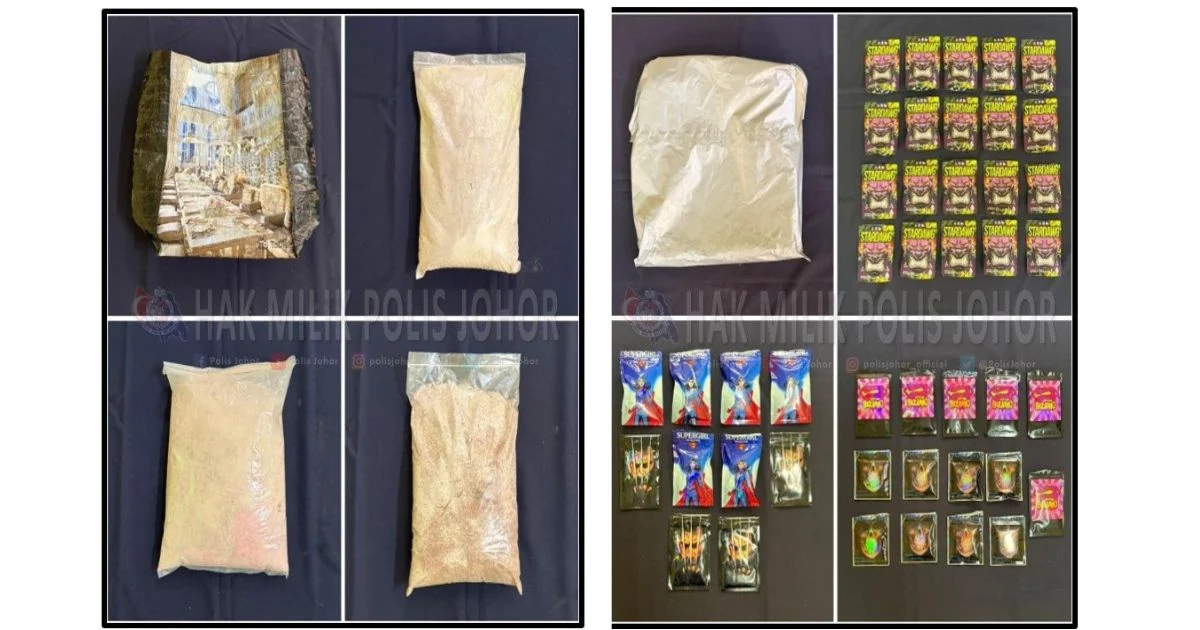
Police in Johor Baru have broken up a substantial drug operation in Kulai following the arrest of a married couple and the seizure of narcotics valued at approximately RM3.59 million. The successful law enforcement operation represents a significant achievement in the ongoing battle against organised drug trafficking in the state, which has become increasingly sophisticated in recent years as criminal networks adapt to heightened enforcement efforts.
The dismantling of this particular syndicate underscores the persistent challenge that drug trafficking poses across Johor, one of Malaysia's largest and most strategically important states. Its position as a major entry and distribution point for narcotics—owing to its proximity to Singapore and accessibility via major road networks—has made it a focal point for both local and international drug operations. The Kulai area, which straddles the northern approaches to Johor Baru, has historically been identified as a critical juncture in the supply chain for substances destined for Malaysian consumption and regional distribution.
The involvement of a married couple in the operation reveals how family networks increasingly feature in the architecture of modern drug syndicates. Kinship ties create layers of trust that make these organisations harder to penetrate through conventional intelligence work, and the utilisation of domestic relationships to facilitate trafficking operations has become a recognized pattern in organised crime investigations across Malaysia. Law enforcement agencies have noted that such family-based structures allow criminals to maintain tighter operational security while leveraging emotional bonds that strengthen loyalty among members.
The magnitude of the seizure—nearly RM3.59 million in estimated street value—indicates this was not a minor operation but rather a mid to upper-level distribution network with access to significant pharmaceutical or chemical resources. The volume confiscated suggests the couple likely had roles in aggregation and onward distribution rather than mere retail-level dealing, pointing to their integration into a more complex supply chain. Understanding the precise nature and extent of their operation will be crucial for police investigations seeking to identify upstream suppliers and downstream distribution networks.
Johor's vulnerability to drug trafficking stems partly from geographical factors beyond immediate law enforcement control. The state's long coastline, numerous unmanned entry points, and extensive road infrastructure create enforcement challenges even with sophisticated policing. Additionally, the economic disparities within communities across Johor create conditions where participation in the drug trade becomes financially attractive for some residents, particularly when legitimate income opportunities remain limited. This socioeconomic dimension means that disrupting supply ultimately requires addressing broader development and employment challenges alongside conventional law enforcement.
The timing of this operation reflects sustained police commitment to combating the drug menace through proactive investigations and intelligence gathering. Rather than simply responding to reported incidents, modern law enforcement in Malaysia increasingly prioritises identifying and dismantling trafficking networks through targeted operations based on accumulated intelligence. This more strategic approach has yielded notable successes, though the sheer scale and adaptability of drug operations means that authorities must maintain constant vigilance to remain ahead of criminal innovation.
For Malaysian readers, the implications of this Kulai bust extend beyond the immediate confiscation and arrests. Each successfully dismantled syndicate potentially prevents significant quantities of narcotics from flooding local communities and schools. The removal of distribution capacity, albeit temporary, forces remaining networks to recalibrate operations and creates temporary market disruptions that theoretically reduce drug availability and increase street prices, which in turn may deter some potential users. However, the broader reality is that a single bust, however substantial, constitutes only one intervention in an ongoing struggle against an industry that remains highly profitable and resilient.
The arrest of the married couple will likely trigger secondary investigations as law enforcement agencies seek to uncover their connections throughout the syndicate's supply and distribution networks. Phone records, financial transaction histories, and physical surveillance data gathered during the initial operation typically yield intelligence identifying other participants and enabling subsequent enforcement actions. These cascading investigations often prove more valuable than the initial bust itself, as they provide opportunities to dismantle larger portions of the criminal infrastructure rather than simply removing individual traffickers who would otherwise be replaced.
International cooperation remains essential for addressing drug trafficking in Johor given the transnational dimensions of modern narcotics operations. The close ties between Johor and Singapore, combined with major regional trafficking corridors passing through the state, mean that effective enforcement requires coordination with neighbouring authorities and participation in regional mechanisms designed to share intelligence and coordinate operations. Bilateral arrangements between Malaysian and Singaporean agencies have proven particularly important in interdicting shipments and identifying trafficking networks operating across their shared maritime borders.
Looking ahead, this bust demonstrates that while drug trafficking remains a serious concern throughout Malaysia, law enforcement agencies possess the capacity to mount effective operations that disrupt criminal activities. The challenge going forward lies in scaling and sustaining such operations while simultaneously addressing the underlying conditions that make the drug trade attractive to participants and accessible to consumers. Achieving meaningful progress against this persistent threat requires not only effective policing but also community engagement, public health approaches to drug addiction, and broader socioeconomic development strategies that reduce reliance on the illicit economy.

