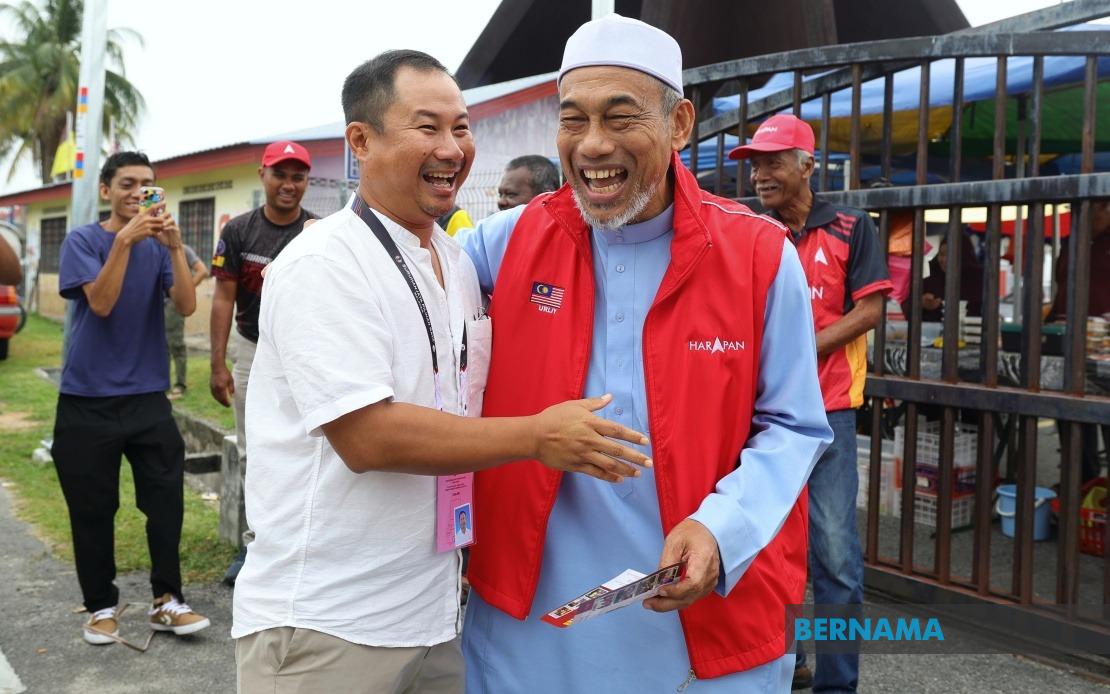
The Negeri Sembilan State Election campaign has taken on a distinctive character in the Klawang constituency, where family ties have not translated into animosity between contending candidates. Datuk Bakri Sawir of Pakatan Harapan and his cousin Danni Rais of Perikatan Nasional crossed paths at Kuala Klawang weekend market as the campaign entered its second day, attracting public interest as the two competitors engaged with voters and traders in close proximity.
The encounter at the market demonstrated a marked contrast to the increasingly polarised nature of Malaysian electoral politics. Rather than the confrontational scenes that sometimes characterise state and federal campaigns, the cousins navigated their simultaneous presence with evident mutual respect. Voters seized the moment to interact with both candidates, capturing handshakes and exchanged pleasantries on camera, suggesting that the broader electorate may welcome this more measured approach to political competition.
Bakri's perspective on the contest reveals an attempt to reframe familial political rivalry as fundamentally about service rather than personal animosity. When addressing the matter with journalists, he emphasised that his competition with his cousin should not be characterised as extraordinary. Instead, he presented the election as an opportunity for both candidates to demonstrate their commitment to constituency development and constituent welfare. This framing potentially resonates with voters fatigued by acrimonious campaign rhetoric elsewhere in the country.
The incumbent candidate articulated a broader vision for electoral conduct that extends beyond his immediate contest. Bakri underscored the importance of campaigns adhering to established regulations and maintaining decorum throughout the process. He illustrated this commitment through concrete action, recounting how his team promptly removed campaign flags from a stadium fence following intervention by the Jelebu District Council. This willingness to comply with administrative directives without defensiveness or legal contestation signals a refreshing acceptance of electoral oversight mechanisms.
Bakri's rhetorical question—if political actors do not respect the law, how can they expect citizens to do so—speaks to a broader social contract consideration in Malaysian democracy. By positioning legal compliance as essential to democratic legitimacy, he articulated a principle that transcends the immediate electoral context. This argument carries particular weight during an election period when campaign conduct sets precedents for how constituents might interpret political authority and institutional respect.
The Klawang seat represents a significant battleground within Negeri Sembilan's state elections, encompassing 13,355 registered voters who will ultimately determine which candidate proceeds to the state assembly. The electoral contest is not a straightforward two-way affair, however. Bersatu's Muhammad Adib Musa enters the fray as a third candidate, transforming the race into a triangular contest that could splinter the opposition or coalition vote depending on demographic and geographical voting patterns within the constituency.
The three-candidate race reflects broader shifts in Malaysian electoral mathematics, where traditional two-coalition frameworks increasingly fragment into multi-party competitions. For Negeri Sembilan voters, this configuration offers expanded choice but also complicates predictive analysis of seat outcomes. The presence of a Bersatu candidate indicates that neither Pakatan Harapan nor Perikatan Nasional commands undisputed support across all demographic segments within Klawang, with the ruling party breakaway faction evidently perceiving scope to mobilise its own constituency base.
Electoral logistics have been precisely delineated by the Election Commission, which scheduled early voting for July 28 with ordinary polling day set for August 1. This timeline compresses the campaign period substantially, concentrating candidate interaction with voters into a narrow window. For candidates like Bakri and Rais, who are pursuing what might be termed a "positive campaign" strategy emphasising community engagement over partisan warfare, the compressed timeline arguably amplifies the importance of efficient voter outreach and media coverage of their messaging.
Bakri's explicit appeal to party machinery to maintain campaign discipline carries significance beyond the Klawang context. Political parties frequently struggle to control grassroots supporters and local party activists who may prioritise factional interests or personal rivalries over national party strategy. By publicly urging internal party structures to enforce standards of conduct, Bakri positioned himself as a leader capable of wielding influence within his own political ecosystem. This public delegation of responsibility to party machinery also provides a mechanism through which campaign discipline can be monitored and enforced by party colleagues.
The harmonious nature of the Klawang campaign so far suggests possibilities for remodelling Malaysian electoral culture, though scepticism regarding sustaining such civility across the remainder of the campaign period remains warranted. Historical precedent indicates that campaign intensity typically escalates as polling day approaches, and external pressure from higher-ranking party figures may complicate locally-established norms of respectful conduct. Nonetheless, the precedent established by Bakri and Rais in the opening campaign phase offers a template that other constituencies and future elections might emulate.
For Southeast Asian observers monitoring Malaysian democratic practice, the Klawang campaign dynamics provide instructive lessons about conducting competitive elections without sacrificing institutional respect or interpersonal civility. As several neighbouring nations grapple with increasingly toxic electoral environments, Malaysia's capacity to sustain political competition alongside social harmony remains a significant democratic consideration. The outcome in Klawang will ultimately matter less than whether the candidates and broader electoral machinery can maintain the measured approach established during the campaign's early stages.

