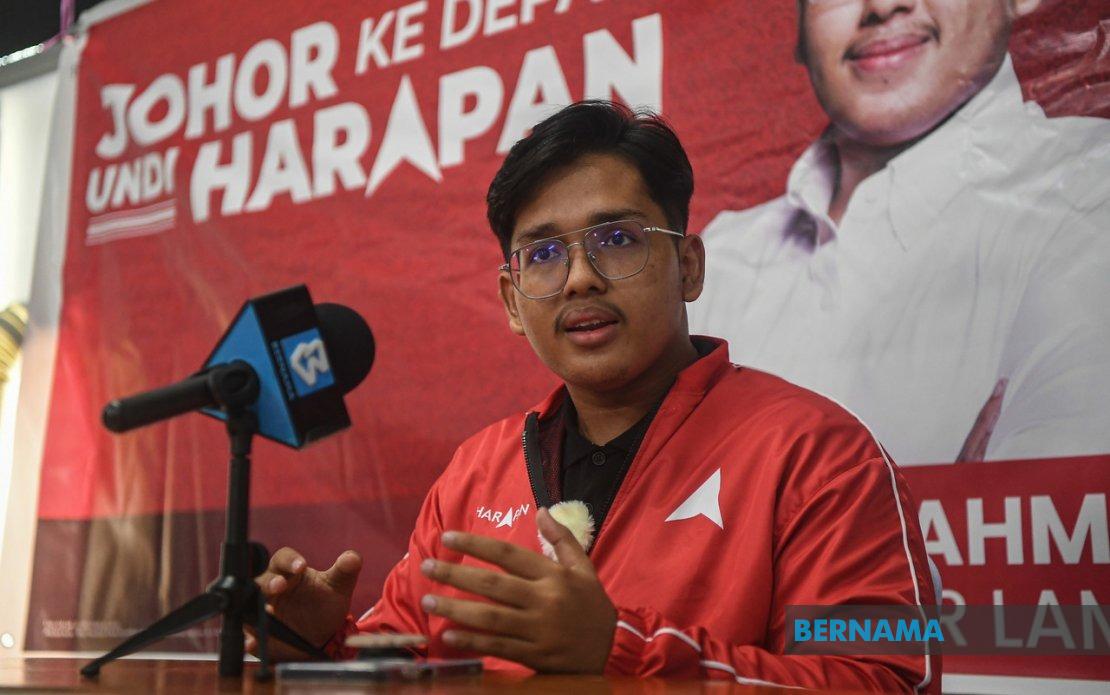
At just 23 years old, Danish Hossman Abd Rahman has emerged as the Pakatan Harapan candidate contesting the Johor Lama state seat in the 16th Johor state election, running on a platform centred on narrowing the development divide between rural and urban areas. His campaign message, encapsulated in the phrase "Wajah Baharu, Johor Lama" (A New Face, Johor Lama), strikes at what he identifies as a critical challenge in the constituency: the persistent exodus of young people from farming communities seeking better prospects in cities like Johor Bahru and across the border in Singapore.
The candidature of Hossman represents a generational shift in how the Pakatan Harapan coalition is approaching rural constituencies. Rather than accepting the conventional wisdom that Felda settlements and peripheral areas must inevitably lose their youth to urban migration, his platform explicitly aims to reverse this trend through targeted economic development. He argues that the problem is not a lack of ambition among young people from these communities, but rather the absence of viable employment pathways and economic opportunities within their own districts. This diagnosis suggests a structural challenge that demands substantial investment and coordinated policy intervention at both state and federal levels.
During his campaign engagement in Kota Tinggi, Hossman emphasized the necessity for strengthened cooperation between Kuala Lumpur and the Johor state government to ensure policies translate into tangible development projects. His observations highlight a recurrent frustration in Malaysian politics: the gap between announcements made at the federal level and their actual implementation in constituencies far from the centre of administrative power. By drawing attention to this coordination challenge, Hossman is implicitly critiquing governance structures that have historically prioritized development in already-prosperous zones such as Johor Bahru, Tebrau, and Kulai while neglecting outlying agricultural areas.
Perhaps most significantly, Hossman's strategy centers on attracting substantial private sector investment to Johor Lama. This approach reflects evolving thinking within Pakatan Harapan about how to address rural stagnation—not through government handouts or traditional subsidy mechanisms, but through creating genuine private sector opportunities. By positioning investment attraction as a core campaign plank, he suggests that sustainable rural development requires establishing competitive advantages that draw businesses to these areas. The implication is that Felda communities possess potential assets—whether in terms of labour, agricultural capacity, or strategic location—that remain underutilized under current governance.
Beyond economic matters, Hossman has identified a seemingly mundane but practically consequential gap in government services: the absence of an Immigration Department office in Kota Tinggi itself. This issue exemplifies how rural residents bear hidden costs through time and travel expenses when accessing basic administrative services. Residents currently must journey to Johor Bahru, Kulai, or Mersing simply to apply for passports or handle immigration procedures—journeys that consume half a day or more. By pledging to establish a branch office in Kota Tinggi, Hossman addresses what might be dismissed as a minor inconvenience but actually represents a form of governance inequality that particularly burdens lower-income families with fewer resources for such trips.
His campaign methodology blends traditional and digital approaches, recognizing that Johor Lama's electorate spans different demographics and communication preferences. With over 32,000 registered voters in the constituency, Hossman has committed to direct face-to-face engagement while simultaneously leveraging social media platforms to amplify his message. This dual-track approach acknowledges that rural constituencies cannot be effectively reached through digital channels alone, yet that younger voters and urban-origin residents returning to vote require accessible online engagement opportunities. The positive response he reports from social media indicates that his messaging about youth-focused development resonates with at least portions of the voting population.
The three-cornered contest in Johor Lama brings together incumbent Norlizah Noh representing Barisan Nasional, Aisah Esa for Perikatan Nasional, and Hossman for Pakatan Harapan. This configuration suggests that the seat remains contested rather than being the secure preserve of any single coalition. The presence of Perikatan Nasional as a serious contender indicates that opposition to the incumbent has fractured across multiple alternatives. For Hossman, this presents both opportunity and risk: while he potentially benefits from anti-incumbency sentiment, he must also distinguish his Pakatan Harapan vision from the competing alternative offered by Perikatan Nasional.
Hostman's prominence as the youngest candidate in the Johor state election carries symbolic weight. His age positions him as a representative of a generation that has grown up watching rural areas decline relative to urban centres, and who expects political solutions rather than accepting migration as inevitable. The appeal to younger voters is particularly important in constituencies like Johor Lama, where demography itself has become a political fact: as young people leave, remaining constituencies age, reducing their electoral influence and further justifying political marginalization. By standing as a youthful candidate with a youth-centered platform, Hossman attempts to interrupt this cycle.
The campaign also reflects broader regional dynamics relevant to Malaysian politics. Singapore's continued attraction of Malaysian workers—including from rural Johor—represents a persistent challenge to national development objectives. When young people from Felda settlements migrate not merely to Johor Bahru but across the causeway to Singapore, Malaysia loses not only labour but also tax revenues, consumer spending, and demographic vitality in these areas. Hossman's investment-focused approach implicitly addresses this cross-border dimension by proposing that rural areas can be made competitive enough to retain their youth.
Voting in the Johor state election is scheduled for July 11, with early voting set for July 7. The contest will determine not only the representation of Johor Lama but also the overall composition of the state assembly. For Hossman and his Pakatan Harapan colleagues, success in rural constituencies like this will be essential to demonstrating that the coalition can govern across diverse terrain rather than remaining an urban-focused political force. His campaign thus carries implications extending well beyond the Kota Tinggi district.

