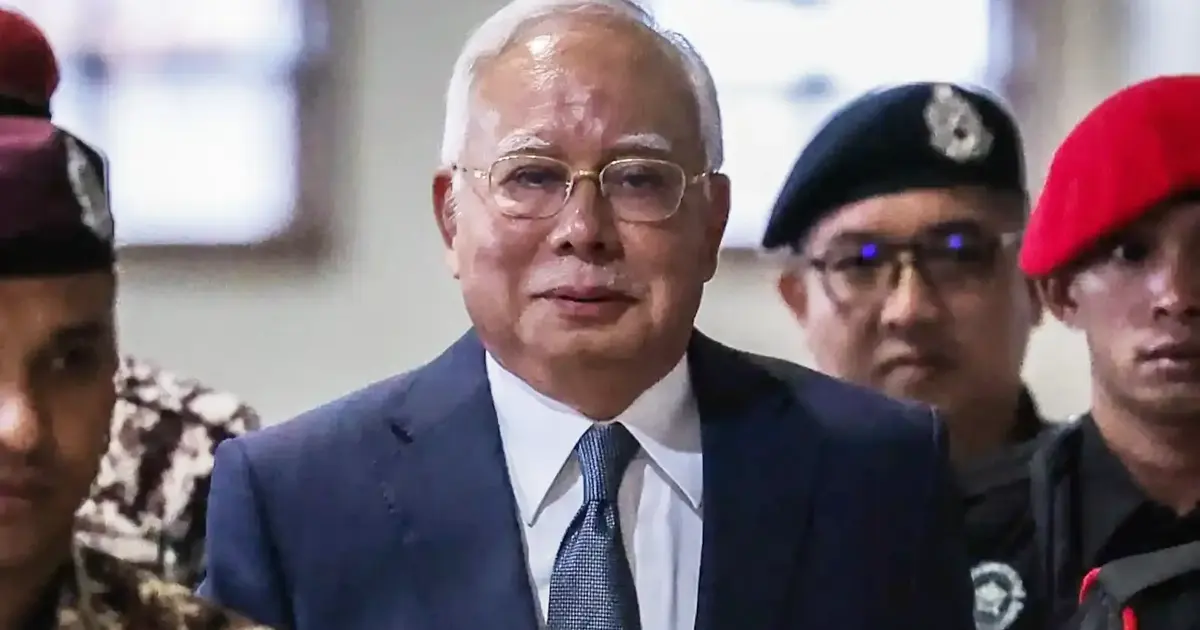
The political question of whether Malaysia's major coalition parties align on the question of clemency for Najib Razak has moved into sharper focus, with DAP politician Ong Hui Xue pressing the Malaysian Chinese Association to articulate its position as Umno leaders grow increasingly vocal in seeking a full pardon for the former prime minister.
Ong's intervention reflects mounting uncertainty about the internal dynamics within Barisan Nasional, the ruling coalition that includes both MCA and Umno as major components. While Umno, the dominant Malay-Muslim party, has stepped up its public appeals for Najib's release from conviction, the position of MCA—which represents the coalition's Chinese business and professional constituency—remains opaque to observers and the broader public.
The question carries substantial weight in Malaysian politics. Najib's 1MDB-related convictions and subsequent imprisonment have created an ideological and political fault line that cuts across party lines and threatens established factional alignments. For MCA, publicly endorsing calls for a pardon could alienate portions of its voter base and damage its credibility as a party committed to transparency and rule of law, particularly among urban, educated Chinese voters who tend to scrutinise governance issues more closely.
Conversely, remaining silent or ambiguous may be interpreted as tacit acquiescence, or as political weakness in the face of its more powerful Umno partner. This dilemma exposes one of the structural vulnerabilities of coalition governance in Malaysia: junior partners often struggle to maintain independent voices without risking marginalisation, yet capitulating entirely to senior partners erodes their distinct political identity.
Umno's intensifying campaign for Najib's pardon reflects the party's complex relationship with its former leader. Although Najib was ousted and faced legal jeopardy following the 2018 election defeat, significant segments of Umno's grassroots membership and leadership remain personally or ideologically loyal to him. For these figures, securing his release has become a litmus test of party solidarity and a way to signal defiance against what they characterise as political persecution.
The timing of increased pardon advocacy also coincides with broader political repositioning within Malaysia's leadership. As factional tensions within Umno and the wider coalition continue to simmer, certain figures may calculate that championing Najib's cause strengthens their standing with key constituencies or enhances their leverage in internal party negotiations. The pardon question has thus become a proxy battleground for deeper power struggles.
For MCA, the silence is becoming increasingly untenable. The party operates in a unique position as a component of Barisan Nasional while simultaneously needing to maintain appeal to voters who favour good governance and independent judicial processes. Many of MCA's traditional supporters view the rule of law and institutional integrity as fundamental to Malaysia's economic stability and their own business interests. A full endorsement of Najib's pardon would send troubling signals about the party's commitment to these principles.
Ong's public challenge therefore serves a dual purpose: it pressures MCA to clarify its actual position rather than remaining in strategic ambiguity, while simultaneously highlighting the tensions that exist within the governing coalition over this deeply contentious issue. His intervention also reflects DAP's interest in exploiting divisions within Barisan Nasional, particularly gaps between component parties on matters of principle.
The broader implications extend beyond coalition mechanics. The question of presidential clemency or pardon for Najib ultimately rests with the constitutional monarchy, specifically the Yang di-Pertuan Agong. How coalition parties publicly position themselves on this matter signals to the monarchy their collective commitment—or lack thereof—to judicial independence and constitutional propriety. Pressure from senior coalition figures for a pardon could be interpreted by the palace as an attempt to influence what remains a sovereign prerogative that should be exercised with due constitutional solemnity.
Moreover, Malaysia's international reputation as a jurisdiction pursuing corruption accountability hinges partly on whether the judicial outcomes against Najib are seen as legitimate and final. Public campaigns by prominent political figures to overturn convictions risk conveying internationally that Malaysian courts operate under political pressure rather than according to rule of law principles. This perception carries economic consequences for investor confidence and Malaysia's standing in global governance indices.
The MCA's eventual response—should Ong's challenge force one—will reveal important information about the current balance of power within Barisan Nasional. A clear rejection of pardon calls would signal MCA asserting independent voice and principle; a qualified endorsement or continued evasion would suggest subordination to Umno pressure. For Malaysian voters evaluating the ruling coalition, MCA's positioning on this issue will likely influence perceptions of the party's future viability and moral authority in governance.
As Umno's campaign intensifies, the political space for other coalition partners to remain neutral continues to contract. Ong's intervention reflects the reality that silence on such a polarising question increasingly reads as a form of implicit agreement—a dynamic that may force MCA toward a more explicit clarification of where the party genuinely stands on accountability, constitutional governance, and its role within the coalition.

