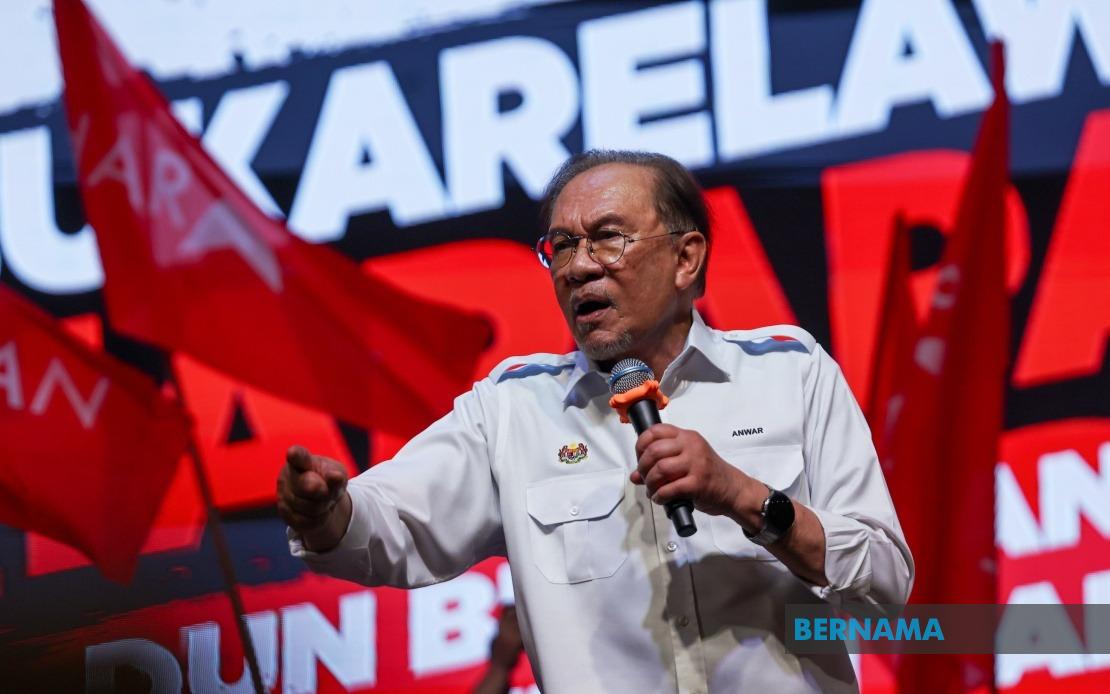
Prime Minister Datuk Seri Anwar Ibrahim has moved to counter what he characterised as a deliberate attempt to misrepresent the Democratic Action Party, asserting that DAP has consistently upheld the constitutional rights of Malays and other Bumiputera communities. Speaking at the Meeting Anwar Programme in Muar on July 5, Anwar sought to dismantle narratives portraying the predominantly Chinese-led party as harbouring anti-Malay sentiment, a charge that has periodically surfaced in Malaysian political discourse, particularly during election cycles.
The Prime Minister pointed to concrete evidence of DAP's acceptance of Malay-centric policies, specifically noting the party's lack of objection to the government's plan to gazette 20.23 hectares of land in Bandar Malaysia as Malay Reserve Land. This example carries symbolic weight in Malaysian politics, where land designation and resource allocation between communities remains a sensitive and closely monitored issue. The willingness of a non-Bumiputera-dominated party to endorse such measures, Anwar suggested, fundamentally contradicts allegations of racial bias against Malays and represents a pragmatic approach to governance within a multi-racial coalition.
As chairman of Pakatan Harapan and leader of the broader Unity Government, Anwar articulated a vision of balanced governance that simultaneously acknowledges constitutional protections for specific communities while ensuring no demographic group is systematically excluded from development initiatives. This balancing act sits at the heart of contemporary Malaysian governance, where the federation's founding social contract—which guarantees Malay-Bumiputera privileges in exchange for citizenship rights for non-Bumiputeras—must coexist with modern demands for transparent, equitable resource distribution. Anwar's framing suggests the Unity Government interprets this contract as compatible with needs-based assistance across ethnic lines.
The Prime Minister elaborated on his administration's dual approach, noting that development programmes targeting Malays and Bumiputeras, including increased allocations to Perbadanan Usahawan Nasional Berhad (PUNB), proceed without impediment from any coalition partner. PUNB, a national entrepreneurs agency historically focused on Bumiputera business development, remains a key instrument for implementing constitutional provisions, and continued funding signals commitment to these mandates. Simultaneously, Anwar stressed his insistence that comparable development initiatives cannot be forestalled for other communities, particularly the economically vulnerable.
In an era where income inequality has widened considerably across Malaysia's demographic spectrum, Anwar reframed the poverty and development question beyond traditional communal categories. He argued that deprivation transcends ethnic boundaries, with struggling Chinese and Indian Malaysians deserving targeted assistance alongside the majority of poor Malays. This perspective represents a subtle but significant reorientation from zero-sum thinking, where assistance to one community was perceived as diminishment for another. Instead, Anwar positioned inclusive development as a prerequisite for national prosperity, implying that allowing any segment to languish economically undermines collective wellbeing and social cohesion.
His comments arrived amid Malaysia's current economic expansion, prompting reflection on how growth dividends should be distributed across society. Anwar critiqued the notion that economic progress should accrue primarily to a narrow elite or serve narrow sectional interests. Rather, he contended that measurable growth must translate into tangible improvements in ordinary Malaysians' lives, manifested through affordable housing, reliable basic infrastructure, and quality education accessible to all. This emphasis on translating macroeconomic gains into household-level benefits resonates strongly with Southeast Asian voters who have grown skeptical of growth statistics disconnected from their lived reality.
The Prime Minister's comments carry particular relevance for Malaysian and regional observers tracking whether the Unity Government can sustain consensus across its ethnically and ideologically diverse membership. The Pakatan Harapan coalition, comprising DAP alongside the multiracial People's Justice Party and the Malay-Muslim oriented Amanah, has historically faced scrutiny regarding whether parties can genuinely collaborate on contentious issues spanning race, religion, and resource allocation. Anwar's explicit defence of DAP's bona fides suggests ongoing tensions within the coalition architecture, perhaps reflecting external pressure campaigns questioning DAP's commitment to constitutional safeguards.
Contextualising these remarks within the 16th Johor state election—where 172 candidates competed across 56 state assembly seats with voting scheduled for July 11—reveals their immediate political purpose. Johor, Malaysia's second-largest state, has long been contested terrain between Umno-led coalitions and opposition forces. State-level elections provide opposition parties opportunities to demonstrate competence in governance while managing sensitivities around race and religion that dominate federal discourse. Anwar's intervention directly addresses voter concerns about whether DAP influence within Pakatan Harapan threatens traditional communal settlements.
Moreover, Anwar's invocation of public trust in political leadership introduced a moral dimension often obscured in technocratic governance discussions. He emphasised that political authority constitutes a sacred trust deployed for public welfare rather than personal enrichment, a principle that implicitly critiques both past corruption scandals and contemporary perceptions of political elites as self-serving. This framing appeals across demographic lines, resonating with voters fatigued by rent-seeking behaviour in both Umno-dominated and Pakatan-led administrations. The Prime Minister's assertion that political service ranks above personal accumulation positioned the Unity Government's economic inclusivity agenda as moral imperative, not merely pragmatic policy.
For Malaysian observers assessing coalition stability and governance trajectories, these statements underscore ongoing efforts to construct a multiracial political settlement that preserves constitutional bargains while adapting to contemporary demands for equitable development. Anwar's simultaneous affirmation of Bumiputera rights and expansion of development criteria beyond communal categories suggests an attempt at synthesis rather than subordination of any principle. Whether this philosophical positioning translates into sustained policy coherence, particularly if economic circumstances constrain resources available for broad-based distribution, remains a critical question for Malaysia's medium-term political economy.

