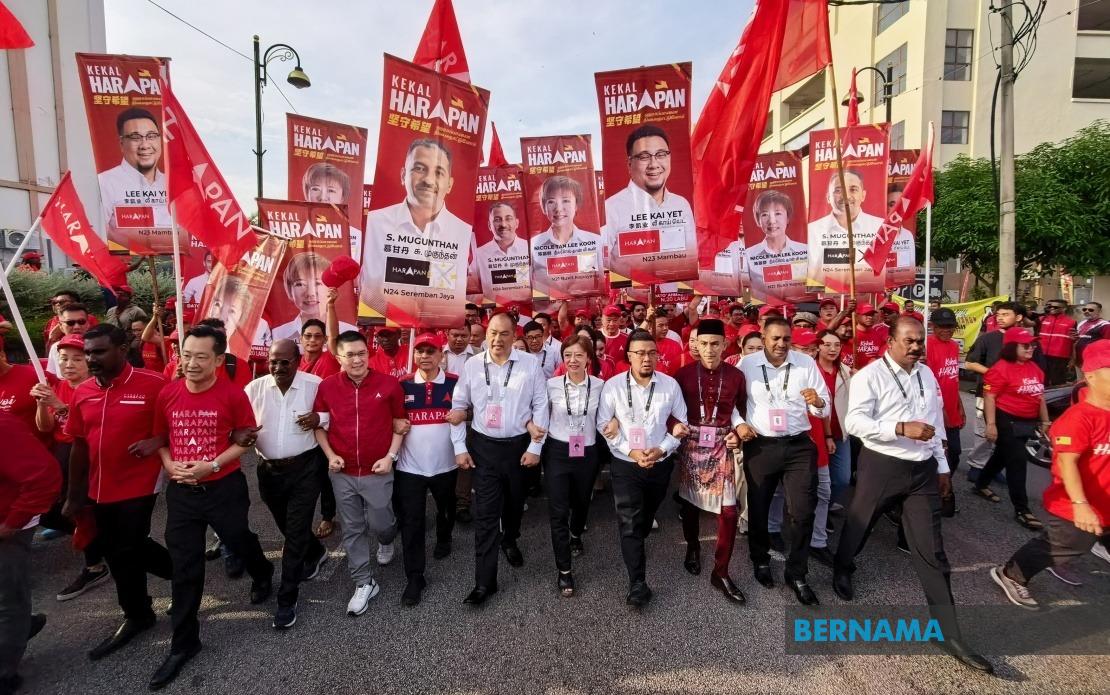
The 16th Negeri Sembilan state election is shaping up to be highly competitive, with the Rahang constituency emerging as a particular flashpoint where multiple political forces are vying for control. Siaw Meow Keong, the Negeri Sembilan DAP treasurer who has represented Rahang since 2023, will defend his position under the Pakatan Harapan banner in a complex four-cornered contest that underscores the fragmented electoral landscape across Malaysia's central region.
Siaw's challengers represent a broad ideological and political spectrum, each bringing distinct constituencies and messaging to the battle for votes. His primary rival appears to be Yap Siok Moy, the Rasah MCA Wanita chief fielded by Barisan Nasional, who represents the traditional conservative coalition's attempt to reclaim territory in an area where its grip has loosened in recent years. Simultaneously, S. Thinagaran of Parti Sosialis Malaysia brings a left-wing alternative to voters seeking to move beyond the established two-coalition framework, while Tang Jay San of Bersatu introduces the Perikatan Nasional element into the competition. This diversity of contenders reflects broader realignments occurring within Malaysian politics, where the once-binary choice between BN and opposition has fractured into multiple competing visions.
The nomination process concluded smoothly at the Seremban City Council Hall, with returning officer Mohamad Najib Mustafa overseeing proceedings. Candidates submitted their papers within a tight one-hour window, with Thinagaran filing first at 9.06 am, followed swiftly by Tang at 9.10 am, Siaw at 9.12 am, and Yap at 9.13 am. The compressed timeline and sequential filings highlight the administrative precision that characterizes Malaysian electoral procedures, though the speed also underscores how rapidly political dynamics can shift in contemporary Malaysia.
The Negeri Sembilan election encompasses multiple constituencies with varying competitive dynamics. While Rahang presents a four-way race, the Bukit Kepayang seat offers a more straightforward binary contest. Nicole Tan Lee Koon, the DAP Wanita chief defending Bukit Kepayang for Pakatan Harapan, faces a direct confrontation against Lee Boon Shian representing Perikatan Nasional. This straight fight suggests that in certain urban or demographically favorable areas, PN has effectively consolidated opposition forces against DAP's incumbency, a pattern worth monitoring for broader implications.
Three constituencies will feature three-cornered contests, each revealing distinct regional political patterns. In Labu, incumbent Datuk Ahmad Faez Abdul Razak of Pakatan Harapan faces competition from Mohamad Hanifah Abu Baker of Bersatu and Siti Nur Umaira Hasim of Barisan Nasional. The Mambau seat will see PH's Lee Kai Yet competing against Bersatu's N. Sarawanan and PN's Eric Michael. In Seremban Jaya, PH's S. Mugunthan must contend with Datuk T. R. Thinalan representing Barisan Nasional and R. Mahendran of Bersatu. These multi-way contests complicate traditional voting patterns and potentially fragment opposition voices, potentially benefiting incumbents or disadvantaging challengers depending on local political allegiances.
For Malaysian observers, these Negeri Sembilan contests serve as a crucial barometer for national political sentiment heading into any future federal elections. The state's positioning as a swing region and its diverse demographic composition make it a microcosm of broader Malaysian politics. The performance of DAP incumbents like Siaw and Tan will indicate whether the party has successfully embedded itself into state legislatures beyond its traditional strongholds, or whether opposition momentum has stalled after the 2022 federal election disappointing results for Pakatan Harapan.
The emergence of competitive contests across multiple constituencies suggests that none of the major coalitions can take Negeri Sembilan for granted. Pakatan Harapan must defend existing seats while navigating splinter challenges from PSM and PN, both of which are evidently attempting to carve out constituencies where they can present themselves as alternatives to the established order. Barisan Nasional's presence in multiple contests indicates its determination to recover ground it has lost in recent election cycles, even in constituencies where PH has established some presence.
The election timetable provides clear markers for the campaign period. Early voting has been scheduled for July 28, allowing eligible voters—including frontline workers and those unable to vote on polling day—to cast their ballots early. This compressed early voting window suggests a relatively brief official campaign period, though groundwork has likely been underway for months as parties identified target constituencies and positioned candidates strategically.
August 1 has been designated as the general polling day, giving voters a clear date to mark on their calendars. The timing places the Negeri Sembilan election during a period when Malaysian politics remains fluid, with various coalitions still testing their positioning and attempting to build narrative momentum ahead of eventual federal electoral contests. How voters in constituencies like Rahang ultimately decide may carry implications far beyond Seremban, influencing perceptions about which political forces command genuine grassroots support versus those merely maintaining structural presence.
For Siaw Meow Keong specifically, retaining Rahang will require demonstrating that DAP-led governance has delivered tangible benefits to constituents while positioning himself as the viable representative against fragmented opposition. His four-way contest presents both opportunity and hazard: multiple challengers dilute anti-incumbent votes, but they also allow each opponent to target specific demographic segments. The coming weeks will reveal whether Pakatan Harapan's Negeri Sembilan machinery can successfully mobilize support across multiple constituencies simultaneously, or whether the fractured opposition landscape will exact significant electoral costs.

