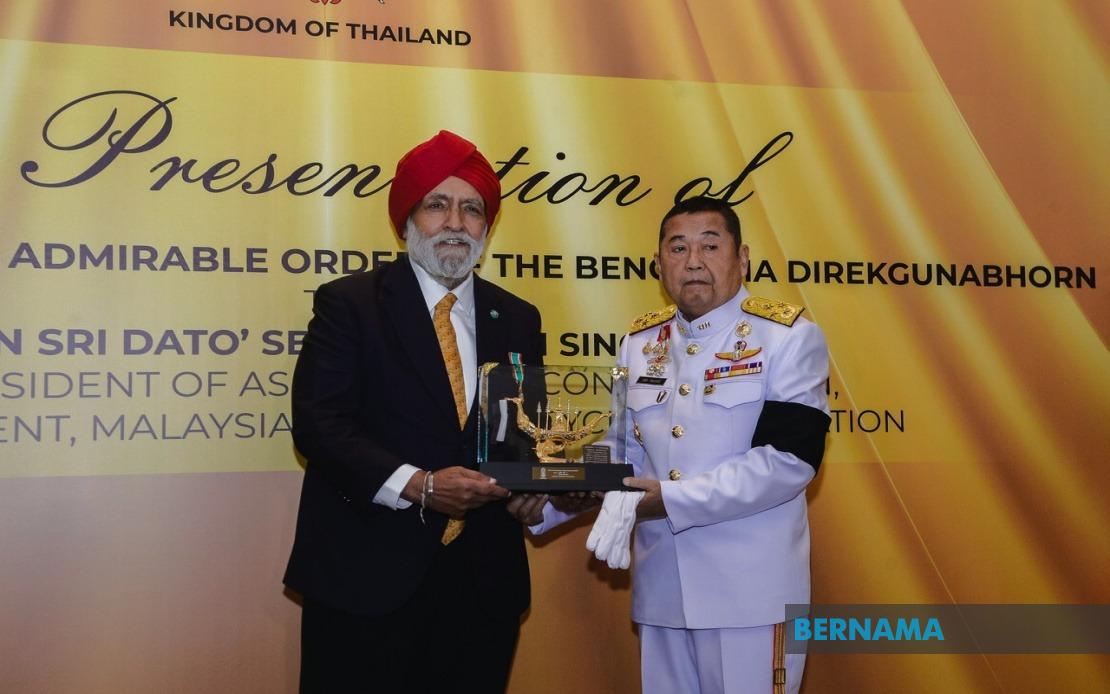
Tan Sri Darshan Singh Gill, a towering figure in Malaysian and Asian cycling administration, has been conferred one of Thailand's highest civilian honours in recognition of his four decades of service to the sport. The Most Admirable Order of the Direkgunabhorn (Fifth Class - Benjama Direkgunabhorn) was presented to him in Kuala Lumpur on August 6, honouring his instrumental role in elevating cycling standards and governance across the region during his tenure leading two of Asia's most important cycling bodies.
The royal decoration, originally bestowed by the late King Bhumibol Adulyadej The Great of Thailand, was formally presented by ACC senior vice-president General Decha Hemkasri, underscoring the cross-border respect that Darshan's work has garnered among fellow administrators across Southeast Asia and beyond. The honour extends beyond personal recognition; it represents Thailand's acknowledgement of Malaysia's growing influence and competence in international sports administration and development.
Darshan's career in cycling governance spanned two critical periods of expansion for the sport in the region. His leadership of the Malaysian National Cycling Federation from 1988 to 1990 came during a formative period when cycling was establishing itself as a serious competitive discipline in Malaysia. More significantly, his nine-year tenure as Asian Cycling Confederation president from 1996 to 2005 coincided with a period when the confederation was professionalising its operations and raising performance standards across Asian nations, positioning the continent as a credible player in global cycling competitions.
In remarks to journalists following the ceremony, Darshan framed the award not as a personal accolade but as recognition of Malaysia's broader trajectory in cycling. He drew a clear line between the pioneers of his generation—M. Kumaresan and Rosman Alwi—and the current generation of world-class athletes and administrators, suggesting that Malaysia's emergence as a cycling powerhouse represents a natural evolution built on foundations laid during his era. This perspective offers insight into how institutional memory and continuous development shape sporting achievement over decades.
The most visible embodiment of Malaysia's cycling prowess today is Datuk Mohd Azizulhasni Awang, the track cyclist who recently captured the gold medal in the men's keirin event at the Commonwealth Games in Glasgow. This victory ended a 16-year drought for Malaysia in track cycling at the Commonwealth level, marking a watershed moment that validates the long-term investment in cycling infrastructure and coaching that figures like Darshan helped establish. Azizulhasni's success on the world stage demonstrates that the administrative and strategic work done by earlier leaders created pathways for elite performance.
Equally significant is the elevation of Malaysian cycling administration itself to the highest levels of international governance. Datuk Amarjit Singh Gill, the current Malaysian National Cycling Federation president, made history last year by becoming the first Malaysian elected to the International Cycling Union (UCI) executive as vice-president for the 2025-2029 term. This milestone, achieved during the 194th UCI Congress in Kigali, Rwanda, represents a seismic shift in how the global cycling community views Malaysian leadership capacity and expertise.
Darshan's emphasis on Amarjit's election as UCI vice-president reveals an important dimension of sporting development that often escapes public attention. While athlete performance captures headlines and public imagination, the ability of a nation's administrative representatives to influence policy at world governing body level demonstrates something equally valuable: institutional credibility, technical competence, and diplomatic skill. Amarjit's election suggests that Malaysian administrators have successfully positioned the country not merely as a participant in global sports governance, but as an indispensable voice shaping the future direction of international cycling.
For Malaysia specifically, the award to Darshan carries implications beyond nostalgic recognition of past service. It signals to the international sports community that Malaysia's commitment to cycling excellence spans generations and reflects sustained institutional investment rather than ad-hoc achievement. In an era where nations compete for hosting rights to major sporting events and seek influence within international federations, the demonstration of deep institutional knowledge and continuity of vision provides tangible diplomatic capital.
The honour also arrives at a moment when Asian cycling is experiencing renewed dynamism. Track cycling in particular, traditionally dominated by European nations, has seen increasing investment and competitive success from Asian countries. Thailand itself has emerged as a major cycling hub in Southeast Asia. Darshan's recognition by Thailand underscores the cross-border professional relationships and mutual respect that characterise Asian sports administration at its best, where neighbouring nations acknowledge excellence regardless of borders.
For current and emerging cycling administrators in Malaysia and across Southeast Asia, Darshan's trajectory offers a template for building lasting influence. His progression from leading a national federation to presiding over a continental body, and subsequently maintaining relevance in the evolving global cycling landscape, suggests that patient institution-building and consistent advocacy for development create opportunities for both personal recognition and national advancement. The Thai honour essentially validates that approach.
The timing of this award also merits attention. Recognition at this stage of Darshan's life, when he can witness the fruits of his earlier labour in Azizulhasni's achievements and Amarjit's historic election, creates a narrative of continuity and legacy. It demonstrates that the decisions made during his era in cycling administration—about funding, talent development, technical coaching standards, and international engagement—had consequences that extended well beyond his tenure.
Looking forward, the award highlights a broader question about institutional memory and succession in Malaysian sports. As experienced administrators like Darshan receive international recognition, their accumulated knowledge about what works, what failed, and why certain approaches succeeded becomes invaluable for the next generation. The challenge for Malaysian sports bodies will be ensuring that this institutional wisdom is systematically documented and transferred rather than lost when veteran administrators eventually step back from active roles.

