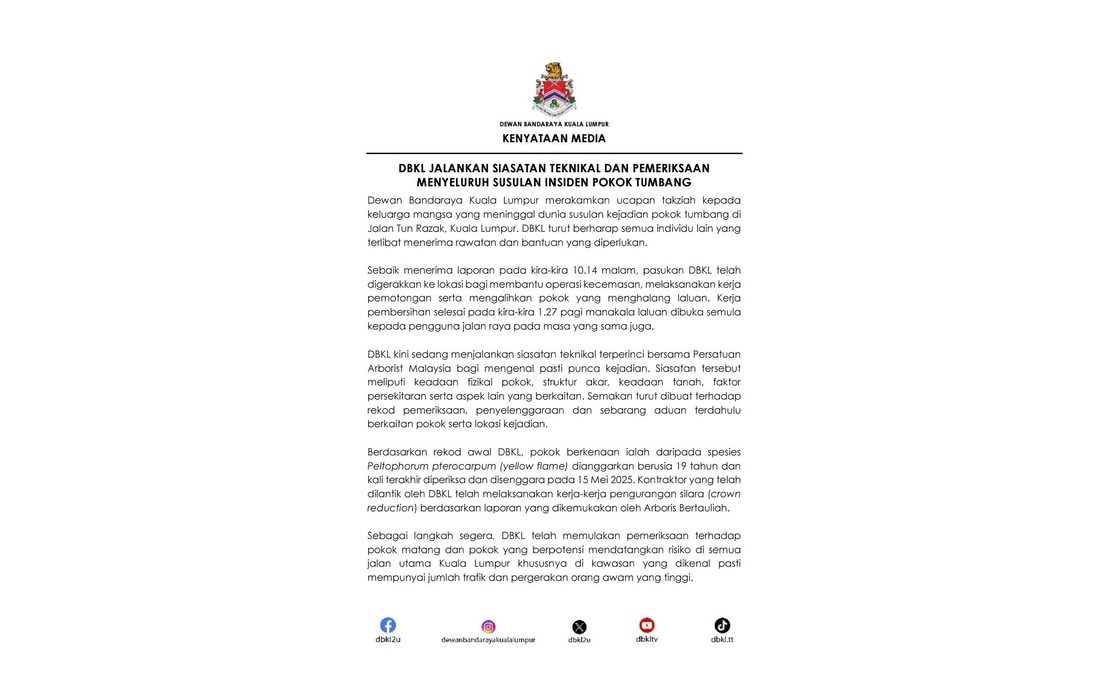
A man was killed when a mature tree fell on Jalan Tun Razak in Kuala Lumpur late on July 19, triggering an urgent investigation and a broader reassessment of the city's tree management practices. Kuala Lumpur City Hall (DBKL) has launched a comprehensive technical inquiry into the incident, working alongside the Malaysian Society of Arborist to establish what led to the structural failure. The investigation will examine multiple variables including the tree's physical integrity, its root system, soil composition, and broader environmental influences that may have contributed to the collapse.
Due diligence protocols surrounding the fallen tree reveal that maintenance records were maintained, with the Peltophorum pterocarpum specimen undergoing its most recent inspection and upkeep on May 15. The tree, approximately 19 years old at the time of the incident, had undergone crown reduction procedures prescribed by a qualified arborist contractor. Despite these preventive interventions, the tree ultimately failed catastrophically, raising questions about the effectiveness of standard inspection regimes and whether current assessment methodologies can reliably predict dangerous conditions in urban forest environments.
DBKL mobilized emergency response personnel immediately upon notification at 10.14 pm. Teams worked throughout the night to remove the fallen tree and restore normal traffic flow, with Jalan Tun Razak reopened by 1.27 am. The incident has prompted institutional expressions of sympathy toward the deceased and commitments to assist affected parties, while DBKL pledged full collaboration with police and other relevant authorities to determine precise causation and draw lessons for future prevention.
The tragedy has catalyzed a systematic examination of high-risk vegetation across Kuala Lumpur's arterial network. DBKL has commenced intensive inspections of mature and potentially vulnerable trees along primary thoroughfares, with particular emphasis on corridors experiencing heavy traffic and pedestrian congestion. Initial focus areas include Jalan Ampang, Jalan Sultan Ismail, Jalan Raja Laut, Jalan Datuk Keramat, and additional sections of Jalan Tun Razak itself. Eight dedicated teams, incorporating five certified arborists, will execute these assessments over a ten-week timeframe, reflecting the scale and complexity of auditing the capital's urban tree inventory.
Beyond immediate inspection efforts, DBKL is pursuing technological solutions to enhance early detection of structural instability. The municipal authority is awaiting certification from SIRIM, Malaysia's national standards body, to deploy 400 specialized tree sensors across high-risk zones. These devices represent a medium-term strategy to move beyond periodic manual assessment toward continuous real-time monitoring of critical parameters affecting tree stability and safety.
The proposed sensor network will track multiple indicators simultaneously, measuring soil conditions and moisture saturation levels while simultaneously monitoring structural movement and deformation within the tree itself. The system will also register the cumulative impact of severe weather events such as intense rainfall and flood conditions, which can destabilize root anchorage and compromise structural integrity over time. This integrated approach recognizes that tree failure typically results from complex interactions between biological, environmental, and hydrological factors rather than single isolated causes.
The initial rollout of sensor technology will concentrate on four strategically significant locations: Jalan Bangsar, Dataran Merdeka, Jalan Ampang, and Jalan Raja Chulan. These zones represent areas where tree failure would pose maximum public risk due to pedestrian volume, vehicle density, or proximity to critical urban infrastructure. Phased installation allows DBKL to establish operational protocols and refine data interpretation methodologies before broader citywide deployment.
For Malaysian and Southeast Asian urban planners, this incident underscores the growing tension between dense urban development and the maintenance of mature vegetation canopy. Many cities across the region face similar challenges as aging trees planted decades ago enter periods of heightened vulnerability while urban environments around them intensify through increased construction, infrastructure density, and climate pressures. The Jalan Tun Razak incident serves as a sobering reminder that municipal forestry requires continuous vigilance and investment, not merely regulatory compliance.
The implications extend beyond Kuala Lumpur, as other Malaysian cities manage comparable inventories of aging trees in congested urban settings. Penang, Selangor's municipal areas, and Johor Bahru similarly maintain substantial populations of mature trees that may require similar proactive assessment regimes. The technical investigation into specific causation factors may yield insights applicable across the region's urban environments, potentially informing best-practice standards for tree risk management in tropical and subtropical Southeast Asia.
DBKL's commitment to comprehensive investigation and systematic remediation demonstrates recognition that public safety requires moving beyond reactive crisis management toward anticipatory infrastructure governance. The deployment of monitoring technology, coupled with enhanced inspection protocols and specialized expertise, represents a more sophisticated approach to urban tree stewardship. Nevertheless, the tragedy itself highlights how quickly sophisticated systems can be overwhelmed by complex failure mechanisms, underscoring the fundamental precariousness of maintaining mature vegetation in densely developed urban cores.

