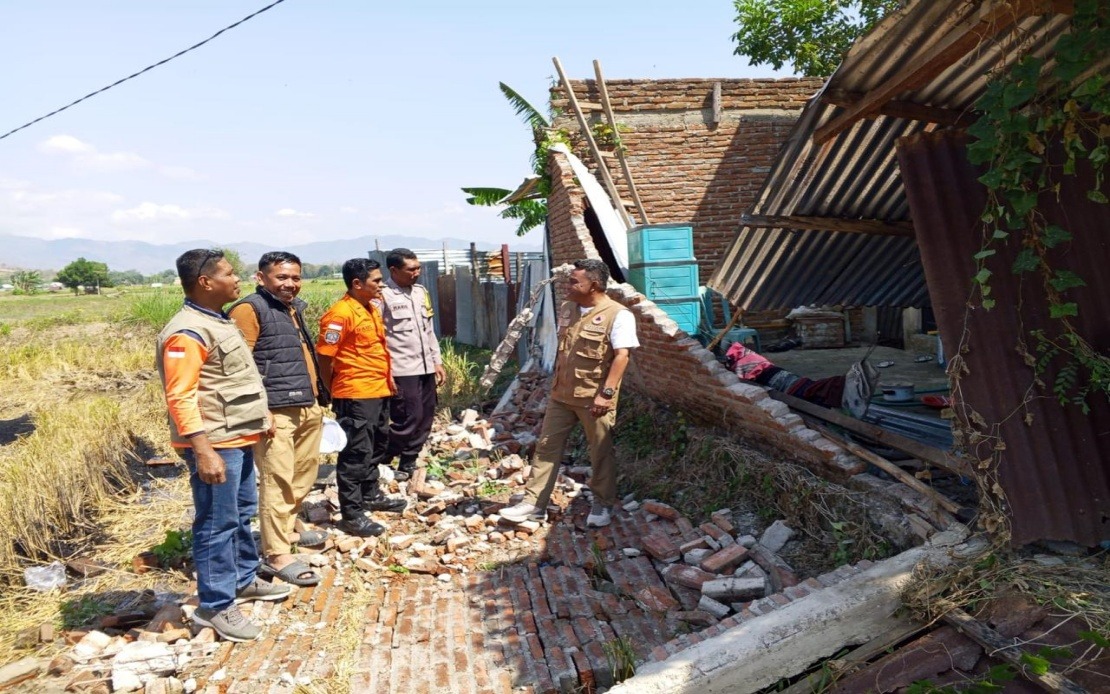
A devastating magnitude 7.7 earthquake has claimed at least 38 lives on Indonesia's Flores Island in East Nusa Tenggara, with rescue operations ramping up as teams race to extract residents believed to be buried beneath destroyed structures. The disaster unfolded in the pre-dawn hours Saturday when the powerful tremor struck at 4.58 am local time, originating from the seabed approximately 30 kilometres northwest of Mbay at a depth of 15 kilometres. The shaking triggered immediate evacuations and prompted authorities to issue a tsunami alert that was later lifted after sea-level monitoring showed no dangerous waves developing.
National Disaster Management Agency chief Suharyanto reported that beyond the confirmed fatalities, two individuals suffered serious injuries whilst eleven others sustained minor wounds. Approximately 2,000 residents independently fled the impacted zones, demonstrating the scale of alarm the earthquake generated among the local population. However, authorities remain concerned about additional residents who may be trapped in collapsed buildings or unable to evacuate, making the ongoing search and rescue operation critical to limiting further loss of life.
The earthquake's destructive footprint extended across multiple categories of infrastructure and housing. Dozens of residential structures were reduced to rubble, whilst several community health centres sustained significant damage, creating additional challenges for medical response efforts in an already strained situation. Landslides triggered by the tremor blocked numerous roads, complicating access routes that rescue vehicles and supply convoys need to navigate. The disaster also affected airport terminal facilities and two port installations, though the airport's runways fortunately escaped major damage, preserving a crucial logistics pathway for bringing in emergency personnel and humanitarian supplies.
The response mobilised substantial resources from Indonesia's emergency services apparatus. Personnel from the National Search and Rescue Agency, the Indonesian military, and police forces were deployed immediately to systematically search affected areas and retrieve survivors from the debris. Two helicopters and one fixed-wing aircraft were commissioned to support evacuation efforts and transport relief materials into zones where ground access remained compromised. This aerial capability proved essential given the road blockages caused by landslide activity, enabling responders to reach isolated communities more efficiently.
As the first full day of the disaster unfolded, authorities acknowledged that casualty and damage figures remained provisional and subject to significant revision upward. Suharyanto emphasised that comprehensive damage assessments were still underway, with field teams systematically documenting the extent of destruction across multiple districts. The provisional 38-death toll represented preliminary accounting that would inevitably increase as rescue workers penetrated remote areas and extracted bodies from wreckage, a sobering reality familiar to disaster management officials in a seismic nation.
Supply chain logistics became an immediate concern as the government mobilised critical resources to support displaced populations. Relief distributions began almost immediately, encompassing food rations, potable drinking water, clean water supplies for sanitation purposes, temporary shelter tents, electrical generators, and other survival essentials. These distributions targeted communities that had evacuated into open spaces or temporary refuge centres, preventing secondary humanitarian crises stemming from malnutrition or disease in the aftermath period.
The Public Works Ministry assumed responsibility for restoring transportation connectivity, deploying mechanical equipment and personnel to systematically clear roads obstructed by landslide debris. Restoring these vital arteries constituted more than merely convenience—they represented lifelines for emergency vehicles, supply trucks delivering food and medicine, and ambulances transporting injured persons to functional medical facilities. The ministry's mobilisation demonstrated the whole-of-government coordination that Indonesia's disaster management framework demands during major crises.
For Malaysian observers, the Flores earthquake underscores the shared seismic vulnerability that characterises the entire Southeast Asian region. Both nations occupy the Pacific Ring of Fire, where tectonic plate movements generate frequent, sometimes catastrophic earthquakes. Malaysia's own vulnerable zones along the Strait of Malacca and the Sabah-Sarawak regions remain under constant geological stress, reminding policymakers that robust disaster preparedness transcends borders. The Indonesian response mechanisms demonstrated here—from search and rescue coordination to supply chain mobilisation—offer instructive lessons for Malaysian emergency management protocols.
The disaster also highlights infrastructure resilience considerations that apply throughout the developing Southeast Asian context. Older building stock in areas like Flores often fails to meet modern earthquake-resistant construction standards, a challenge Malaysia continues addressing in less-developed regions. The damage sustained by airport terminals and port facilities suggests that even critical infrastructure may lack adequate seismic engineering, a concern relevant to Malaysian authorities planning upgrades to essential facilities.
Communication restoration emerged as a parallel priority to physical reconstruction, with authorities recognising that severed telecommunications links hamper not only coordination but also public reassurance. Indonesian officials understood that families separated during the chaos required communication channels to confirm relatives' safety, whilst media updates containing accurate information prevent rumour and panic. These lessons apply equally to Malaysia's emergency management doctrine.
The immediate post-disaster period also raised public health considerations beyond obvious injury management. Damaged water systems and sanitation infrastructure create vulnerability to waterborne disease outbreaks, whilst displaced populations living in close quarters within emergency shelters face heightened infection risks. These secondary health impacts often prove as consequential as the earthquake's direct casualties if not proactively managed through coordinated medical and public health responses.
As recovery operations continued, Indonesia's national government demonstrated the institutional capacity required to coordinate multiple agencies, mobilise resources at scale, and maintain operational tempo during chaotic circumstances. The BNPB's leadership proved instrumental in establishing unified command structures that eliminated duplicated effort and ensured responders worked cohesively. For Malaysia's disaster management framework, such institutional integration remains an ongoing priority as agencies develop stronger cooperative mechanisms.

