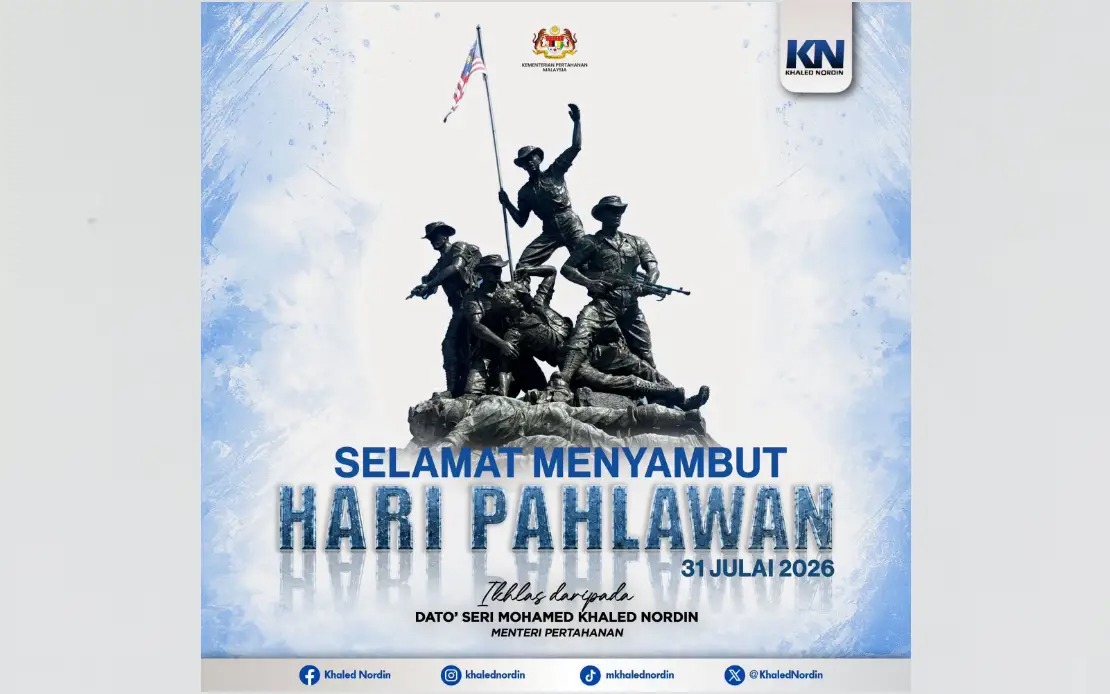
The responsibility for safeguarding Malaysia's sovereignty belongs to every citizen, not merely to uniformed personnel and security agencies, Defence Minister Datuk Seri Mohamed Khaled Nordin emphasised on July 31 as the nation observed Warriors' Day 2026. Speaking through his official social media channels, he articulated a vision of collective national defence that transcends traditional military boundaries, positioning civilian participation as integral to long-term security and stability.
In his statement, Mohamed Khaled outlined a practical framework for how ordinary Malaysians can contribute meaningfully without taking direct military action. The approach centres on cultivating genuine patriotism within communities, actively working to strengthen social cohesion across diverse groups, providing steadfast backing for the armed forces and police, and consciously avoiding behaviours that might compromise the nation's territorial integrity or institutional legitimacy. This multi-layered strategy reflects contemporary security thinking that recognises internal stability and public confidence in state institutions as foundational elements of national defence.
The Defence Minister invoked the concept of Total Defence, locally known as HANRUH, an integrated framework encompassing military, civil, economic, psychological and social dimensions of national security. Under this doctrine, the entire population becomes a stakeholder in defence mechanisms rather than passive beneficiaries of security provision. The emphasis on psychological and social resilience acknowledges that modern threats to sovereignty often manifest through information warfare, social fragmentation and erosion of institutional trust—challenges that no military force can address alone. By mobilising civilian participation, the government seeks to build comprehensive resistance against multifaceted threats to national integrity.
July 31 holds particular significance in Malaysia's calendar as Warriors' Day, an annual observance dedicated to commemorating the service and sacrifice of those who have fought to defend the nation's borders and independence. The date serves as a collective moment for reflection on the historical struggles that established Malaysia's territorial sovereignty and the ongoing commitment required to preserve it. Through such commemorations, the state reinforces narratives of shared sacrifice and collective destiny, encouraging citizens to view national defence not as an abstract governmental responsibility but as a personal obligation rooted in historical continuity.
Mohamed Khaled explicitly acknowledged the contributions of the Malaysian Armed Forces, the Royal Malaysia Police and military veterans, expressing the government's gratitude for their decades of service. This recognition serves multiple purposes: it validates the sacrifices made by security personnel, sustains their institutional morale, and implicitly contrasts their professional commitment against the broader civilian responsibilities he outlined. By celebrating these institutions while simultaneously expanding the conception of who defends the nation, the statement positions military and police as essential but insufficient components of a comprehensive defence architecture.
The Defence Minister's remarks carry particular resonance within Southeast Asia's contemporary security environment. The region faces evolving threats ranging from traditional border disputes to transnational terrorism, maritime security challenges and cyber warfare. Malaysia specifically navigates complex diplomatic relationships, maritime disputes and internal diversity that requires constant management. By framing sovereignty defence as a collective endeavour, the government signals that national security depends not primarily on military hardware or strategic positioning but on the resilience and commitment of the population itself.
For Malaysian citizens, this message reframes civic participation in security matters beyond conventional channels like military service or police work. It legitimises and encourages everyday actions—from teaching children about national history and values to resisting divisive rhetoric, reporting security concerns, and maintaining confidence in democratic institutions. This democratisation of defence responsibility reflects recognition that stability emerges from bottom-up social cohesion as much as from top-down security operations. Communities that maintain internal trust and shared values prove more resilient against extremism, foreign interference and internal destabilisation attempts.
The emphasis on avoiding actions that undermine national sovereignty addresses a particular concern for Malaysian policymakers: the fear that internal divisions, loss of institutional faith, or susceptibility to external influence could weaken the nation from within. In an interconnected world where information flows rapidly and foreign actors can amplify existing social tensions, maintaining psychological and social cohesion becomes a strategic asset equivalent to military readiness. The Defence Minister's appeal thus carries an implicit warning about the perils of fragmentation while offering citizens a constructive role in maintaining national integrity.
Mohamed Khaled's vision extends beyond immediate security threats to encompass long-term national prosperity and peace. He expressed hope that the heroism displayed by Malaysia's warriors would continue to inspire succeeding generations, ensuring that the country remains peaceful, sovereign and prosperous. This temporal framing—connecting past sacrifice to present responsibility to future wellbeing—creates a narrative arc that transcends individual generations and positions national defence as fundamentally connected to prosperity and quality of life. Citizens who understand how security underpins economic opportunity, educational advancement and social stability become more invested in collective defence mechanisms.
The broader context for these remarks involves ongoing discussions within Malaysia and the wider region about the nature of modern threats and appropriate responses. Traditional security paradigms emphasised military superiority and technological advantage, yet contemporary challenges increasingly require social resilience, information literacy and institutional legitimacy. By positioning every citizen as a participant in national defence, Mohamed Khaled signals alignment with evolving security thinking that recognises technology and force as necessary but insufficient without popular buy-in and social stability.
The timing of these remarks during Warriors' Day also reflects deliberate political messaging about national priorities and values. By coupling commemoration of past sacrifices with calls for present civilian engagement, the government reinforces its commitment to security while simultaneously mobilising public participation in achieving it. This approach potentially strengthens legitimacy for security policies and institutional authority by framing them as expressions of collective will rather than impositions from above. Citizens who actively participate in national defence feel greater ownership over national priorities and institutional performance.

