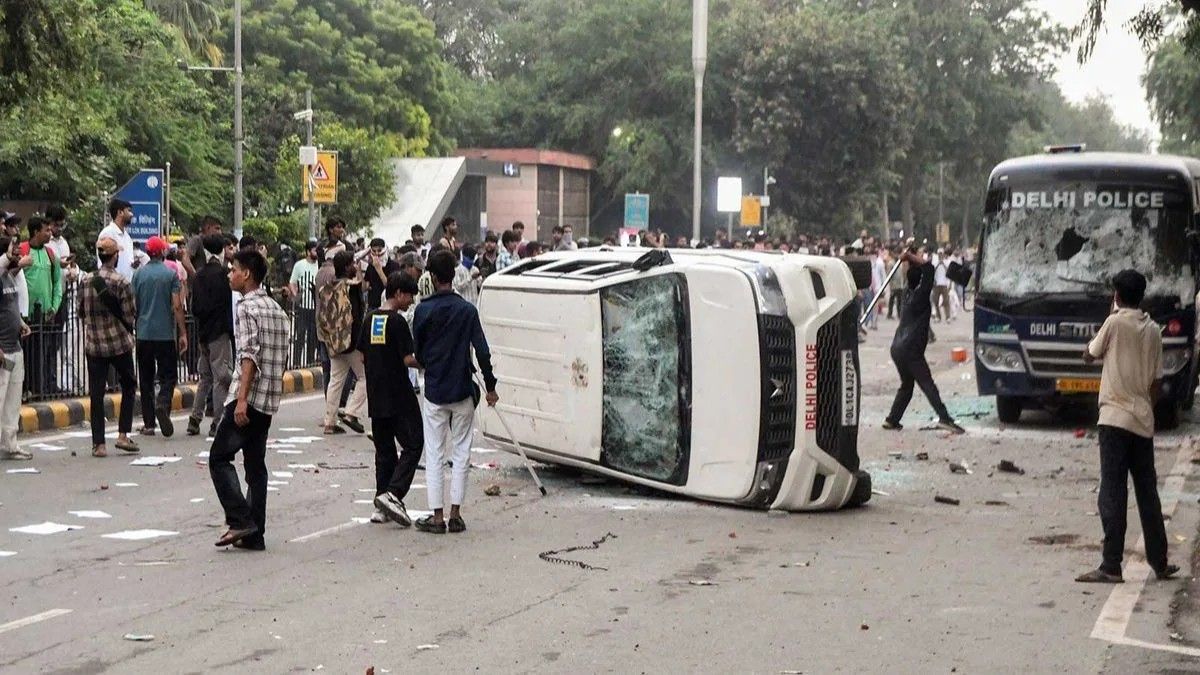
Delhi Police have initiated legal action across multiple stations following violent scenes that erupted during the Cockroach Janta Party's "Sansad Chalo" march towards Parliament on Monday. The 10 first information reports span five police stations in the New Delhi district, marking a significant enforcement response to what authorities describe as instances of aggressive and destructive behaviour during the demonstration. The party had mobilised supporters to demand the resignation of Union Education Minister Dharmendra Pradhan over allegations concerning examination irregularities, but the protest escalated into confrontations that prompted police intervention and the filing of criminal cases.
The cases have been distributed across Parliament Street, Connaught Place, Mandir Marg, Barakhamba Road and Kartavya Path police stations, with the highest concentration of four FIRs lodged at Parliament Street. The charges invoke multiple statutory frameworks including provisions of the Bharatiya Nyaya Sanhita, India's new criminal code, alongside the Arms Act and the Prevention of Damage to Public Property legislation. Among the specific allegations are assault against Rapid Action Force personnel, unauthorised drone operations conducted during the parliamentary session, conspiracy charges, and destruction of public infrastructure. The breadth of criminal provisions invoked suggests authorities are treating the incidents as coordinated disruption rather than spontaneous crowd violence.
Amidst ongoing controversy over the nature and extent of Monday's clashes, Delhi Police have explicitly countered claims circulating across social media platforms that fresh stone-pelting and police action occurred on Tuesday at Jantar Mantar, where protesters have maintained a continuous sit-in demonstration. In an official statement posted on X, the Deputy Commissioner of Police for New Delhi flatly denied such incidents, characterising videos making these allegations as "false and misleading" and appealing to the public to rely exclusively on official police communications. This defensive posture from law enforcement suggests significant misinformation regarding the protest situation has spread online, complicating public understanding of events and potentially fuelling tensions between demonstrators and authorities.
The Cockroach Janta Party and its supporters, however, maintain a contrasting narrative regarding Monday's violence. Party spokesperson Ashutosh Ranka asserted that the agitation would persist until their central demand for Minister Pradhan's resignation materialises, while simultaneously alleging that numerous demonstrators, including students and volunteers, sustained injuries during police action. The spokesperson further claimed that female participants faced mistreatment, specifically naming Geetanjali J. Angmo, the wife of prominent activist Sonam Wangchuk, as suffering inappropriate conduct by security personnel. These counterclaims highlight the polarised interpretations of Monday's events and raise questions about the proportionality and conduct of police responses to protest action.
For Malaysian observers, the Delhi protest dynamics reveal important contrasts with domestic political expression norms. While Malaysia has seen large-scale demonstrations on parliamentary premises and significant political mobilisations, the Indian approach to policing parliament-area protests appears more heavily enforcement-oriented, with rapid resort to criminal charges. The invocation of conspiracy provisions and the aerial drone surveillance concerns reflect heightened state sensitivity to parliamentary security, an aspect with relevance to Southeast Asian democracies navigating similar balances between public expression rights and institutional protection.
Police investigations into the Monday violence have expanded considerably, with authorities examining more than 250 video recordings to identify individuals involved and to determine whether coordinated planning preceded the demonstrations. This investigative scope underscores how digital documentation now shapes protest accountability, with both official and citizen-generated footage becoming central to determining culpability. The investigative approach aims to distinguish between spontaneous crowd reactions and premeditated disruption, a distinction that will likely influence charges and prosecutorial strategy in forthcoming court proceedings.
The physical removal of protest infrastructure, including tents and demonstration stages by security personnel, followed by the resumption of sit-in activity at Jantar Mantar by returning demonstrators, illustrates the cyclical nature of confrontation at India's primary protest venue. Heavy deployments of Delhi Police and Rapid Action Force personnel maintained presence at the site following Monday's violence, yet Tuesday's denial of fresh clashes suggests a managed de-escalation despite the continued occupation. This pattern reflects broader dynamics in Indian protest management, where authorities attempt tactical restraint to avoid inflaming situations while maintaining sufficient security presence to prevent renewed violence.
The examination of judicial provision invocation reveals important evidentiary thresholds that Indian prosecutors must establish. Conspiracy charges, while commonly filed in protest-related cases, require demonstration of coordinated intent among multiple actors, a standard frequently contested in courts. Similarly, charges under public property damage legislation must establish direct causation between identified individuals and specific property destruction, rather than generalised participation in a gathering where such damage occurred. These legal frameworks create opportunities for judicial scrutiny of police charging practices, a consideration particularly relevant for similar protest management scenarios in Malaysian courts.
Communication challenges evident in the Delhi Police's repeated appeals for the public to disregard unverified social media content demonstrate how contested narratives undermine institutional credibility during major protest episodes. By acknowledging that extensive misinformation circulates while simultaneously denying fresh Tuesday incidents, authorities inadvertently highlight their limited control over information environment narratives. For Malaysian public institutions managing protest situations, these communication dynamics suggest the importance of rapid, detailed official information provision before alternative narratives become entrenched online.
The ongoing sit-in at Jantar Mantar, maintained despite Monday violence and infrastructure removal, reflects the resolve of Cockroach Janta Party supporters and indicates the dispute remains unresolved from demonstrators' perspectives. The minister targeted by protest demands has not resigned, suggesting either official resistance to the pressure or delayed institutional response. This standoff dimension typically extends protest timelines, creating possibilities for renewed confrontation, negotiated settlement, or gradual momentum loss among participants. The intersection of legal proceedings from 10 registered cases with continued on-site demonstrations creates complex governance scenarios requiring sustained police resource allocation and crisis management.

