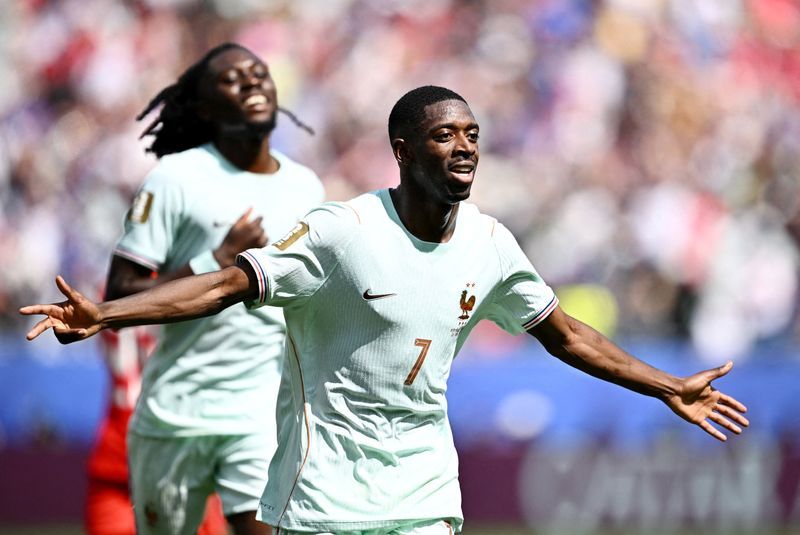
Ousmane Dembele's devastating first-half performance carried France to a 4-1 victory over a reserve-laden Norway side in Foxborough on Friday, confirming the 2018 world champions' progression to the knockout stages as Group I winners. The Paris Saint-Germain winger's three-goal blitz in just 25 minutes of action proved the defining moment in a match where the French clearly held the upper hand from start to finish. The emphatic win offers Les Bleus momentum heading into the decisive tournament phase, while their topping of the group secures a more favourable fixture schedule across the sprawling North American venue rotation.
France's commanding display carried particular significance given the circumstances surrounding their squad. The players had collectively pledged to pursue victory as a tribute to coach Didier Deschamps, who departed the United States during the tournament to attend his mother's funeral. Despite their qualification being mathematically confirmed before kickoff—Norway had also already secured a last-32 berth—the French side demonstrated complete professionalism and attacking intent from the opening whistle, suggesting the tribute motivation proved genuine rather than mere formality.
Norway's depleted lineup, assembled through Stale Solbakken's rest-rotation strategy, provided little resistance to France's attacking onslaught. The Scandinavian coach had elected to bench nearly all regular starters, conspicuously excluding prolific Manchester City striker Erling Haaland and captain Martin Odegaard following their midweek fixture against Senegal. This calculated approach prioritised squad recovery over competitive intensity in a match where their Round of 32 progression had already been secured.
France's attacking intent materialised almost immediately when Kylian Mbappe saw his angled effort cannon off the bar within 20 seconds, signalling the hosts' aggressive intent. Mbappe, emerging as a realistic challenger for the Golden Boot award alongside Haaland, created the opening goal minutes later with a precision cross-field pass that sent Dembele clear. The winger's composure in cutting inside his marker before striking past goalkeeper Egil Selvik illustrated the clinical finishing France would showcase throughout the encounter.
Dembele's second goal arrived with similar efficiency in the 20th minute, again courtesy of Mbappe's creative instigation, as the attacker manufactured space before dispatching a dipping drive beyond Selvik. The rapidity of France's dominance appeared almost demoralising for their opponents, yet Norway briefly threatened to complicate matters when Thelo Aasgaard reduced the deficit immediately. The goal proved merely a temporary reprieve as Dembele completed his remarkable treble in the 32nd minute, curling an immaculate low finish into the bottom corner to become only the third French player ever to achieve a World Cup hat-trick after Just Fontaine and Mbappe.
Dembele's achievement carries historical weight beyond national pride. His three-goal contribution ranks as the second-fastest hat-trick in World Cup history, bettered only by Austria's Erich Probst who registered three goals against Czechoslovakia after 24 minutes in the 1954 tournament. The speed with which Dembele operated—completing his treble inside 32 minutes—underscores the exceptional calibre of his performance against an admittedly weakened defensive unit.
Norway sought to inject greater urgency following the interval, creating occasional openings that exposed gaps in France's backline. However, their momentum proved insufficient to seriously trouble their opponents. Jorgen Strand Larsen's critical opportunity from the penalty spot fell victim to Mike Maignan's sharp goalkeeping, while Oscar Bobb's subsequent effort similarly proved inadequate to narrow the deficit. These moments highlighted Norway's limited attacking threat despite their improved second-half application.
France's victory margin ultimately extended to four goals when substitute Bradley Barcola delivered a cross that Desire Doue finished with a header in the final moments, adding gloss to an already emphatic scoreline. The consecutive goalscoring contributions from different attacking units—Dembele, Doue, and the creative influence of Mbappe—suggest French coaching staff will head into knockout fixtures confident in their attacking depth and finishing capacity across multiple forward positions.
The group-stage conclusion carries tangible consequences for Round of 32 matchups. France's first-place finish sets up a rematch against Sweden, the group runner-up from another qualifying bracket. Conversely, Norway's second-place position in Group I dictates their knockout opponent will be Ivory Coast, a fixture presenting a notably different tactical challenge. For Southeast Asian football audiences monitoring the tournament, France's comprehensive display and offensive versatility serves as a reminder that defending runners-up remain among the competition's most genuinely threatening propositions as the tournament approaches its climactic knockout stages.

