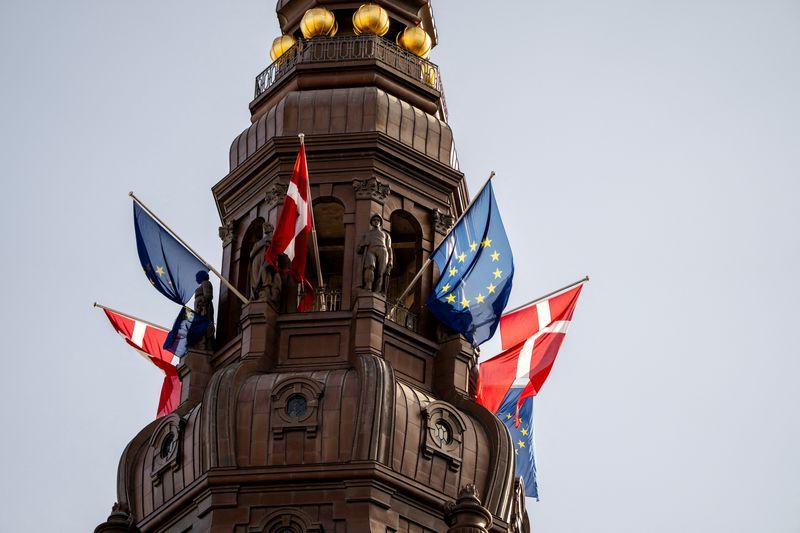
Denmark's government has stepped into a significant legal battle at the European Court of Justice, filing a written intervention to support Belgium's position in a case that pits major technology platforms against national media protections. The Danish Culture Ministry announced the move on Monday, emphasising that the outcome carries substantial implications for Danish newspaper publishers and the broader European media landscape. The intervention signals how contentious the issue of digital content compensation has become across the European Union, with smaller member states increasingly willing to defend their media sectors against the commercial interests of technology giants.
The case, known as the Streamz case, was brought to the court in 2023 by a coalition of technology companies including Google, Meta, Spotify, Sony, and Streamz. These corporations argue that Belgium's implementation of Article 15 of the Digital Single Market Directive conflicts with existing EU legal frameworks. Article 15 is part of a broader European directive designed to give news publishers explicit rights to compensation when their content appears on digital platforms and generates revenue. The tech companies contend that Belgium's application of this provision goes beyond what EU law permits, potentially creating an unsustainable regulatory burden on their business operations across the continent.
Denmark's decision to participate in the oral hearings scheduled for July 6 and 7 represents an active rather than passive approach to the case. The Danish government will be represented by a procedural delegation coordinated by the Culture Ministry, demonstrating that this is not a symbolic gesture but a serious engagement with the court. By intervening on Belgium's behalf, Denmark essentially argues that the protections Belgium has established for its publishers should remain intact, and that the European Court of Justice should use this case to clarify and strengthen, rather than weaken, the rights of news organisations across the EU.
The Danish position rests on a clear principle: technology platforms that profit from publisher content should compensate those publishers for that content. This argument resonates particularly in a Nordic context, where strong media traditions and public discourse are viewed as essential to democratic functioning. Danish Culture Minister Zenia Stampe made this connection explicit, stating that allowing tech giants to use media content without payment ultimately harms Danish media and damages democracy itself. This framing elevates the dispute beyond a commercial or regulatory disagreement into a matter of democratic principle, suggesting that media independence and sustainability are foundational to a functioning democratic society.
Denmark will urge the European Court of Justice to provide clear guidance on two interconnected issues during the oral hearings. First, the court should define with precision what rights publishers possess under the Digital Single Market Directive. Second, the court should establish unambiguous rules regarding the financial obligations that technology companies incur when publisher content appears on their platforms. Without such clarity, individual member states have struggled to implement Article 15 effectively, leading to fragmented approaches across Europe and creating legal uncertainty for both publishers and platforms. A definitive ruling from the court would provide the consistency the EU market requires.
The potential consequences of a ruling in favour of the technology companies concern Danish policymakers considerably. If Google, Meta, Spotify, Streamz, and Sony succeed in overturning or significantly narrowing Belgium's protections, the precedent could embolden challenges to similar measures in other European countries. Such an outcome might effectively dilute the protections that Article 15 was intended to provide, leaving news publishers with weaker negotiating positions when dealing with dominant platforms. For smaller media markets like Denmark's, where newspaper publishing has already faced significant economic pressures from digital disruption, such a development could accelerate the decline of quality journalism and reduce the diversity of news sources available to citizens.
Denmark's intervention also reflects a broader European strategy to defend media pluralism in the digital age. The Nordic countries have consistently advocated for stronger protections of cultural and media interests in EU policymaking, viewing these sectors as essential infrastructure rather than merely commercial activities. By intervening in the Streamz case, Denmark joins a coalition of member states determined to establish that technology platforms cannot operate as neutral distribution mechanisms but rather bear responsibility for the content they amplify and monetise. This principle, if accepted by the court, would represent a significant shift in how European law conceptualises the relationships between technology companies and content creators.
Beyond the Streamz case, Denmark has already demonstrated its commitment to these issues by participating in another landmark copyright lawsuit involving Google's use of press releases to train artificial intelligence systems. This parallel case addresses a related but distinct concern: whether technology companies can use journalistic and published content without permission or compensation to develop and improve their artificial intelligence models. Denmark's involvement in both cases shows a coordinated effort to establish clear rules governing how technology companies interact with and benefit from professional content creation, particularly journalism. The outcomes of these cases will likely influence how artificial intelligence development and deployment are regulated across Europe, with potentially global implications.
The economic stakes for Danish publishers are substantial. The newspaper industry has contracted significantly over the past two decades as digital platforms have captured an increasing share of advertising revenue that once sustained newsrooms. Publishers argue that they provide the original reporting and investigation that platforms merely distribute, yet technology companies capture the majority of the economic value generated by that content. Article 15 represents an attempt to rebalance this relationship by creating a legal basis for direct compensation. For Denmark, a country with strong traditions of press freedom and a vibrant media sector, ensuring that Article 15 provides meaningful protections could help sustain the journalistic capacity that underpins public discourse and democratic accountability.
The timing of Denmark's intervention also reflects growing political momentum in Europe for stronger regulation of technology companies. The European Union has increasingly scrutinised the market power and societal impact of major platforms through mechanisms like the Digital Markets Act and the Digital Services Act. Within this broader regulatory context, the question of publisher compensation takes on added significance as part of a wider rebalancing of power between large technology platforms and other actors in the digital economy. Denmark's support for Belgium can be understood as part of this larger project of establishing clearer rules and greater accountability for how technology companies operate in European markets.

