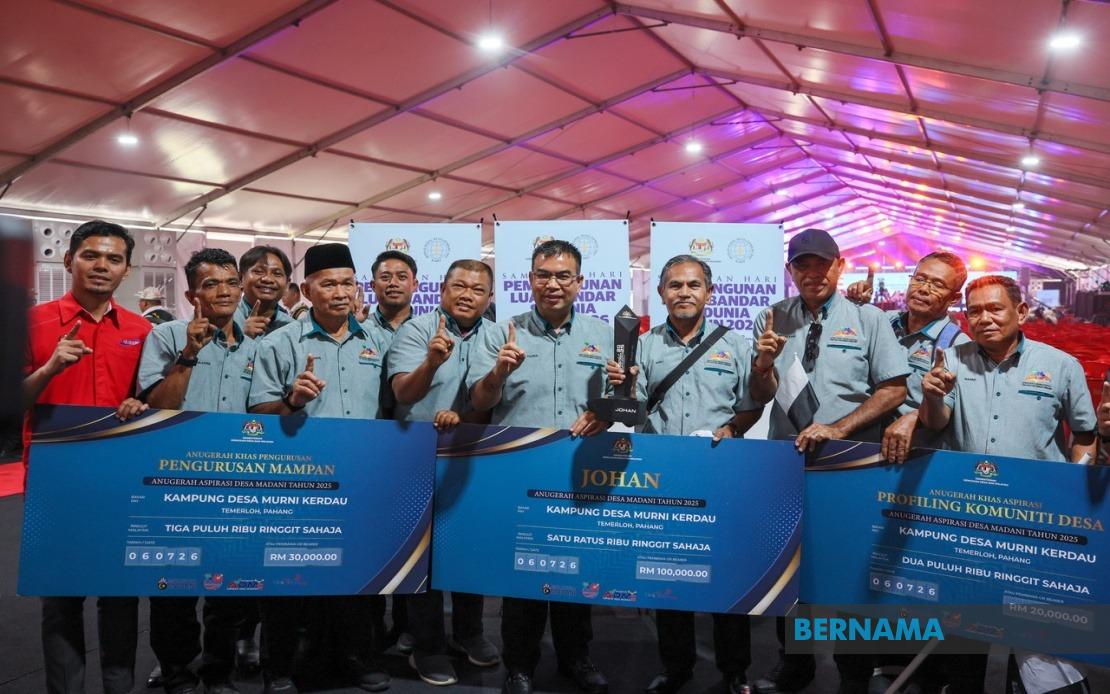
Desa Murni Kerdau, a carefully managed village settlement in Temerloh within Pahang state, has secured three significant accolades at the World Rural Development Day 2026 celebration held at Tun Abdul Razak Stadium in Jengka Sentral. The village's triple award haul underscores the growing recognition of exemplary rural administration and grassroots development work across Malaysia's countryside regions.
The most prestigious of the three honours bestowed upon the community was the 2025 MADANI Rural Aspiration Award Champion designation, conferred during a formal ceremony attended by Deputy Prime Minister Datuk Seri Dr Ahmad Zahid Hamidi. Running alongside this major accolade were two additional special awards recognising the village's achievements in rural community profiling and sustainable environmental management practices. Deputy Minister of Rural and Regional Development Datuk Rubiah Wang delivered these complementary recognitions, reflecting the government's broader commitment to acknowledging rural excellence across multiple dimensions.
The awards carry particular significance at a time when Malaysia's development strategy increasingly emphasises balanced growth between urban and rural areas. By honouring villages that demonstrate sophisticated governance structures and sustainable practices, the government sends a clear message about the importance of strengthening rural Malaysia through institutional excellence rather than capital-intensive projects alone. The recognition of Desa Murni Kerdau suggests that rural development success depends on effective local leadership and community engagement.
Mohamad Fazrul Ahmad, who chairs the Village Development and Security Committee for Desa Murni Kerdau, attributed the village's success to its integrated approach to governance and community welfare. Speaking after the award presentation, he emphasised that the recognition validated the village's commitment to institutional quality and inclusive decision-making processes. His remarks highlighted how contemporary rural development extends beyond infrastructure improvements to encompass the softer dimensions of community leadership and transparency.
The economic profile of Desa Murni Kerdau reveals a community that has deliberately diversified its income sources beyond traditional agriculture. The village has successfully incubated approximately twenty entrepreneurs operating across distinct economic sectors, including small and medium-sized enterprises, farming operations, and the automotive industry. This entrepreneurial ecosystem suggests that the village's development strategy has deliberately promoted business creation and skills transfer among residents, moving beyond subsistence activities to create wealth-generating opportunities.
Tourism has emerged as an unexpected economic pillar for the community through its "Kampung Stay" initiative, which packages the village's traditional character and rural setting as an authentic tourism experience. This product has achieved notable recognition within Malaysia's domestic tourism market, attracting visitors seeking alternatives to conventional holiday destinations. The venture demonstrates how rural communities can monetise their distinctive cultural and environmental assets while maintaining community cohesion and traditional practices.
Physically, Desa Murni Kerdau comprises approximately two hundred residential structures housing over six hundred inhabitants, positioning it as a medium-sized village with sufficient critical mass for meaningful infrastructure investment yet intimate enough to maintain collective identity. The community's manageable scale likely facilitates the coordination required for participatory decision-making and the implementation of village-wide improvement initiatives. This balance between size and organisational coherence may partly explain the village's capacity to achieve coordinated development outcomes.
The financial rewards accompanying the awards will be channelled back into resident welfare and community development projects, according to Mohamad Fazrul Ahmad. This allocation approach reinforces the principle that award recognition serves not merely symbolic purposes but generates tangible resources for ongoing community enhancement. By distributing benefits among residents rather than concentrating them in administrative structures, the village's leadership demonstrates commitment to inclusive prosperity.
For broader Malaysian policy perspectives, Desa Murni Kerdau exemplifies the model of rural development increasingly promoted by the Ministry of Rural and Regional Development. Rather than imposing standardised development templates across diverse rural communities, the recognition of villages achieving excellence within their own contexts encourages locally-adapted solutions reflecting specific environmental, economic, and social circumstances. This approach respects rural communities' agency in shaping their development trajectories.
The World Rural Development Day celebration itself represents a deliberate institutional effort to spotlight rural achievement and counterbalance narratives emphasising rural decline and urban migration. By convening national-level recognition ceremonies and presenting awards through senior government officials, Malaysia's development establishment signals that rural vitality remains a strategic priority. Such ceremonial recognition can catalyse reputational gains that facilitate rural communities' access to investment, tourism, and talent.
Desa Murni Kerdau's experience offers potential lessons for other Malaysian villages seeking to strengthen local governance and diversify economic bases. The combination of institutional discipline, entrepreneurial promotion, and strategic tourism development provides a replicable model. However, success factors including effective local leadership, community cohesion, and responsive administration cannot be easily transplanted across contexts, suggesting that villages must develop contextually-appropriate development strategies rather than adopting wholesale external blueprints.
Looking forward, the village's triple award recognition establishes a performance benchmark within its state and region. Maintaining momentum will require sustained attention to the governance excellence and sustainable practices that earned recognition, alongside continued innovation in economic diversification and community welfare. The awards validate past efforts while placing expectations on the community to demonstrate that recognition reflects enduring commitment to development rather than temporary achievement.

