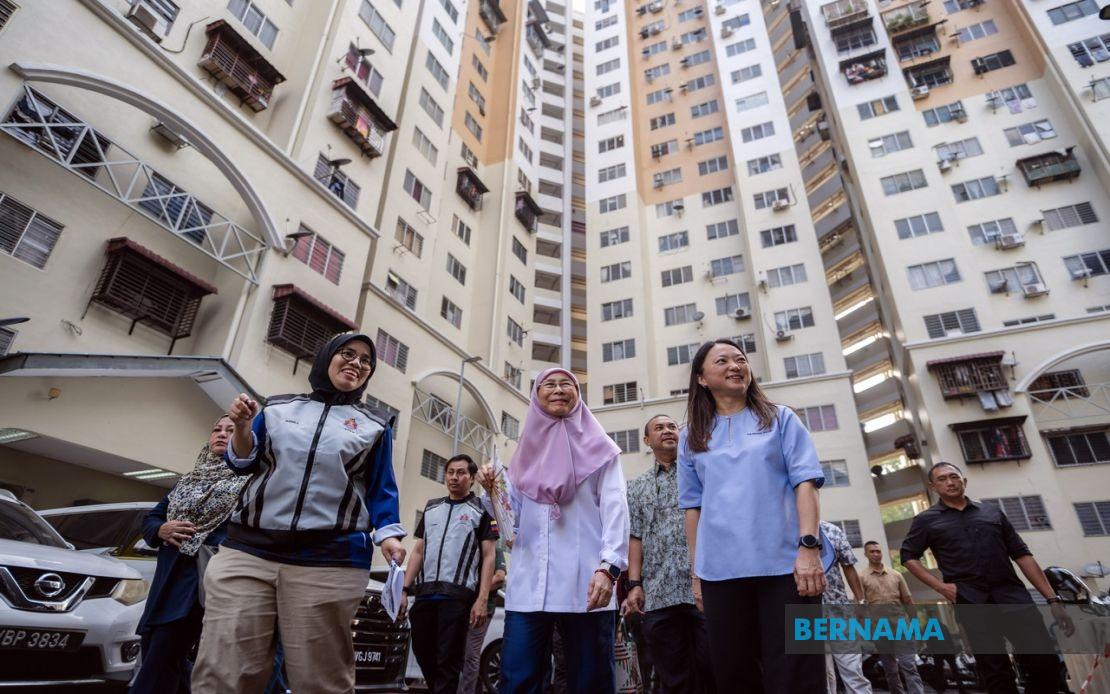
The federal government has marked another milestone in its systematic overhaul of Kuala Lumpur's ageing public housing stock, with the completion of upgrading works at the Desa Tun Razak People's Housing Project (PPR). The RM9.6 million intervention represents a tangible step towards rehabilitating deteriorating residential facilities that have served lower-income residents for decades. With 22 projects now finished out of 61 slated improvements across the capital, the initiative demonstrates a commitment to moving beyond the reactive, piecemeal maintenance approach that has historically plagued public housing estates throughout Malaysia.
Minister in the Prime Minister's Department (Federal Territories) Hannah Yeoh underscored the philosophical shift behind the government's approach during an inspection of the completed works. Rather than responding to crises as they emerge, the RM300 million allocation approved for this financial year represents a deliberate pivot towards planned, comprehensive asset management. This distinction matters significantly for residents and policymakers alike. A strategic maintenance programme protects both the physical integrity of structures and, more importantly, the safety of approximately 8,000 people who inhabit the Desa Tun Razak complex, which first welcomed residents in 1998.
Yeoh emphasised that securing broad political consensus among all Kuala Lumpur Members of Parliament was essential to establishing this dedicated funding stream. In Malaysia's often fractious political environment, achieving unanimous agreement on resource allocation across constituencies reflects genuine recognition of the urgency surrounding public housing deterioration. The existence of a special maintenance fund removes the temptation to allow deferred maintenance to accumulate—a pattern that eventually transforms minor repairs into costly reconstruction efforts or, worse, safety hazards for vulnerable residents.
The scope of work completed at the Desa Tun Razak estate illustrates why systematic upgrading has become necessary across Kuala Lumpur's PPR network. Electrical wiring replacement, road resurfacing, and enhanced fire safety systems formed the core of the intervention. These are not cosmetic improvements; they address fundamental infrastructure that directly impacts habitability and security. The fire safety enhancements carry particular weight, given that the estate experienced multiple fire incidents during the previous year. Such incidents in densely populated public housing carry catastrophic potential, making preventive investment a moral imperative as much as a practical necessity.
Kuala Lumpur Mayor Datuk Fadhlun Mak Ujud provided granular details on how the RM9.6 million was deployed. Repainting work claimed the largest share at RM7 million—a figure that may surprise readers unfamiliar with the scale of such undertakings. When applied across an entire residential complex housing thousands of units, coupled with proper surface preparation and weather-resistant finishes, repainting alone constitutes substantial work. Fire prevention systems and electrical upgrades consumed RM1.68 million, while road resurfacing required nearly RM1 million. Additional upgrades to fire riser and drainage systems, though not individually quantified, suggest that contractors addressed systemic deficiencies throughout the complex.
The pace of project completion offers cautious optimism for the broader programme. With 22 of 61 projects completed and the mayoralty expressing confidence that all RM300 million-funded upgrades will conclude by year's end, Kuala Lumpur appears positioned to achieve meaningful progress. However, the mathematics warrant scrutiny: if 22 projects are complete from a RM300 million allocation and each averages roughly RM9.6 million, the remaining 39 projects would consume approximately RM375 million—suggesting either that the original estimate accommodates higher costs for larger complexes or that some variation in project scope and expense exists across the estate network.
Parking shortages at the Desa Tun Razak PPR represent a secondary but significant concern that the upgrade programme did not directly address. Fadhlun acknowledged this constraint and indicated that Kuala Lumpur City Hall would identify vacant land for temporary parking provision. This acknowledgment reflects the reality that physical infrastructure challenges often extend beyond structural and safety repairs. For residents of public housing, inadequate parking creates daily friction, reduces quality of life, and can drive housing abandonment even when other conditions improve. That the municipal government recognises this problem suggests future phases of the PPR programme may incorporate parking solutions.
Bandar Tun Razak Member of Parliament Datuk Seri Dr Wan Azizah Wan Ismail used the opportunity to appeal for resident stewardship of upgraded facilities. Her remarks touch on a fundamental challenge facing public housing programmes throughout Southeast Asia: the gap between government investment and community maintenance culture. When residents feel that public spaces belong to someone else—a bureaucracy distant from their daily lives—degradation accelerates rapidly. Conversely, when communities develop ownership mentality, facilities remain serviceable far longer. Fostering this cultural shift requires sustained effort, including resident education, accessible complaint mechanisms, and visible responsiveness to maintenance issues.
The Desa Tun Razak completion carries broader implications for public housing policy across Malaysia and the region. Kuala Lumpur's PPR network serves as a test case for whether systematic, adequately funded upgrading can halt decline in ageing residential complexes. The answer carries particular relevance for other Malaysian cities where similar estates—often built during rapid urbanisation decades ago—face mounting maintenance backlogs. Economic pressures frequently force governments to defer such spending, yet deferred maintenance invariably costs more later. By approving RM300 million and committing to completion within a single fiscal year, the federal government has prioritised public housing improvement in a way that previous administrations did not.
The investment also signals to lower-income households that government acknowledges its responsibilities toward affordable housing residents. In an era of rising urban inequality, such signals matter psychologically and politically. Public housing residents represent a constituency often overlooked in policy debates dominated by middle-class concerns. That a federal minister conducted a public inspection, that the mayor provided detailed financial breakdowns, and that multiple lawmakers participated suggests that PPR upgrading has ascended on the political priority list. Sustaining this attention beyond the current fiscal year will determine whether 2024's RM300 million programme represents the beginning of a transformation or merely a temporary political gesture.
Looking forward, the completion of the Desa Tun Razak project should prompt policymakers to examine lessons learned that might inform similar initiatives elsewhere. How effectively have contractors executed work? Have completion timelines held? Have residents' feedback mechanisms ensured their concerns shape implementation? Transparent documentation of these outcomes would benefit other Malaysian cities managing comparable housing stock. The RM300 million allocation for Kuala Lumpur's 61 projects establishes a cost benchmark—approximately RM4.9 million per estate on average—that could inform budgeting for PPR improvements in Penang, Selangor, and other urban centres where public housing serves as a crucial anchor for lower-income families.

