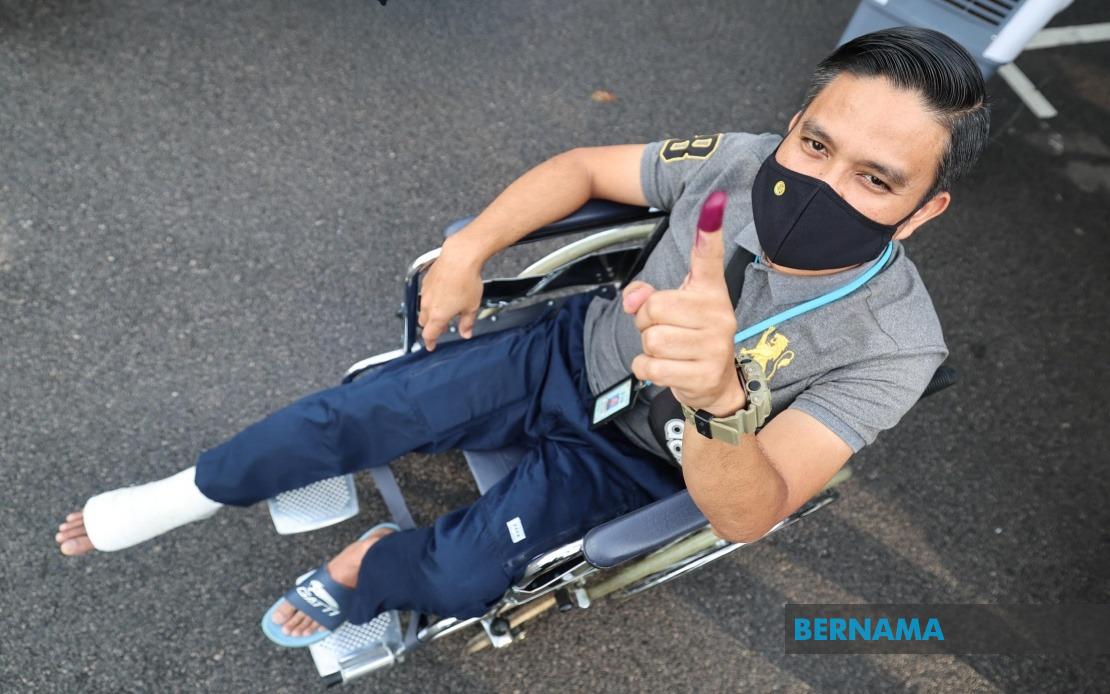
An Achilles tendon injury that confined him to a wheelchair proved no barrier for Sergeant Syahrizal Musa, 40, who travelled to the early voting centre at Johor Police Contingent Headquarters on July 7 to cast his ballot in the 16th Johor state election. The injury, sustained while playing sepak takraw the previous week, had left him on medical leave until mid-July, yet the police officer from the Internal Security and Public Order Department remained resolute in fulfilling his electoral duty.
Syahrizal's determination to vote despite his incapacity underscores a broader narrative about civic engagement among Malaysia's security forces during state elections. The sergeant, who hails originally from Seri Iskandar in Perak but has been stationed in Johor for the past nine years, explained that his physical condition was irrelevant to his commitment as a citizen. He travelled from the police quarters in Tampoi with assistance from a colleague, a journey that would have been considerably more challenging given his reliance on mobility support.
In an interview at the polling centre, Syahrizal reflected on his extensive record as a voter, emphasising that his more than two decades of service with the Royal Malaysia Police had never seen him abstain from an election. The distinction he drew—between the discomfort of voting while wheelchair-bound and the importance of participation—illustrates how frontline personnel often frame their electoral involvement as an obligation tied to their professional ethos. For security force members, voting carries symbolic weight beyond the individual act; it represents a personal stake in the governance structures they serve to uphold.
Medical assessments had revealed that Syahrizal sustained only a minor tear to his Achilles tendon, injuries common among active athletes in traditional Malaysian sports. His background as a competitive sepak takraw player—a discipline at which he had represented his police contingent in multiple tournaments—speaks to a lifelong engagement with physical activity. The injury that would sideline him temporarily proved insufficient to deter his electoral participation, a choice that reflects values of resilience often embedded in law enforcement culture.
The early voting arrangement that enabled Syahrizal's participation formed part of a broader institutional accommodation for security personnel in Johor's state election. A total of sixty-four dedicated polling centres opened specifically for early voters, facilitating participation among 12,041 Malaysian Armed Forces personnel and their spouses alongside 12,710 Royal Malaysia Police officers and General Operations Force members with their families. This infrastructure recognises that security sector staff, particularly military and police personnel, often face operational commitments that clash with standard polling day schedules.
The 16th Johor state election represented a significant electoral exercise, with 172 candidates competing across 56 seats and approximately 2.7 million ordinary voters scheduled to participate on polling day that Saturday. Early voting provisions thus served as a crucial mechanism to ensure that security forces—whose members might be deployed or working during standard voting hours—could exercise their franchise without compromising operational readiness. Syahrizal's participation exemplified how these institutional arrangements translate into tangible democratic participation for groups whose employment circumstances might otherwise create barriers to voting.
His public decision to vote despite discomfort carried implications beyond his individual choice. When security personnel visibly prioritise electoral participation, even under challenging circumstances, the message resonates within institutional cultures that emphasise duty and responsibility. For police colleagues, witnessing a sergeant overcome physical limitations to vote could reinforce narratives about the importance of democratic engagement, particularly within organizations whose members might otherwise view politics as tangential to their professional obligations.
The timing of Syahrizal's injury—emerging from recreational activity during off-duty hours—also illuminates how Malaysia's security forces maintain connections to community life beyond their formal roles. Sepak takraw, as a sport deeply embedded in Malaysian cultural heritage, represents a space where police and military personnel engage as ordinary citizens and athletes. Yet even within this recreational context, institutional identity persists; Syahrizal's representation of his police contingent in tournaments suggests how professional roles extend into social and sporting domains.
Syahrizal's exhortation to fellow Malaysians to exercise their voting rights carried particular resonance within the context of security sector engagement. When a police officer frames electoral participation as fundamental to determining both state and national futures, the statement carries weight derived from professional standing. His two-decade track record of voting in every election establishes him as embodying institutional virtues around civic responsibility, making his advocacy for turnout something other than generic encouragement.
The provision of accessible early voting infrastructure—enabling participation for those unable to attend standard polling—reflects Malaysia's gradual evolution toward more inclusive electoral arrangements. While the system in Johor primarily served security personnel's operational needs, Syahrizal's experience demonstrates how such provisions can accommodate individuals facing temporary physical limitations. Whether other voting centres across Johor extended comparable accessibility features for civilians with mobility restrictions remained unclear, though the sergeant's experience suggests room for broader consideration of how electoral access might serve diverse populations.
As Johor's electorate prepared for standard polling day that Saturday, Syahrizal's early vote represented one data point within larger patterns of security sector participation. Whether elevated turnout among military and police personnel translated into measurable electoral outcomes remained an open question; individual voting choices among security forces personnel were constitutionally protected from disclosure. Yet the visible commitment of officers like Syahrizal to participate—overcoming genuine physical obstacles to do so—reinforced public associations between state institutions and democratic engagement, however those individual votes might ultimately be cast.

