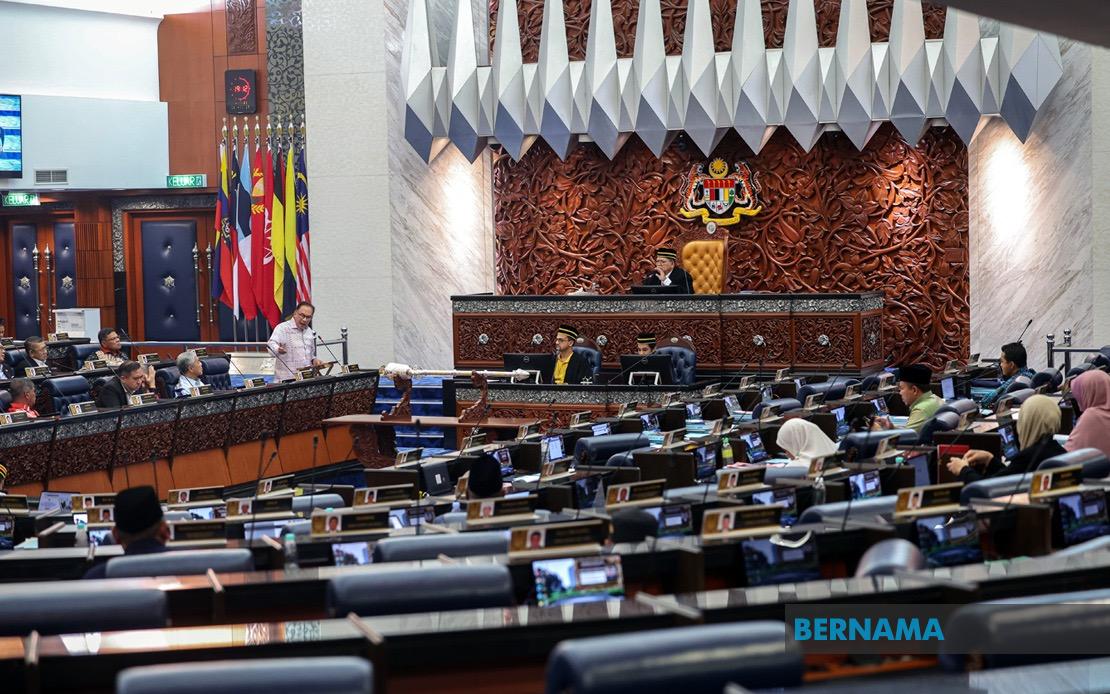
Parliament's lower house passed a crucial financing motion on July 15, clearing the way for RM14.5 billion in outstanding proceeds from Malaysian Government Investment Issues to flow into the Development Fund. The voice vote, which proceeded after remarks from both Datuk Seri Ismail Abd Muttalib and Datuk Zulkafperi Hanapi, represents a significant step in managing the government's development spending agenda as the nation navigates budget pressures expected throughout the remainder of 2026.
The transfer mechanism underscores a foundational principle of Malaysia's fiscal architecture: government borrowing must be earmarked exclusively for developmental infrastructure and capital projects, while operating expenses rely solely on tax revenue and other recurring income sources. Deputy Finance Minister Liew Chin Tong articulated this constraint during parliamentary proceedings, emphasising that the Development Fund itself draws resources from multiple channels including transfers from the Consolidated Revenue Account, loan repayments, and receipts tied to development activities. This layered funding approach reflects efforts to maintain fiscal discipline while accommodating the substantial capital requirements of the country's development pipeline.
The RM14.5 billion figure emerges from a broader MGII issuance programme totalling an estimated RM95 billion across the first five months of 2026. Within this larger borrowing envelope, authorities allocated RM55 billion specifically to refinance existing MGII instruments approaching maturity, essentially rolling over debt rather than accumulating new net borrowing. A separate RM2 billion portion addresses the scheduled redemption of Malaysian Islamic Treasury Bills, short-term shariah-compliant instruments that form part of the government's Islamic financing toolkit. The remaining RM38 billion directly finances the fiscal deficit anticipated across the calendar year, demonstrating how Malaysia's 2026 budget construction balances multiple competing financial obligations.
The pathway to the RM14.5 billion net transfer illustrates the mechanics of government debt management in practice. Between January and May, authorities issued RM40 billion in new MGII instruments. After accounting for RM25.5 billion devoted to refinancing maturing obligations, the net proceeds available for development purposes totalled RM14.5 billion. Deputy Finance Minister Liew indicated that additional tranches covering June through December issuances would require parliamentary approval at a subsequent sitting, suggesting a sequenced approach to maintaining legislative oversight of large capital allocations.
During questioning, concerns emerged regarding potential "crowding out" effects within Malaysia's domestic financial markets. This technical concern reflects a real phenomenon whereby large government debt issuances can absorb savings that might otherwise flow into private-sector investment, potentially constraining credit availability and raising borrowing costs for businesses. Specifically, lawmakers highlighted the purchasing patterns of major institutional investors including the Employees Provident Fund and the Retirement Fund Incorporated, which collectively represent trillions of ringgit in managed assets and serve as natural anchors for government securities markets. These entities must continuously deploy capital to generate returns for their beneficiaries, making government debt securities an attractive and relatively safe investment vehicle.
Liew's response reframed the crowding-out concern within a broader context of Malaysia's borrowing trajectory. He asserted that the government has progressively reduced annual new borrowing volumes over recent years, suggesting that the current MGII programme reflects restraint rather than reckless fiscal expansion. Moreover, he argued that the availability of investment opportunities in domestic government securities strengthens rather than weakens Malaysia's financial position. Without such instruments, foreign and domestic investors seeking safe-haven assets might direct capital elsewhere, potentially weakening demand for ringgit-denominated investments and creating currency headwinds that could prove far more costly than modest debt issuances.
This argument carries particular weight for Malaysia and other Southeast Asian economies competing for regional investment flows. As geopolitical tensions and global monetary volatility persist, countries that maintain transparent, liquid debt markets with consistent investment opportunities hold advantages in stabilising their currencies and attracting patient capital. The government securities market functions not merely as a financing mechanism but as an anchor for broader financial stability, allowing institutional investors to match asset duration against their liability structures while earning predictable returns.
The MGII programme itself represents Malaysia's evolution in debt management sophistication. Unlike conventional Malaysian Government Securities, MGII instruments serve as a complementary issuance vehicle that provides flexibility in maturity structuring and investor targeting. By issuing multiple tranches across the year with varying tenors and characteristics, the government can smooth funding flows, manage refinancing risk, and provide diverse investment opportunities. The existence of both MGS and MGII channels also allows for tactical adjustments based on prevailing market conditions, interest rate expectations, and investor appetite profiles.
Parliamentary oversight of these transfers carries symbolic and practical significance. By requiring legislative approval for large fund movements, Malaysia maintains checks on executive financial discretion and ensures that major borrowing and allocation decisions receive public scrutiny. The debates between government and opposition members, particularly discussions around crowding out and fiscal sustainability, reflect legitimate policy tensions that democracies must navigate when balancing development ambitions against prudent financial management.
The immediate development implications of this RM14.5 billion transfer remain substantial. Malaysia continues pursuing significant infrastructure projects across transport, utilities, telecommunications, and urban development sectors. Proceeds flowing through the Development Fund will underpin capital spending across federal and state initiatives, supporting employment generation and productivity-enhancing investments. The question of whether such spending translates into genuine economic returns depends heavily on project selection, execution quality, and strategic alignment with long-term productivity growth.
Looking ahead, Liew's indication that June-to-December MGII proceeds would require separate parliamentary approval suggests a deliberate pacing of debt authorisation aligned with actual funding needs and market conditions. This sequenced approach allows flexibility should economic circumstances change, interest rate environments shift, or investment priorities require recalibration. It also maintains periodic parliamentary engagement with fiscal matters, ensuring that borrowing programmes remain subject to democratic oversight rather than operating on autopilot.
For Malaysian investors and economic observers, this parliamentary decision confirms government commitment to continued development spending despite fiscal constraints. The approval signals that Malaysia intends to pursue infrastructure and capital investment rather than contracting expenditure, even as deficit financing remains elevated by historical standards. Whether this proves optimal policy depends on realised returns from development projects and broader economic performance throughout 2026 and beyond.

