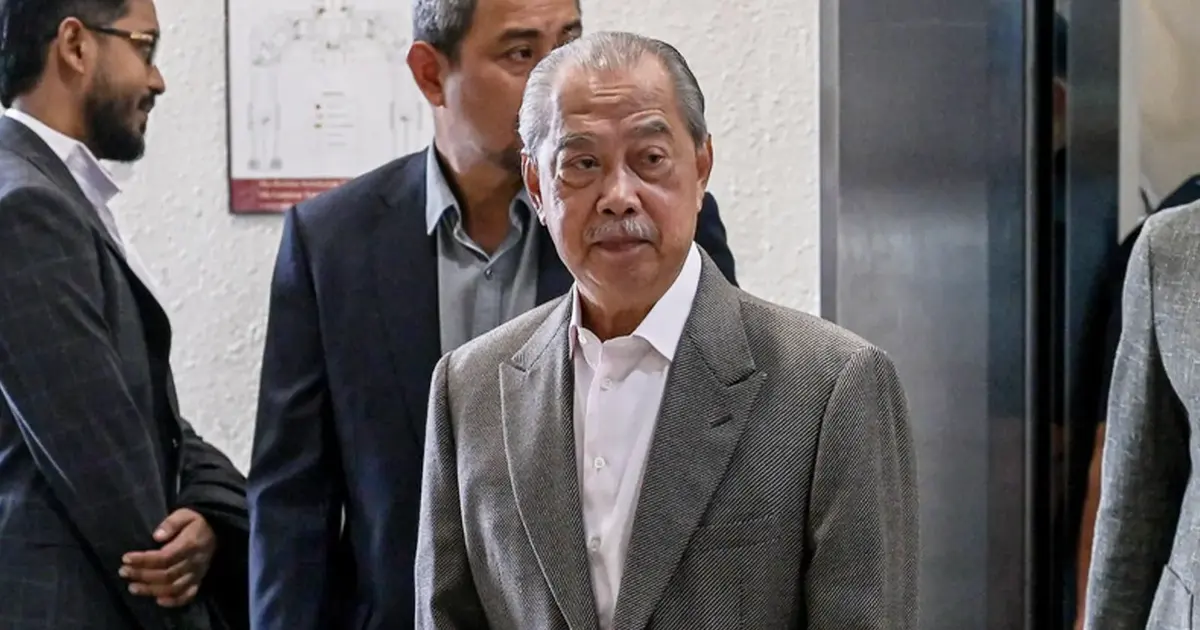
Questions about the true extent of Tan Sri Muhyiddin Yassin's authority within Bersatu intensified during High Court proceedings as the defence team probed whether Malaysia's former prime minister functioned as little more than a figurehead who simply rubber-stamped party decisions rather than wielding meaningful control.
The inquiry centred on testimony from Zulhelmi Zaulkafly, Bersatu's financial officer, who appeared before the court to address the party's operational structure and governance framework. His evidence proved pivotal in establishing how the Bumiputera Advancement Party managed its monetary affairs and delegated responsibilities among senior leadership. The defence counsel, particularly the Deputy Public Prosecutor's office, sought to establish whether financial matters and broader party decisions rested in a single person's hands or were distributed among multiple office-holders with defined authority.
Zulhelmi's statement that no individual possessed exclusive oversight of Bersatu's finances carries significant implications for understanding the internal hierarchy that shaped the party's trajectory over recent years. By testifying that decision-making authority was diffused across the organisation rather than concentrated in one person's office, the witness effectively complicated any narrative suggesting that Muhyiddin operated as an all-powerful party boss directing every transaction and policy choice unilaterally. This testimony suggests a more nuanced organisational reality where various functionaries held specific domains of responsibility.
For Malaysian observers tracking Bersatu's trajectory since its formation, the court's exploration of these structural details illuminates broader questions about party governance at a critical juncture in the nation's political development. Bersatu emerged as a significant political force that eventually played a central role in reshaping Malaysia's government formation and coalition-building dynamics. Understanding how it actually operated internally—whether through centralised authority or collaborative governance—matters for comprehending the decision-making processes behind major political moves that affected national governance.
The defence's line of questioning suggests they are building an argument that portrays Muhyiddin's role as constrained rather than expansive. By highlighting the distributed nature of financial controls, the defence may be laying groundwork to demonstrate that various organisational functions operated independently or under different individuals' purview. This approach could undermine any prosecution narrative that depends on depicting Muhyiddin as an omniscient autocrat who necessarily knew about or approved all party activities.
The timing of this testimony also resonates within Malaysia's broader political context. Bersatu has become central to contemporary political coalitions and remains influential in state and national-level politics. The internal structure and decision-making processes of such a consequential party thus merit serious scrutiny, particularly when legal proceedings examine its financial management and governance standards. Malaysian political parties have faced increasing public and institutional pressure to demonstrate transparency and accountability in their monetary affairs, making evidence about financial controls highly relevant to debates about political reform.
Zulhelmi's testimony also potentially illuminates tensions between formal position and actual influence within Bersatu. In many Malaysian political organisations, title and function do not always align neatly. Someone holding a particular office may exercise greater or lesser influence depending on informal networks, personal relationships with other leaders, and the particular political moment. The financial officer's evidence suggesting distributed rather than concentrated authority hints at such complexities within Bersatu's actual operating dynamics.
For Southeast Asian observers of Malaysian politics, the court proceedings offer a window into how political parties structure themselves and the mechanisms through which they make consequential decisions. The questions about Muhyiddin's authority within Bersatu reflect broader international interest in Malaysian political leadership and governance patterns. How political parties in the region balance centralised authority with distributed decision-making shapes their resilience, adaptability, and susceptibility to factional conflict.
The defence strategy of emphasising Bersatu's distributed financial controls also raises practical questions about accountability and responsibility within the party structure. If multiple individuals held authority over different aspects of finances and operations, determining who bears responsibility for any problematic decisions or transactions becomes considerably more complex. This distributed accountability framework could have significant consequences for how the court ultimately assesses any allegations against Muhyiddin specifically.
As the High Court case proceeds, testimony like Zulhelmi's contribution will accumulate into a detailed portrait of how Bersatu actually functioned as an organisation. These institutional details, while sometimes appearing technical and procedural, fundamentally shape how courts assess allegations and how public understanding of political leadership evolves. The distinction between being a party leader with formal authority versus exercising genuine substantive control over major decisions represents a crucial distinction that this trial is methodically establishing through witness accounts and documentary evidence.
The broader implication of questions surrounding Muhyiddin's real authority within Bersatu extends to how Malaysian society understands political leadership and institutional governance. If senior political figures exercise less control than their titles suggest, this fundamentally alters perceptions of responsibility, decision-making capacity, and leadership competence. As Malaysia continues its ongoing journey toward more accountable and transparent governance structures, court cases examining the inner workings of political parties provide essential public education about how power actually operates within these organisations.

