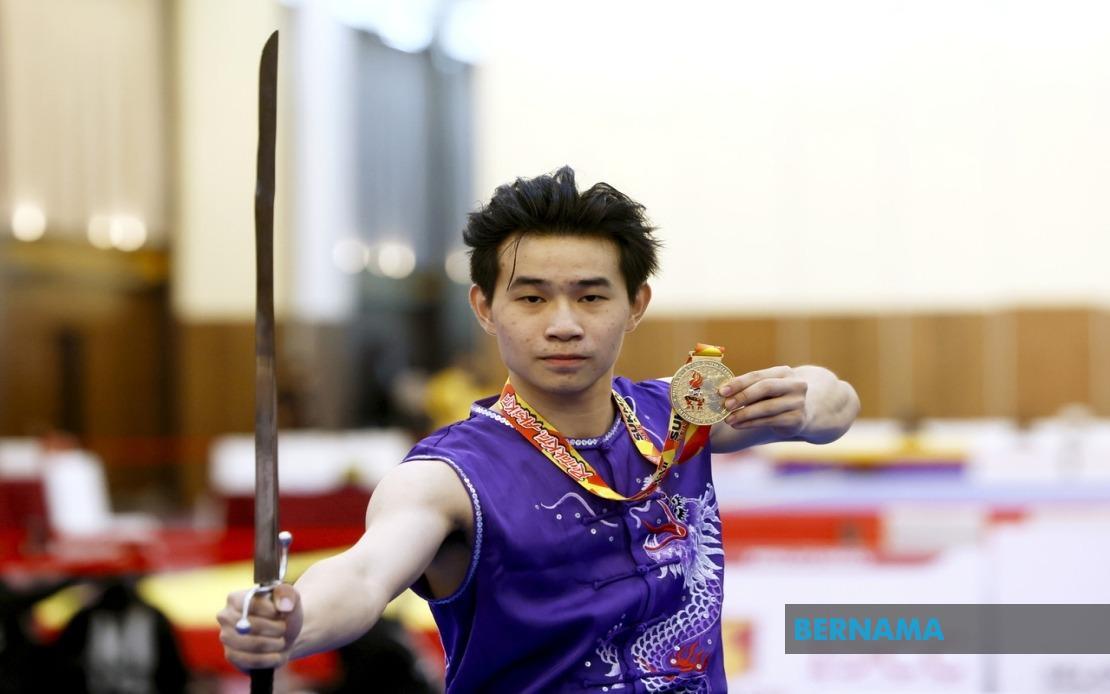
In a triumphant finale to his Malaysia Games career, Penang's Wee Din Jun overcame a significant physical setback to claim the men's nandao nangun gold medal at SUKMA 2026, delivering a redemptive performance that erased the disappointment of his previous two appearances at the quadrennial sporting extravaganza. Competing at the Ideal Convention Centre in Shah Alam on August 21, the 21-year-old Bayan Lepas-born athlete scored 9.600 points, narrowly surpassing Sarawak's John Phang, who garnered 9.563 points for silver, while Selangor's Tan Yu Zhe rounded out the podium with 9.550 points. What made the achievement particularly noteworthy was Din Jun's ability to perform at such a high level despite sustaining a hip injury roughly one month before the Games commenced, a complication that could have derailed his final SUKMA campaign entirely.
Din Jun's journey through the Malaysia Games has been marked by considerable ups and downs that tested his resilience and commitment to the wushu discipline. When he first stepped onto the SUKMA stage at the 2022 edition held in Kuala Lumpur, the younger version of himself managed to secure a bronze medal, establishing early promise within Malaysia's wushu community. However, his second appearance at SUKMA 2024 in Sarawak proved deeply deflating, as he competed across three events only to return home empty-handed after making critical errors during his performances. The weight of that failure plainly haunted the athlete, making yesterday's gold medal victory far more than simply another medal in his career tally.
In reflecting on his mental approach heading into this decisive competition, Din Jun credited his coaching staff with helping him navigate the psychological demands of redemption. He revealed that his coach had specifically advised him to embrace composure and actually savour the competitive experience rather than allowing anxiety or past failures to cloud his focus. This philosophical shift proved instrumental in his execution on the day, as he consciously worked to silence external pressures and concentrate exclusively on delivering technically proficient performances. The tactical emphasis on presence and enjoyment rather than outcomes—a counterintuitive approach that nonetheless aligns with contemporary sports psychology—appears to have unlocked his potential when it mattered most.
For Din Jun, the significance of capturing gold extended beyond the immediate sporting achievement. He had long harboured a personal ambition to demonstrate conclusively that he possessed the capabilities to win a SUKMA gold medal, a validation that had eluded him across two prior attempts. This particular victory became a public affirmation of his abilities and potential, dispelling any lingering doubts about whether his bronze from 2022 represented his ceiling at the Games. The medal thus carried substantial symbolic weight, marking a maturation in his athletic journey and cementing his place among Malaysia's elite wushu practitioners at the SUKMA level.
Beyond his personal gratification, Din Jun took the opportunity to honour a former coach who had invested significantly in his development. This previous mentor, now based in China, had not been present to witness Din Jun's bronze medal achievement in 2024 or celebrate with him following his disappointing showing at that edition. By dedicating his gold medal victory to this coach, Din Jun demonstrated the respect and gratitude that often define coach-athlete relationships, particularly in disciplines like wushu where technical mastery requires years of patient instruction and refinement. The gesture underscored how athlete development in Malaysia's wushu programmes relies heavily on dedicated coaching input, whether from domestic or international sources.
The competitive landscape for wushu at SUKMA 2026 reflects the sport's growth and decentralisation across Malaysia's states. The narrow margin separating the top three finishers—just 0.050 points between gold and silver—illustrates how tightly contested the nandao nangun event had become, with practitioners from Penang, Sarawak, and Selangor all operating at championship-calibre levels. This competitive depth suggests that wushu infrastructure and coaching quality have expanded beyond traditional powerhouse regions, creating a more balanced and dynamic competitive environment at the Games. For Malaysian wushu as a whole, such parity represents healthy development, though it also means athletes must maintain exceptional technical consistency to prevail at championship moments.
Looking ahead, Din Jun has already set his sights on extending his SUKMA farewell with another medal in the nanquan event scheduled for the following day. This remaining opportunity allows him to potentially depart the Games with multiple medals, adding further lustre to what has already become a memorable final SUKMA experience. The fact that he competes across multiple wushu disciplines demonstrates the breadth of technical expertise demanded within the sport, requiring athletes to master different weapon-based and open-hand forms. Successfully navigating both the nandao nangun and nanquan competitions at championship level speaks to the comprehensive training regimen that Din Jun has undertaken throughout his athletic career.
The timing of his triumph at SUKMA 2026 also carries broader significance for Malaysia's Olympic movement preparation, as the Games serve as a crucial development and evaluation platform for identifying athletes capable of eventually representing the nation at the Asian Games and potentially beyond. Wushu's prominent inclusion at SUKMA underscores its growing importance within Malaysia's sporting hierarchy, and performers like Din Jun who demonstrate both technical excellence and the mental fortitude to overcome adversity become valuable models for younger cohorts entering the sport. His injury comeback and competitive redemption embody the kinds of narratives that inspire future generations to pursue excellence within wushu despite its demanding technical requirements and the substantial time investment necessary to reach elite levels.

