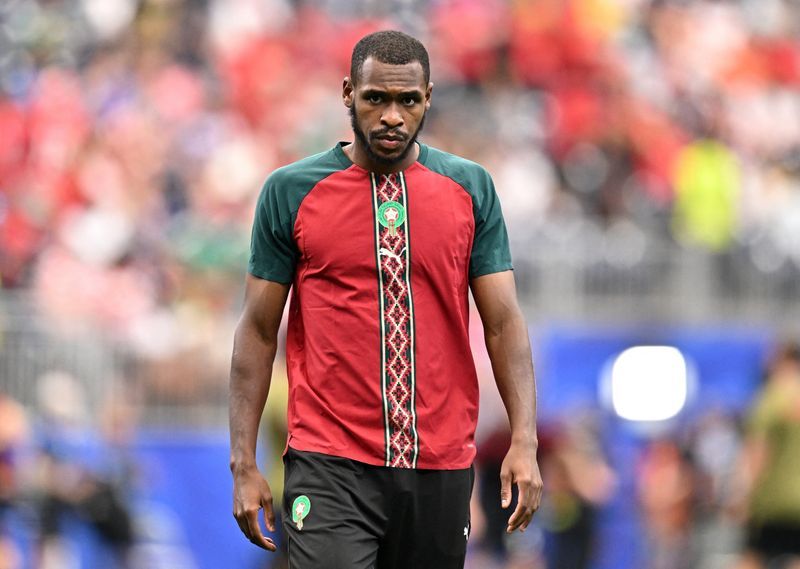
Issa Diop's journey to the World Cup quarter-final represents one of international football's most striking reversals of allegiance, placing the Moroccan centre-back in the peculiar position of defending against the nation he spent years trying to represent. The 29-year-old, born in Toulouse to a Senegalese father and Moroccan mother, will attempt to contain Kylian Mbappé when Morocco faces France in Boston on Thursday evening—a matchup that transforms a straightforward tactical contest into something far more layered with personal and professional complexity.
Diop's commitment to French football was previously absolute and unambiguous. When wearing France's Under-21 colours seven years ago, he delivered a candid statement to Canal Plus that revealed his mindset at the time: he regarded himself as thoroughly French, having been born and raised in France, and viewed switching allegiance merely because he had failed to secure a senior call-up as fundamentally disingenuous. This declaration became a defining moment in how he publicly positioned himself, leaving little room for doubt about where his international priorities lay. Both Morocco and Senegal made repeated overtures to persuade him to change course, but Diop consistently declined these approaches, demonstrating an almost defiant loyalty to France.
The reversal came abruptly in March this year when Diop agreed to commit to Morocco, a decision that triggered considerable backlash on social media platforms where observers questioned his sincerity and accused him of opportunism. Critics pointed to his previous pronouncements as evidence of calculation—that he had only switched when he realised a meaningful opportunity existed with Morocco. However, the context surrounding his recruitment reveals a more pragmatic story. Morocco's defensive resources had been depleted following the departure of captain Romain Saiss after January's Africa Cup of Nations and the injury to Nayef Aguerd in March, creating a genuine need for experienced centre-back cover heading into the World Cup. Coach Mohamed Ouahbi deliberately pursued Diop precisely because of his substantial pedigree in elite European football.
For eight seasons, Diop has been a constant fixture in the English Premier League, representing both West Ham United and Fulham. This extended exposure at the highest level of club football gave him exactly the kind of defensive maturity that Morocco sought. Ouahbi's assessment of Diop suggested the coach had conducted thorough due diligence beyond simply checking his playing credentials. The Moroccan manager observed someone displaying genuine commitment to Moroccan culture and identity, someone who regularly visited Morocco and appeared to embrace the lifestyle beyond the purely footballing dimension. This observation mattered because international football demands more than technical proficiency; it requires players who feel invested in representing their nation. Ouahbi's remarks indicated that any lingering questions about Diop's authenticity had been addressed to his satisfaction.
Diop made his competitive debut for Morocco in a March friendly against Ecuador, immediately establishing himself as the preferred partner for Crystal Palace's Chadi Riad at centre-back. He appeared to slot seamlessly into Morocco's defensive structure despite the compressed timeline between his commitment and World Cup participation. However, his most decisive contribution came during the knockout stages when Morocco faced the Netherlands in the round of 32. In the closing moments of regulation time, with the match level and Morocco's World Cup hanging by a thread, Diop powered forward from his central defensive position to attack a cross from Chemsdine Talbi. His powerful header, struck in the first minute of stoppage time, drew the teams level and forced extra time. Morocco eventually prevailed on penalties, and Diop's goal became the defining moment of his short but crucial tenure.
When Diop later reflected on his unexpected contribution in the attacking phase, he offered a characteristically pragmatic explanation: he had advanced upfield instinctively, driven by the desperation of the moment rather than any predetermined tactical instruction, and simply capitalised when space became available. This moment of individual brilliance rescued Morocco from elimination and demonstrated that his value extended beyond his core defensive responsibilities. The goal also served to neutralise much of the criticism he had faced following his switch in allegiance, as supporters could point to a tangible contribution that directly benefited the team.
Now Diop faces the challenge of concentrating entirely on containment and defensive discipline, with no prospect of wandering forward in search of redemptive moments. Morocco's pursuit of a second consecutive World Cup semi-final appearance depends heavily on suffocating France's attacking possibilities, and Mbappé represents the single most dangerous threat that the Moroccan backline must neutralise. The PSG forward has been among the tournament's most devastating attacking forces, and Diop's eight seasons in the Premier League have exposed him to similar calibre opponents regularly. However, the psychological dimension of this particular duel cannot be dismissed—Diop is defending against a player representing the nation he previously insisted was his only conceivable international home.
For Morocco, Diop's presence in the team represents more than defensive depth; it signals the nation's growing ability to attract diaspora players who have developed in European football but recognise opportunities to contribute meaningfully to their heritage nation's ambitious World Cup campaign. His integration into the team, despite initial controversy, demonstrates that coaching staff and supporters can look past noise on social media to focus on actual performance and commitment. The narrative surrounding Diop will inevitably be invoked throughout Thursday's fixture, with commentators likely exploring the irony and complexity of his position. Yet from Diop's perspective, the past has become irrelevant. What matters now is whether he can deliver the defensive solidity that Morocco requires to overcome one of the tournament's favourites and advance deeper into the competition.

