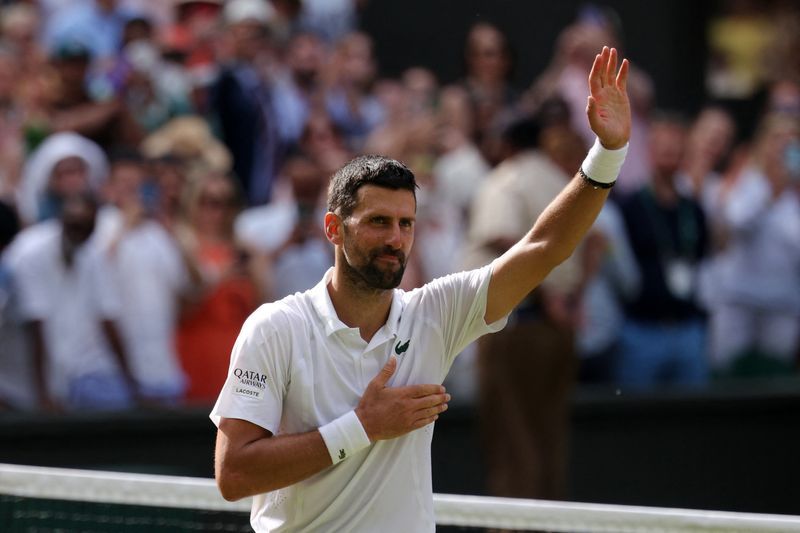
The All England Club reaches its decisive phase on Tuesday as the Wimbledon quarter-finals commence, with tennis's elder statesman Novak Djokovic standing on the threshold of a historic achievement while Japanese star Naomi Osaka attempts to reclaim the mantle of Grand Slam champion. Djokovic's confrontation with Canadian third seed Felix Auger-Aliassime represents a pivotal moment in the 39-year-old's extraordinary career, as he pursues what would be a record 25th major title. Simultaneously, Osaka's dramatic dispatch of world number one Aryna Sabalenka has reignited belief in the 28-year-old's capacity to compete at the sport's highest level, setting up an intriguing collision with Czech Republic's Karolina Muchova.
Djokovic has already etched himself into Wimbledon's history books during this tournament, securing his 106th victory at the All England Club during his hard-fought round-of-16 victory over Roman Safiullin. That triumph broke the previous record for most wins at the tournament, a milestone that underscores the Serbian champion's unparalleled success on grass. However, the manner of his progression has raised questions about his physical resilience, as the aging champion has been drawn into extended four-set contests in both his most recent matches. His struggle against qualifier Safiullin, which consumed three and a half hours, presented a sobering reminder that defending a record at nearly 40 years of age requires both skill and relentless mental fortitude.
The former world number one has acknowledged the gruelling nature of his journey through the tournament, suggesting that such demanding matches, while far from ideal, are an inevitable component of championship tennis. Djokovic's willingness to embrace the suffering inherent in extended contests reveals a competitor still driven by the hunger to achieve goals that seemed improbable at such an advanced stage of his career. His previous encounters with Auger-Aliassime, particularly their head-to-head record from 2022 where honours were evenly split, indicate that Tuesday's quarter-final will present a genuine examination of whether the veteran can sustain his excellence across multiple sets against an opponent hungry to prove his credentials against one of tennis's all-time greats.
Auger-Aliassime, at 25 years old, represents the new generation of male tennis talent seeking to usurp the dominance of players from an earlier era. The Canadian's respectful acknowledgement of Djokovic's accomplishments demonstrates a maturity often absent from younger professionals, yet his explicit desire to demonstrate marked improvement since their previous meetings suggests competitive fire alongside reverence. For Auger-Aliassime, a quarter-final appearance at Wimbledon against perhaps the greatest grass-court player of the modern era offers both an opportunity to test himself against an icon and a genuine pathway to the semi-finals if his preparation and execution align.
On the women's side, Osaka's transformation from what many perceived as a declining force to legitimate championship contender has captivated observers worldwide. Her dominant performance against Sabalenka, the top-ranked player entering the tournament, demonstrated attributes of the champion who claimed back-to-back Australian Open titles in 2019 and 2021. The Japanese star's serving prowess and devastating forehand combination proved too much for the American-Belarusian, suggesting that Osaka's Wimbledon fashion statements are complemented by equally impressive tennis on grass. Her characterisation of the Sabalenka contest as merely a practice match reveals either remarkable confidence or an intriguing psychological strategy employed by competitors at the highest echelon of professional sport.
Osaka's preparation for Wimbledon, having contested two preparatory tournaments beforehand, has seemingly reversed years of inconsistency that followed her early career dominance. The 14th seed's first-ever appearance in a Wimbledon quarter-final, despite her massive Grand Slam pedigree, indicates that earlier editions of the tournament have not yielded results commensurate with her abilities. This represents both a gap in her otherwise impressive resume and a potential source of motivation as she confronts Muchova, an opponent who has similarly found success elusive at the All England Club despite three previous quarter-final appearances. The head-to-head record between these two players stands evenly balanced from their previous encounters, with Muchova holding the advantage in their sole grass-court meeting at Bad Homburg last month.
Muchova's path to the quarter-finals included a significant scalp in the form of fellow Czech and former Wimbledon champion Barbora Krejcikova, whose elimination demonstrates the 10th seed's continued capacity for excellence on the sport's most prestigious grass-court stage. The Czech player's strategic approach of accumulating match play prior to Wimbledon reflects a calculated attempt to peak at precisely the right moment, a tactic that has historically proven effective for competitors struggling to find rhythm on grass. Her previous three quarter-final appearances without progressing further suggests that mental aspects of championship tennis remain a challenge, yet Tuesday offers another opportunity to transcend those limitations.
In the men's draw, defending champion Jannik Sinner faces an intriguing matchup against German veteran Jan-Lennard Struff, who has become the oldest man in the Open Era to reach a Grand Slam quarter-final for the first time at 36 years old. Sinner's three previous victories over Struff might suggest an inevitable progression, yet the Italian's measured comments about his form indicate appropriate caution regarding any opposition. The four-time major champion's acknowledgement of increased tension at the quarter-final stage, combined with his satisfaction regarding his current position, reveals a competitor balancing confidence with respect for the mounting difficulty of subsequent rounds.
Struff's remarkable achievement in reaching the quarter-finals during his 36th year, secured when his German opponent Hubert Hurkacz retired from their round-of-16 contest, represents one of professional tennis's inspirational narratives. The German's longevity and continued competitiveness at an age when many contemporaries have retired entirely demonstrate the evolving physical capabilities of modern athletes. Struff's primary challenge will be recovering from the physical exertion of his extended round-of-16 contest while simultaneously attempting to find answers to Sinner's attacking brand of tennis, a dual demand that could prove prohibitive.
The final quarter-final pairing sees American Jessica Pegula contending with compatriot Coco Gauff, with Pegula seeded fourth and Gauff seventh respectively. This all-American confrontation offers compelling intrigue given the friendship between the two players and their frequently intersecting trajectories throughout major tournaments. Both competitors represent the current strength of American women's tennis, a sport in which the United States has historically maintained competitive advantage. Tuesday's quarter-finals will determine whether Djokovic can achieve his 25th major, whether Osaka has genuinely rekindled her championship form, and which emerging or veteran players will progress toward Sunday's final.

