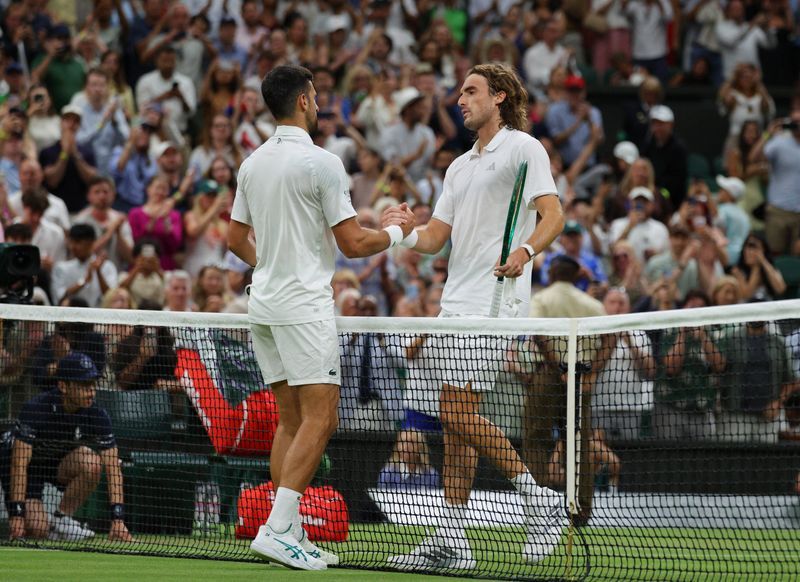
Novak Djokovic's passage into the third round at Wimbledon on Wednesday demonstrated the sort of clinical execution that has defined his decades-long dominance in professional tennis. The 39-year-old Serbian dismantled Stefanos Tsitsipas with a 6-3 6-4 6-2 victory on Centre Court, a performance so commanding that it appeared Tsitsipas never genuinely threatened an upset despite the pre-match narrative of a "heavyweight collision."
The decisive moment arrived at 4-4 in the second set when Tsitsipas faced a break point opportunity. Rather than applying pressure, the Greek player squandered two straightforward overhead smashes that he should have converted into winners. Djokovic capitalised immediately, breaking serve and thereby extinguishing any remaining hope his opponent harboured of a competitive contest. From that juncture onwards, Djokovic seized eight of the final ten games, transforming what bookmakers had advertised as a genuine test into a masterclass in precision and court intelligence.
This latest victory extended Djokovic's head-to-head supremacy over Tsitsipas to a twelfth consecutive win, a statistic that underscores the vast gulf between the two competitors. The 27-year-old Tsitsipas arrived at the All England Club as the seventh seed but carrying substantial personal and professional baggage that likely undermined his preparations. Mere days before the tournament commenced, he terminated his coaching arrangement with his father Apostolos, a dramatic split that inevitably creates psychological turbulence for any athlete, regardless of their pedigree.
Tsitsipas had entered the grasscourt season nursing considerable anxiety about his trajectory. His world ranking had plummeted to 87th, a dramatic reversal for a player who had once appeared destined for multiple Grand Slam triumphs. Last summer's withdrawal from his opening Wimbledon match through chronic back pain had cast a shadow over his resilience and durability. That injury crisis prompted genuine fears about whether Tsitsipas could sustain a career-length challenge to tennis's elite tier. The intervening year had not substantially alleviated those concerns.
Djokovic, by contrast, appeared energised and unburdened on Wednesday afternoon. The 39-year-old Serbian spoke candidly about the privilege of competing at Wimbledon at his stage of life, telling spectators that he refused to accept the notion of advancing age as merely academic. His dismissal of "age is just a number" carried particular resonance given that Federer's men's record of 105 match victories at Wimbledon now looms within reach—Djokovic stands just one victory away from equalling that remarkable benchmark.
The Serb's immediate objectives extend beyond matching Federer's grasscourt milestone. He pursues his eighth title at the All England Club and a 25th Grand Slam championship, which would represent an unprecedented accumulation of major tennis trophies. These twin ambitions have animated his campaign throughout the season, and his destruction of Tsitsipas provided tangible evidence that his pursuit remains entirely realistic. Next, Djokovic faces Arthur Rinderknech, the 25th-seeded Frenchman, a fixture that on paper presents considerably fewer complications than Wednesday's encounter nominally suggested.
Tsitsipas's profile as a future Grand Slam champion has undeniably diminished sharply. He had contested two major finals against Djokovic—at Roland Garros in 2021 and the 2023 Australian Open—losing both encounters decisively. Those defeats to the Serbian great had become reference points, unhappy bookmarks in a career trajectory that has disappointed the expectations attached to his talent. His back troubles and recent coaching upheaval have conspired to derail momentum at precisely the moment when reassertion was imperative.
For Malaysian and Southeast Asian tennis enthusiasts, Djokovic's performance carries broader implications about competitive longevity at the sport's highest echelon. The Serbian's ability to maintain elite form into his fifth decade challenges conventional thinking about athletic decline and retirement timelines. His methodical approach to point construction and court positioning offers a compelling counterpoint to the raw power and youthful exuberance that dominate modern professional tennis. Djokovic's longevity demonstrates that intelligence, experience, and strategic acumen remain formidable weapons even as physical capabilities inevitably diminish.
Dispatch of Tsitsipas required less than two hours, a completion time that reflected Djokovic's complete superiority on the day. The match never developed the competitive texture that the tournament programme had promised, largely because the Serbian refused to permit his opponent any pathway back into contention. When faced with break points or critical junctures, Djokovic consistently found the forehand winner or service placement that rendered Tsitsipas's attempts to construct attacking sequences futile. This sort of relentless precision distinguishes Djokovic from competitors who might win identical sets through more dramatic rallies and spectacular shotmaking.
Moving deeper into the tournament, Djokovic's draw shapes as increasingly favourable, assuming he maintains the form displayed on Centre Court. His ranking as one of the primary contenders reflects not merely his trophy cabinet but his demonstrated capacity to elevate performance when the stakes escalate. Tsitsipas, meanwhile, must confront uncomfortable questions about whether his earlier promise can be revived or whether injuries and psychological factors have permanently compromised his trajectory toward Grand Slam supremacy.

