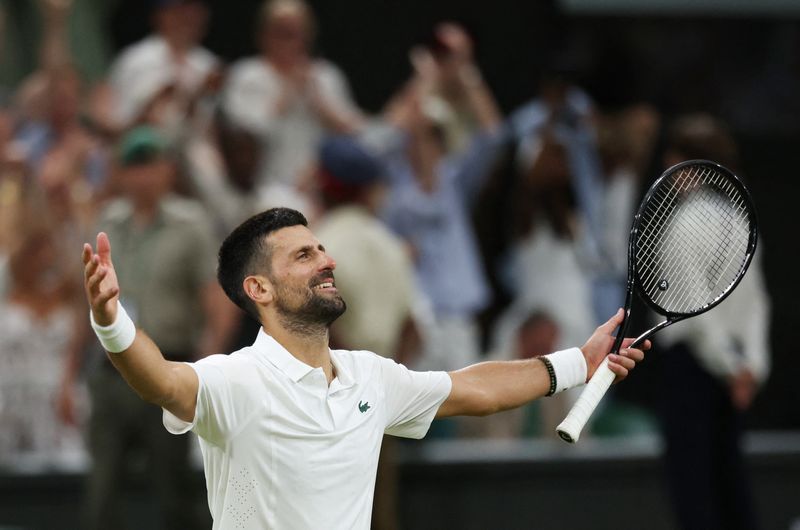
Novak Djokovic showcased the resilience that has defined his three-decade career by navigating through one of Wimbledon's most demanding quarter-final encounters, eventually prevailing over Canada's Felix Auger-Aliassime with a scoreline of 7-6(10) 3-6 6-3 6-7(4) 7-6(10-4) on Tuesday in London. The Serbian champion, now 39 years old, consumed five hours and 15 minutes to secure victory in what stands as the longest quarter-final match in the tournament's illustrious history, simultaneously etching his name deeper into the record books as he reached the semi-final stage for an unprecedented eighth consecutive year at the All England Club.
Djokovic's continued dominance at Wimbledon underscores his extraordinary longevity in professional tennis. By advancing past Auger-Aliassime, he not only added a 106th match victory at the venue—surpassing Roger Federer's previous record—but became the first male player ever to reach the semi-final stage in eight successive Wimbledon campaigns. This achievement carries particular weight given that Djokovic is competing at an age when most of his contemporaries have long since retired from the professional circuit. The accomplishment positions him as a singular figure in the sport's hierarchy, transcending mere statistics to represent an almost unprecedented combination of physical endurance, tactical mastery, and mental fortitude.
The match itself embodied the unpredictable drama that characterises Wimbledon's later stages. Auger-Aliassime, displaying the aggressive baseline play and powerful serving that characterises the modern generation of tennis professionals, pressed Djokovic relentlessly throughout, particularly in the opening set. The opening-set tiebreak became a microcosm of the entire encounter—neither player willing to yield, with both reaching the 10-point mark before Djokovic finally capitalised on a wayward volley from his opponent to claim the set. This early setback appeared to demoralise neither competitor; instead, Auger-Aliassime responded emphatically, breaking Djokovic's serve and claiming the second set with a measure of comfort that suggested an upset might materialise.
As the match progressed into its middle stages, environmental factors introduced a new variable into the competition. With Centre Court's retractable roof closing around 7:40 p.m. local time as evening light dimmed, Djokovic's initial protestations about the closure proved momentary. Once play resumed under artificial lighting in the enclosed environment, the Serbian champion recalibrated his approach with characteristic pragmatism. He elevated the precision of his striking, successfully breaking Auger-Aliassime's serve in the sixth game of the third set and consolidating his advantage to seize control of what had been an evenly-contested battle. The closure ultimately appeared to benefit Djokovic's experience-honed ability to adjust to changing conditions.
Yet Auger-Aliassime's competitive spirit never wavered despite mounting fatigue and evident frustration. In the fourth set, losing his opening service game prompted an outburst—the Canadian angrily struck his chair with his racket—that revealed the emotional toll of the protracted battle. Rather than capitulating, however, he demonstrated the resilience characteristic of his generation, recovering to force the set into a tiebreak where he drew level once more. The trajectory suggested an encounter that could extend to a decisive fifth set, and indeed that is precisely what unfolded. For 12 consecutive games in the final set, neither player managed to break the other's serve, the tension mounting with each service game as both competitors wrestled mentally and physically with the demands of the moment.
The resolution came in the form of the super tiebreak—the extended tenth-point tiebreak that now determines fifth-set encounters at Wimbledon under current tournament regulations. This format proved decisive in a way that straightforward point accumulation had not. Drawing upon nearly four decades of competing in tennis's highest echelons, Djokovic's experience in these high-pressure situations manifested itself decisively. He executed with greater consistency precisely when consistency mattered most, eventually prevailing 10-4 in the super tiebreak to finally vanquish an opponent who had given everything across nearly five-and-a-half hours of continuous play. The Centre Court crowd, exhausted yet exhilarated, erupted with appreciation for a contest that had transcended mere sporting competition.
In his post-match commentary, Djokovic characteristically downplayed the magnitude of what he had accomplished, deflecting attention toward the immediate future rather than dwelling on the historical significance of his eighth consecutive semi-final appearance. "I won with a racket and a lot of heart," he reflected, before dissecting the psychological dimensions of competing in such emotionally and physically demanding contests. His remarks about managing nerves and extreme tension revealed the mental architecture required to sustain excellence at the professional sport's apex, particularly when the outcome remains genuinely uncertain deep into a fifth set. For Djokovic, these moments continue to provide the ultimate motivation for remaining competitive at an age when most athletes have long since stepped away.
Ahead lies a semi-final confrontation with defending champion Jannik Sinner, the Italian who currently ranks as the world's top-rated player and has already claimed two Grand Slam titles this year alone. This matchup represents not merely another rung on the ladder toward an eighth Wimbledon championship and a 25th major title overall—both of which would further extend Djokovic's already unparalleled achievements in the sport—but another chapter in a rivalry beginning to define this transitional era in professional tennis. Sinner's elevation to the sport's pinnacle represents the generational shift that has been gradually reshaping tennis as Djokovic, Rafael Nadal, and Roger Federer have ceded their dominance. That Djokovic continues to compete credibly against the game's current elite at age 39 amplifies the improbability of his continued success.
Recovery now becomes paramount for Djokovic as he faces the immediate challenge of restoring his body after such a gruelling encounter. The fact that his semi-final opponent defeated him earlier in the season at the Australian Open adds another layer of intrigue, suggesting Sinner possesses the tactical tools and physical attributes to exploit any residual fatigue from this extended quarter-final battle. Yet Djokovic's capacity to compartmentalise and move forward from one match to the next has proven virtually limitless throughout his career. His comment that he humorously "told his kids to go to sleep after the fourth set but they didn't want to listen" before later expressing profound satisfaction that they remained awake reflected the perspective of someone who understands that matches of such quality represent the ultimate expression of competitive tennis, regardless of the personal cost.
For Malaysian and Southeast Asian tennis enthusiasts, Djokovic's continued presence at Wimbledon's latter stages offers a reminder of the exceptional individual achievement that the sport can generate. In an era increasingly dominated by younger players from Italy, Spain, and other European nations, Djokovic's defiance of age and physical decline stands as a testament to preparation, mental discipline, and an almost monastic dedication to the craft. His advancement creates a semi-final pairing that will determine whether the established order represented by Djokovic can still triumph against the emerging generation of champions or whether Sinner's youth and current form will prove insurmountable in the tournament's pressurised atmosphere. The outcome remains genuinely uncertain as these two formidable competitors prepare for their semi-final confrontation.

