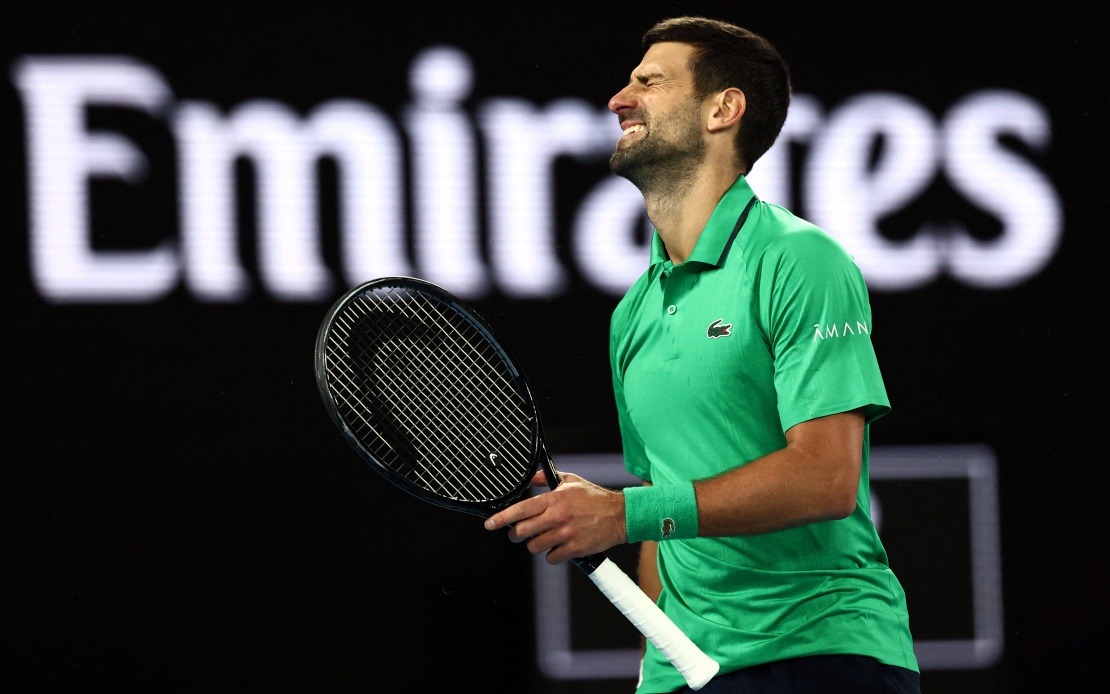
Novak Djokovic has entered the history books alongside Roger Federer after capturing his 105th victory at Wimbledon, the Serbian champion reaching the fourth round by overcoming France's Arthur Rinderknech in a compelling four-set contest on Centre Court. The milestone achievement places Djokovic alongside the Swiss legend in one of tennis's most exclusive records, cementing his status as one of the sport's greatest performers across the grass-court championship.
The 39-year-old's triumph over 25th seed Rinderknech, secured 7-5, 6-4, 1-6, 7-6 (7-4) after three hours of intense competition, delivered his 18th appearance in the fourth round at the All England Club. Djokovic's consistency at this particular venue remains remarkable given his age and the demands of elite professional tennis. The rally between these two competitors produced moments of exceptional quality, with both players demonstrating the technical mastery required at sport's highest echelon. Rinderknech, a qualifier who has worked his way through the draw, mounted considerable resistance, particularly in the third set where he levelled the match before succumbing in the fourth-set tiebreak.
The milestone prompted characteristic humour from the Serbian champion. In his response to achieving this landmark, Djokovic suggested a novelty match against Federer to determine who would claim the 106th victory, demonstrating the mutual respect and camaraderie that defines his relationship with the retired Swiss player. Beyond the levity, however, Djokovic acknowledged the profound significance of the achievement. Speaking during his on-court interview, he reflected on the honour of making history within a sport that has defined his adult life, whilst emphasising that such records remain secondary to the immediate challenge of winning individual matches.
Djokovic's seven Wimbledon championships represent his most successful Grand Slam tournament, surpassed only by his record 24 Grand Slam titles across all competitions. His progression at this year's championship positions him for a potential quarter-final meeting with Roman Safiullin, a Russian qualifier whose advancement itself represents an impressive accomplishment. For Malaysian and Southeast Asian tennis enthusiasts, Djokovic's continued dominance at his age demonstrates the longevity possible in professional sport with appropriate dedication, training methodology, and mental fortitude.
Meanwhile, defending champion Jannik Sinner advanced through the third round with a commanding display, defeating American Jenson Brooksby 6-4, 6-3, 6-4 without showing significant stress. The Italian world number one has now extended his perfect record in third-round matches at Grand Slam tournaments to 20 consecutive victories, an Open Era men's record that underscores his status as the emerging dominant force in men's tennis. Sinner's composed performance, delivered before enthusiastic crowd support, illustrates the confidence and tactical maturity he has developed over recent seasons.
On the women's side, top-seeded Aryna Sabalenka progressed by dismissing former French Open champion Jelena Ostapenko 6-4, 6-4, maintaining her pursuit of an elusive first Wimbledon title. The Belarusian, who has previously won the Australian Open twice, possesses the aggressive baseline game required to succeed on grass, though this surface has historically challenged hard-court specialists. Sabalenka's victory over Ostapenko, a player known for explosive strokemaking, demonstrated her capacity to control rallies and dictate terms from the baseline even on terrain that traditionally favours more defensive players.
Sabalenka now confronts four-time Grand Slam champion Naomi Osaka in the fourth round, setting up what promises to be a compelling encounter. Osaka has showcased impressive form at this year's Wimbledon, advancing to the fourth round for the first time in her career after powering past Daria Kasatkina 6-1, 6-3 in earlier action. The Japanese star's commanding victory suggests she has rediscovered the form that previously delivered four major championships. Osaka's serve-and-volley instincts and court positioning have proven effective on grass, where the reduced court time and serve dominance suit her playing style.
Sabalenka's acknowledgement of this matchup revealed her competitive mindset and strategic approach to grand tournaments. She recognised Osaka as another aggressive competitor, similar in playing philosophy to herself, and committed to a combative approach focused on resolving the contest through controlled aggression rather than defensive patience. This psychological readiness, combined with her superior ranking and recent tournament success, positions her as favourite, though Osaka's experience in major competitions and her demonstrated form in London provides legitimate challenge credentials. For regional viewers, this fourth-round clash represents an opportunity to observe two players with significant Asian connections competing at tennis's highest level.
The Wimbledon progression of these leading competitors illustrates the tournament's continued capacity to produce compelling storylines. Djokovic's record-equalling achievement carries particular significance given his age and the suggestions that players are supposed to decline after 35 in professional tennis. His refusal to accept conventional wisdom about athletic longevity, much like his contemporary champions, challenges assumptions about the timeline of athletic careers. Sinner's emergence as a dominant force suggests a generational shift, whilst Sabalenka and Osaka continue battling through a competitive women's draw characterised by genuine uncertainty regarding championship outcomes.
For Malaysian audiences following international tennis, these developments underscore the sport's continuing evolution and globalisation. The diverse nationalities represented in Wimbledon's advanced rounds—Serbian, Italian, Belarusian, Japanese, French, Russian, and American competitors all featuring prominently—reflects tennis's status as a genuinely international sport. The championship continues to attract global audiences through its combination of sporting excellence, historic venue significance, and tradition, with these players' performances contributing to the tournament's ongoing cultural relevance.

