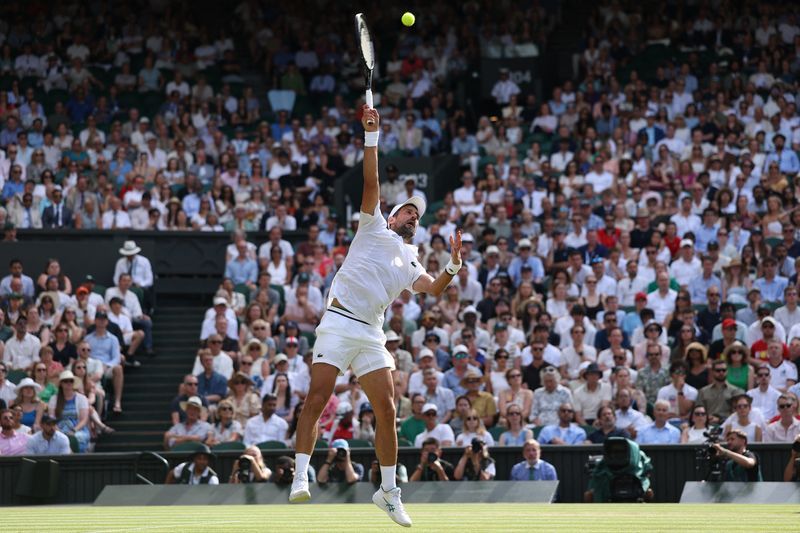
Novak Djokovic extended his Wimbledon dominance on Sunday, outlasting Russian qualifier Roman Safiullin 7-6(6) 6-3 3-6 6-3 on Centre Court to secure his record 106th match victory at the All England Club. The result propels the 39-year-old Serbian past Roger Federer's longstanding tally of wins at the grand old tournament, adding another milestone to a career defined by relentless pursuit of records. The seventh seed's progression to the quarter-finals marks another step forward in his quest to equal Federer's eight Wimbledon crowns whilst simultaneously hunting a 25th Grand Slam title overall, which would place him alone at the summit of tennis history.
Safiullin, ranked 132nd and returning from months sidelined by a hip injury, arrived at the match as an unlikely threat yet proved far more formidable than seeding might suggest. Playing with the freedom of someone with nothing to lose, the Russian qualifier began aggressively and forced Djokovic into an uncharacteristic early struggle. The opening set exemplified the contest's intensity: Djokovic found himself trailing 2-5 before engineering a remarkable turnaround, saving two set points to force the tiebreak and ultimately prevailing 7-6(6) through sheer resilience. Such defensive displays against lower-ranked opponents have become increasingly familiar this fortnight, revealing potential vulnerabilities despite the historical record being accumulated.
Djokovic's discomfort during the opening exchanges stemmed partly from court conditions that favoured his opponent's baseline gameplan. Safiullin maintained consistency from the back of the court with unforgiving precision, forcing lengthy rallies that disrupted the Serbian's preferred rhythm. Wind conditions compounded matters, with Djokovic later acknowledging how the weather had made rally play particularly challenging. These external factors combined with the Russian's solid technique created genuine difficulty for the world number two, who typically dominates grass through serve dominance and aggressive net play. The early struggles reflected not a significant decline but rather the reality of facing an opponent executing a specific gameplan with technical competence.
As the match progressed, Djokovic's adaptability proved decisive. After the first set, he elevated his service performance markedly, using his delivery as both weapon and shield. The second set showcased this adjustment emphatically, with Djokovic establishing a 4-2 lead before Safiullin's backhand error at the critical juncture essentially surrendered momentum. Djokovic subsequently unleashed an array of serve-and-volley combinations that left his opponent scrambling, demonstrating the precision tennis that has defined his tenure at grass-court majors. The third set represented an anomaly where frustrations briefly surfaced, allowing Safiullin to break serve and claim a set, but the fourth saw Djokovic recalibrate and accelerate through to victory.
Djokovic's post-match commentary revealed an athlete acutely conscious of the challenges his opponents now present, even those ranked considerably lower. He acknowledged how Safiullin's aggressive baseline play had tested him throughout, an admission unusual for someone accustomed to dominating most encounters. Simultaneously, his observations about tactical adjustment—mixing serve-and-volley approaches with patience—highlighted the cognitive demands of maintaining peak performance at age 39. The Serbian recognised that remaining in extended baseline rallies against Safiullin proved counterproductive, necessitating the net assault that ultimately proved successful. These tactical acknowledgements suggest ongoing evolution rather than decline, though they also indicate that opponents have studied footage extensively and developed specific strategies to trouble him.
The accumulation of minor struggles across this opening week presents intriguing context. Djokovic has dropped sets in three of his first four matches, an unusual pattern for someone bidding to claim an eighth Wimbledon title. This statistic alone suggests either elevated competition or potential physical concerns, though the player's own framing—"survive to thrive"—indicates philosophical acceptance rather than alarm. Many great champions have demonstrated this pattern when defending titles across multiple years, as the cumulative physical and mental demands eventually manifest. The phrase itself suggests Djokovic believes the "thriving" phase lies ahead, implying that quarter-final progression may see him shift to higher gears against more accomplished rivals.
Djokovic's quarter-final opponent will emerge from a match between third seed Felix Auger-Aliassime and Spain's Alejandro Davidovich Fokina, either of whom presents markedly stiffer competition than Safiullin. Both players possess the attacking credentials to trouble Djokovic, particularly on grass where serving accuracy and net skills determine outcomes. Auger-Aliassime brings youthful pace and power, whilst Davidovich Fokina offers counterintuitive defensive resilience that frustrates attacking opponents. These matchups carry entirely different complexions compared to facing a qualifier still gaining match conditioning following injury absence. The seventh seed's preparation against Safiullin, despite its struggles, provided valuable time on court and tactical learning that may prove essential in subsequent rounds.
The significance of Djokovic's 106th match victory at Wimbledon extends beyond mere statistics. The All England Club holds particular historical weight in tennis, representing the oldest Grand Slam and the sport's spiritual home. Federer's previous record of 105 wins symbolised the Swiss legend's consistency and excellence across nearly two decades. By surpassing that figure, Djokovic has conclusively established himself as the greatest Wimbledon competitor in men's history by match-win percentage and volume. Whether he ultimately equals or surpasses Federer's eight titles remains uncertain, but the record already stands uncontested. For Malaysian and Southeast Asian tennis enthusiasts following these tournaments closely, Djokovic's achievement represents the continuation of a generational dominance rarely witnessed in sports.
Looking forward, Djokovic's path to an eighth title faces considerable obstacles despite his seeding advantages. The tournament remains genuinely open given his early-round struggles and the emergence of multiple threats among younger players. Jannik Sinner, Carlos Alcaraz, and others possess both the talent and physical conditioning to trouble the Serbian should draws align accordingly. Yet Djokovic's proven ability to elevate performance during decisive stages suggests premature dismissals would prove foolish. His experience navigating pressure situations, combined with the court knowledge accumulated across numerous Wimbledon campaigns, remains invaluable. The coming week will determine whether this fortnight ultimately represents another triumph for a player seemingly incapable of accepting limitations or a reminder that even greatness eventually yields to time's passage.

