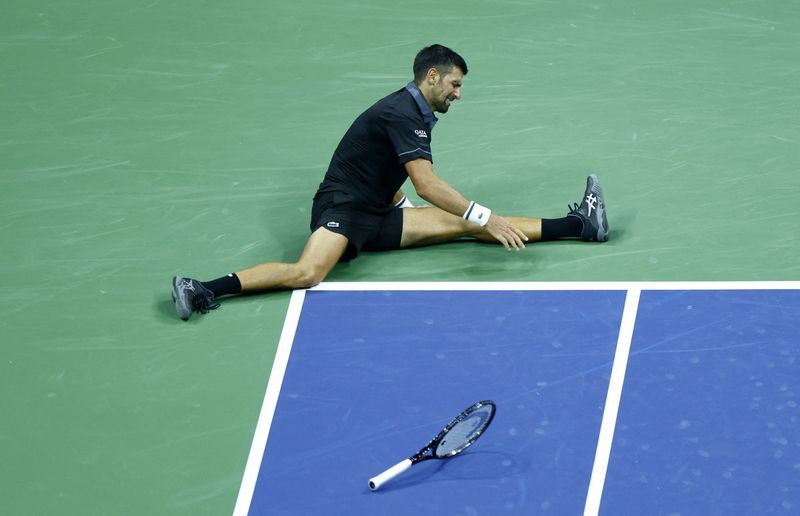
Novak Djokovic's bid to capture an unprecedented 25th Grand Slam championship has been derailed in dramatic fashion at the US Open, where the Serbian star fell to unseeded Argentine Mariano Navone in a five-set marathon on Sunday. The match, decided 7-6(5) 5-7 4-6 6-2 6-1, represents one of the most jarring upsets in recent Grand Slam history, with the world number 49 defeating the fourth-seeded Djokovic in a gruelling four-hour-36-minute encounter at Flushing Meadows in New York.
Djokovic entered the tournament already under scrutiny following a two-week dip in form that saw him suffer defeat to Thiago Agustin Tirante at Cincinnati, raising questions about both his competitive sharpness and physical readiness for the demands of a major championship. At 39 years old, the legendary Serb was making his 20th appearance at this Grand Slam event, a venue where he has traditionally performed with distinction. However, from the opening moments, he appeared encumbered by physical discomfort that would ultimately prove decisive in determining the outcome.
The early stages suggested Djokovic might overcome any concerns, as he powered to a commanding 3-0 lead in the opening set under humid New York conditions. The momentum shifted markedly, however, when rain interrupted play and prompted officials to close the roof of the main showcourt. This tactical pause appeared to provide Navone with a crucial respite and opportunity to reset his approach. The Argentine rallied impressively from that juncture, drawing level at 4-4 before forcing his higher-ranked opponent into a tiebreak that the world number 49 won decisively, much to the delight of the crowd.
Navone's breakthrough in the opening set signalled something fundamental had shifted in the match's complexion. Djokovic, showing visible signs of discomfort and lacking his usual rhythmic precision, appeared far from his customary level of dominance. The physical toll of the encounter was evident not merely in his movement and shot selection but in his demeanour throughout the contest, with the accumulated wear of decades competing at elite level seemingly catching up with him in concentrated fashion.
The second set represented a moment where Djokovic's championship experience momentarily reasserted itself. Drawing on reserves of competitive instinct honed over countless matches at the sport's highest level, he managed to claim the set and seemingly restore some semblance of control. However, the effort appeared to exact a significant price. During the third set, Djokovic was forced to vomit into a courtside bin, a physical manifestation of the stress and strain his body was enduring. Yet he recovered sufficiently to secure a break of Navone's serve and construct a 5-4 lead, briefly suggesting he might engineer an improbable comeback.
The fourth set represented the critical juncture where Navone seized permanent initiative. Djokovic's serve, typically the foundation of his game, began to deteriorate significantly as back issues intensified during the latter stages of the match. This physical limitation proved insurmountable for the aging champion, as Navone capitalized on the opening to claim the set and move within touching distance of an historic upset. The Argentine's composure under such extraordinary pressure demonstrated maturity beyond his ranking and years.
In the fifth and deciding set, with Djokovic visibly depleted and his body increasingly unreliable, Navone maintained his nerve and composure to complete one of professional tennis's most remarkable results. The 25-year-old from Argentina, world number 49 and unseeded in the tournament, had defeated one of the sport's greatest champions in his prime victory, a performance that will likely define the trajectory of his career and thrust him into consideration among the sport's emerging talents.
The loss represents far more than a mere first-round exit for Djokovic. It signals potential questions about his future in professional tennis at the highest level, particularly regarding his ability to sustain the physical demands of competing across multiple sets against determined opponents. At 39, maintaining the physical resilience required to triumph at Grand Slams becomes increasingly challenging, and this encounter with Navone underscores those mounting difficulties.
For the broader tennis landscape and Malaysian sports enthusiasts following the sport regionally, this result highlights the emerging generation of players who possess the skill and mental fortitude to challenge the established order. Navone's breakthrough victory demonstrates how the sport continues to evolve, with unseeded competitors increasingly capable of engineering upset victories against legendary champions. The shock elimination also opens the door for other contenders to pursue the tournament title without the immediate threat posed by the Serb's presence.

