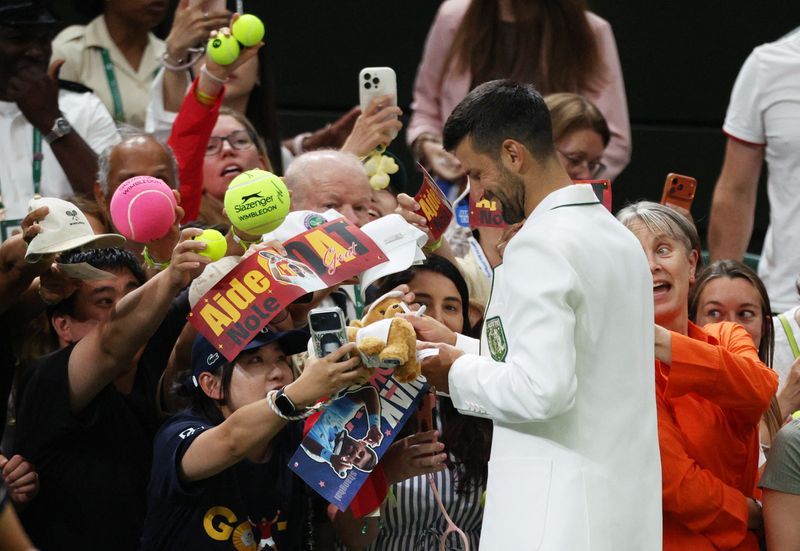
Novak Djokovic's commanding display over Stefanos Tsitsipas at Wimbledon on Wednesday was marked not only by clinical tennis but also by the kind of relaxed confidence that emerges when victory is assured. With the match effectively decided, the 24-time Grand Slam champion turned his attention to entertaining the crowd, orchestrating a moment of mischief that perfectly captured his mood as he dismantled his Greek opponent 6-3 6-4 6-2. The encounter showcased Djokovic at his most dominant, but it was his behaviour off the baseline that would generate the most memorable talking points from the day's play.
During a routine moment when Djokovic required assistance with some black tape affixed to his right shoulder, he seized the opportunity for a bit of playful trickery. As a ball girl dutifully carried out his request to trim the tape with scissors, Djokovic suddenly cried out as though she had inadvertently caused him serious injury. The unsuspecting staff member, confronted with what she momentarily believed was a catastrophic mistake in front of millions of viewers worldwide, visibly recoiled with alarm. Her hand flew to her chest as the reality of potentially injuring one of tennis's greatest players seemed to crash down upon her.
But the apparent tragedy was merely theatrics. Within an instant, Djokovic's face broke into a broad grin as he burst out laughing, immediately defusing the tension with the kind of good-natured humour that transformed a moment of panic into shared amusement. The ball girl, realising she had been the subject of a harmless prank, quickly recovered her composure and joined in the laughter. For observers, it was a glimpse into the lighter side of professional tennis, where even the sport's most celebrated figures recognise the value of breaking tension with genuine levity.
When addressing the crowd during his post-match interview, Djokovic acknowledged the prank with candour and contrition. He explained that such displays of humour and relaxation naturally emerge when a player finds himself commanding the match rather than fighting for survival. "These kinds of things surface when you are two sets to love up rather than two sets to love down, but ... I'm sorry if I scared her... it made me a bit more relaxed on the court. I was just having some fun," the Serbian champion reflected, demonstrating an awareness that his frame of mind had been distinctly different from what it would have been under pressure.
The lopsided victory represented Djokovic at his peak, playing with the kind of fluency that characterises his best performances at the All England Club. His dominance over Tsitsipas extended beyond the scoreline; it reflected a mastery of every facet of the game that justified his position among tennis's pantheon. This level of superiority afforded him the mental space to engage with the occasion in ways that more competitive matches would not permit, turning Centre Court into something approaching entertainment theatre rather than a contest.
As the match concluded and Djokovic settled into his on-court interview, his attention turned to an unexpected spectator in the Royal Box. Rory McIlroy, the accomplished Northern Irish golfer who has claimed two Masters titles, was present wearing his famous Green Jacket, the iconic garment that golf's most prestigious championship awards to its victor. Djokovic, sporting his own personalised cream blazer that has become a fixture throughout this year's Wimbledon fortnight, noticed the sartorial contrast and seized the moment for further banter.
"Rory, what a beautiful jacket," Djokovic called out toward the Royal Box, drawing McIlroy's attention and eliciting a smile from the golfer. The exchange displayed the kind of cross-sport camaraderie that occasionally emerges at major sporting occasions where athletes from different disciplines converge. Djokovic's admiration for the Green Jacket was genuine, yet his tone carried an unmistakable note of covetousness that would quickly develop into something more.
When Djokovic inquired whether McIlroy's jacket was indeed the Masters prize, the golfer confirmed with a nod. Rather than merely complimenting the achievement, Djokovic proposed an unconventional solution to his evident desire for the garment. "I want that jacket. I'll play you. This jacket for that jacket, we play tennis, no golf," he announced, gesturing toward both blazers as the crowd erupted in approval. The suggestion was audacious in its playfulness, essentially proposing that McIlroy wager his prized Green Jacket in a tennis match against someone ranked among the greatest players in the sport's history.
The exchange highlighted the personality that Djokovic brings to tennis when conditions permit such levity. Unlike the grinding, serious demeanour that often characterises elite professional sport, these moments of spontaneous humour and cross-sport banter serve to humanise the athletes and remind audiences why they engage with these figures beyond mere results. For Malaysian and Southeast Asian readers, the interaction underscored how even at the highest echelons of sport, a touch of personality and humour remains valued and celebrated.
Djokovic's performance and conduct throughout the match illustrated the psychology of athletic dominance. When a player achieves such comprehensive control, the mental burden diminishes dramatically, allowing for a kind of creative expression that stress and uncertainty would otherwise suppress. His pranks, his charming interactions, and his jocular challenge to McIlroy all flowed from a position of complete security within the match.
The broader significance of Djokovic's Wimbledon run extends beyond individual matches to questions about his continued trajectory in the sport. At an age when most players have begun their decline, his capacity to produce such decisive performances suggests ongoing relevance and capability. His dominant victory over Tsitsipas positioned him as a formidable contender for the tournament's title, with each subsequent round providing fresh opportunities to demonstrate the consistency that has defined his career.
For McIlroy, the encounter represented an amusing intersecting moment with tennis's elite, though one suspects the Masters champion was content to retain his Green Jacket rather than accept Djokovic's whimsical wager. The exchange nonetheless served to brighten the Wimbledon narrative, injecting human warmth into a competition often characterised by grinding athleticism and fierce competitiveness.

