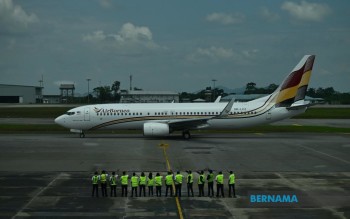
Deputy Prime Minister Datuk Seri Fadillah Yusof formally welcomed AirBorneo Airways' first commercial flight at Kuala Lumpur International Airport Terminal 1 on Saturday, marking a significant development in Malaysia's regional aviation landscape. Flight MY5005 from Kuching carried Sarawak Premier Tan Sri Abang Johari Tun Openg alongside state government officials and dignitaries, underscoring the political importance of this aviation venture to the East Malaysian state.
The launch represents a watershed moment for Sarawak's aspirations to establish greater control over its own air connectivity infrastructure. AirBorneo, the Sarawak state-owned carrier, enters the commercial jet sector with two wet-leased Boeing 737-800 aircraft, transitioning from smaller regional operations to serving major domestic trunk routes. This expansion reflects growing confidence in the airline's operational capacity and strategic positioning within Malaysia's aviation sector.
AirBorneo chairman Datuk Amar Mohamad Abu Bakar Marzuki, who simultaneously serves as Sarawak state secretary, framed the service commencement within broader economic development goals. He articulated that aviation connectivity functions as an essential economic catalyst, linking markets, enabling business expansion and creating employment pathways across the state. For Sarawak, strengthening control over regional air networks addresses long-standing logistical constraints that have historically limited economic growth in the less densely populated state.
The inaugural route between Kuching and Kuala Lumpur positions AirBorneo to compete directly with established Malaysian carriers on one of Southeast Asia's busier domestic corridors. Starting July 21, the airline will operate double-daily frequencies, indicating confidence in passenger demand between Malaysia's capital and Sarawak's major commercial hub. Pricing strategy reveals competitive ambitions, with economy fares set at RM375 one-way and business class commencing at RM736, positioning the carrier between budget operators and full-service legacy airlines.
Several federal ministers attended the ceremony, reflecting Putrajaya's support for the initiative. Tourism, Arts and Culture Minister Datuk Seri Tiong King Sing, Women, Family and Community Development Minister Datuk Seri Nancy Shukri, and Deputy Transport Minister Datuk Hasbi Habibollah's presence underscored cross-portfolio backing for the venture. Their attendance signals government recognition that aviation development aligns with broader objectives around transport infrastructure and regional economic integration.
AirBorneo's chief executive officer Megat Ardian Mohd Aminuddin characterised the launch as a pivotal inflection point in the airline's trajectory. He emphasised that service reliability and passenger experience would form the operational foundation as the carrier navigates its expansion phase. These commitments address potential concerns about new entrants' ability to maintain standards while scaling operations, a relevant consideration given Malaysia's historically competitive aviation market.
The Kuching–Kuala Lumpur route functions as the opening gambit in AirBorneo's broader domestic network expansion strategy. Rather than pursuing multiple simultaneous launches, the airline has adopted a sequential approach, allowing operational procedures to stabilise before adding destinations. This measured methodology contrasts with more aggressive market entry strategies and suggests management prioritises sustainable growth over rapid market penetration.
International expansion forms part of medium-term planning, with Singapore confirmed as the first destination beyond Malaysian borders. This trajectory reflects regional travel patterns and commercial logic—Singapore represents a natural extension from Kuching, offering connections to Southeast Asian business centres and tourism markets. The timing and pricing of international services will significantly influence AirBorneo's competitive positioning throughout the region.
The emergence of AirBorneo addresses structural questions about aviation capacity and economic accessibility across Malaysian regions. East Malaysian states have historically experienced higher domestic airfares and limited service frequency compared to peninsular routes, creating economic friction for businesses and communities. A state-owned carrier positioned to expand services potentially mitigates these disparities, though competitive dynamics and operational efficiency will ultimately determine success.
For Malaysian aviation broadly, AirBorneo represents an interesting regulatory and competitive experiment. State-owned carriers operating alongside federal entities create complex market dynamics, particularly regarding capacity management and route allocation. How federal authorities manage these relationships while maintaining competitive markets will carry implications for other regional players and future aviation policy development.
The broader Southeast Asian context magnifies this launch's significance. Regional connectivity remains fragmented despite growing integration aspirations. AirBorneo's expansion ambitions, particularly regarding international services, contribute incrementally to improving aviation links across the region. However, realising these ambitions requires sustained profitability and consistent service delivery in an increasingly challenging operating environment marked by fuel volatility and intense competition.
Stakeholder confidence, demonstrated by the high-level political attendance and advance ticket sales, provides essential momentum for the airline's launch phase. However, translating this initial enthusiasm into sustainable operations across multiple routes and international services presents formidable challenges. The months ahead will reveal whether AirBorneo can establish itself as a viable long-term player in Malaysia's competitive aviation sector.

