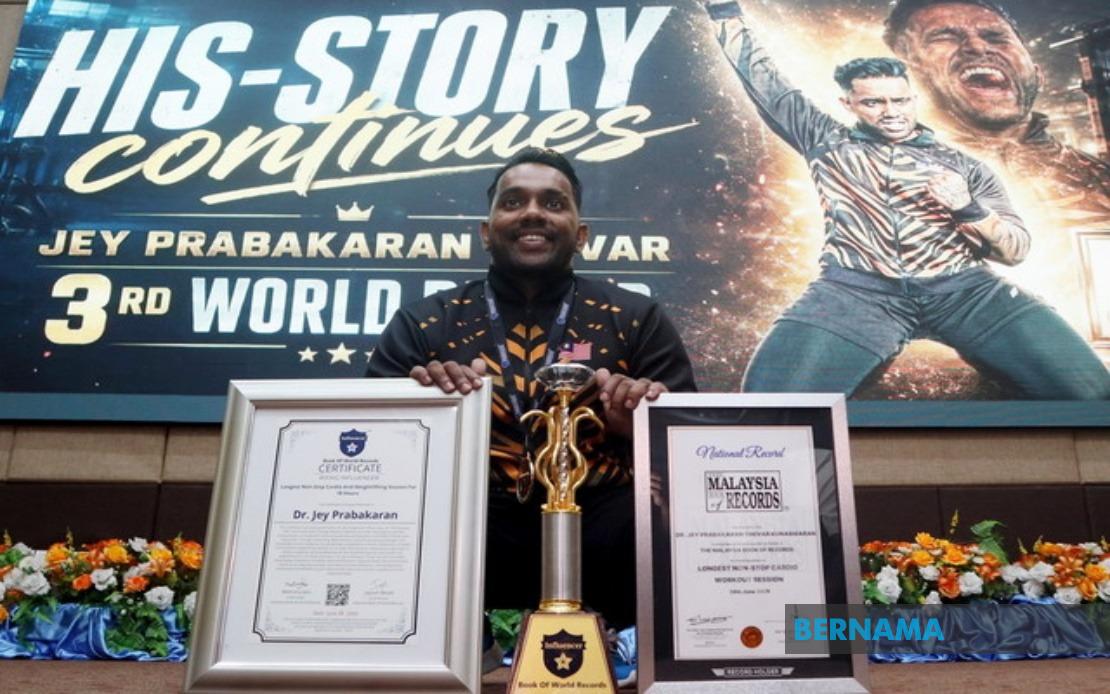
Malaysian fitness athlete K. Jey Prabakaran Thevar, known professionally as Dr Kjey, has etched his name into record books once more by completing an gruelling 18-hour non-stop cardio and weightlifting session in Kuala Lipis, Pahang. The 29-year-old's latest achievement marks his third world record in this endurance category, reinforcing his position as one of the country's most accomplished fitness professionals. The challenge, which took place last Sunday from 4 am to 11 pm at Healthland Kuala Lipis, resulted in the feat being officially recognised by both the Malaysia Book of Records and the Influencer Book of World Records.
Beyond the accolades and record confirmations, Dr Kjey imbued this particular accomplishment with profound personal significance by dedicating it to his late father, Kunasigaran Suppiya Thevar, who passed away on March 3, 1999. Growing up without paternal presence shaped much of Dr Kjey's character and determination, he explained to reporters, noting that the loss became a driving force rather than an obstacle. His remarkable resilience and competitive spirit were forged partly through this early adversity, culminating in what he describes as bringing glory to Malaysia on the international fitness stage.
This latest record builds upon an already impressive trajectory of achievement. In 2023 and 2024, Dr Kjey previously set world records through 12-hour and 15-hour non-stop cardio and weightlifting challenges, both officially recognised by the Malaysia Book of Records and Guinness World Records. Additionally, he holds the distinction of setting an Asian record with a 13-hour completion time, demonstrating his consistent ability to push physical and mental boundaries across multiple event formats. Each successive challenge has required greater endurance and more sophisticated preparation strategies.
The path to this latest achievement involved meticulous planning that commenced immediately following his participation in the national record challenge during National Sports Day last October. Dr Kjey undertook comprehensive lifestyle modifications to optimise his body's performance capabilities. Most notably, he adopted a strictly vegetarian diet regimen and managed to reduce his body weight by 32 kilogrammes prior to attempting the record. This deliberate weight loss strategy reflects the scientific approach modern elite athletes employ when preparing for extreme endurance events.
During the 18-hour ordeal itself, Dr Kjey confronted multiple physiological and psychological obstacles that tested his commitment and conditioning. Beyond the obvious physical demands of sustained cardio work and resistance training over nearly three-quarters of a day, he struggled particularly with managing fatigue and combating drowsiness. These factors represent perhaps the most insidious challenges in such extreme endurance pursuits, as mental fortitude becomes as critical as physical stamina when the body desperately seeks rest.
Dr Kjey's prominence extends well beyond individual athletic achievement. As president of the Malaysian India Fitness Association, he leverages his platform and credibility to promote wellness initiatives within the community. His stated aspiration is that his record-breaking endeavours inspire younger Malaysians to reconsider their relationship with physical fitness and adopt more health-conscious lifestyle choices. In an era of rising obesity and sedentary lifestyles across the region, such ambassadorial messaging carries genuine public health significance.
Looking forward, Dr Kjey has already identified his next ambitious target. He intends to pursue a national record attempt involving 5,000 jumping jacks completed within a five-hour window, scheduled to coincide with National Sports Day celebrations in October. This represents a strategic shift toward different fitness metrics and metrics while maintaining the ultra-endurance philosophy that defines his athletic identity. The graduated approach—progressing from 18-hour mixed cardio and weightlifting toward explosive repetitive movements—demonstrates sophisticated periodisation planning.
For Malaysian sports enthusiasts and fitness professionals, Dr Kjey's progression carries important implications. His achievements demonstrate that world-class competitive standards in niche endurance disciplines remain entirely achievable for Malaysian athletes training domestically. The records he holds are not merely personal triumphs but represent benchmarks that inspire domestic competition and raise the profile of Malaysian fitness athletes internationally. His journey from a boy who lost his father early to a multiple world record holder embodies the narrative of personal resilience that resonates across Southeast Asian audiences.
The broader context matters too. While Malaysia has produced numerous sporting heroes across traditional competitive disciplines, endurance fitness athletes like Dr Kjey occupy a somewhat different space—one that blurs the boundary between sport, personal development, and wellness advocacy. His records attract less mainstream media attention than Olympic achievements, yet they represent equally rigorous physical and mental preparation. As Southeast Asia continues grappling with health challenges including rising non-communicable diseases, individuals who champion fitness at this level serve as important cultural touchstones, suggesting that transforming one's body and capabilities remains possible through disciplined commitment.

