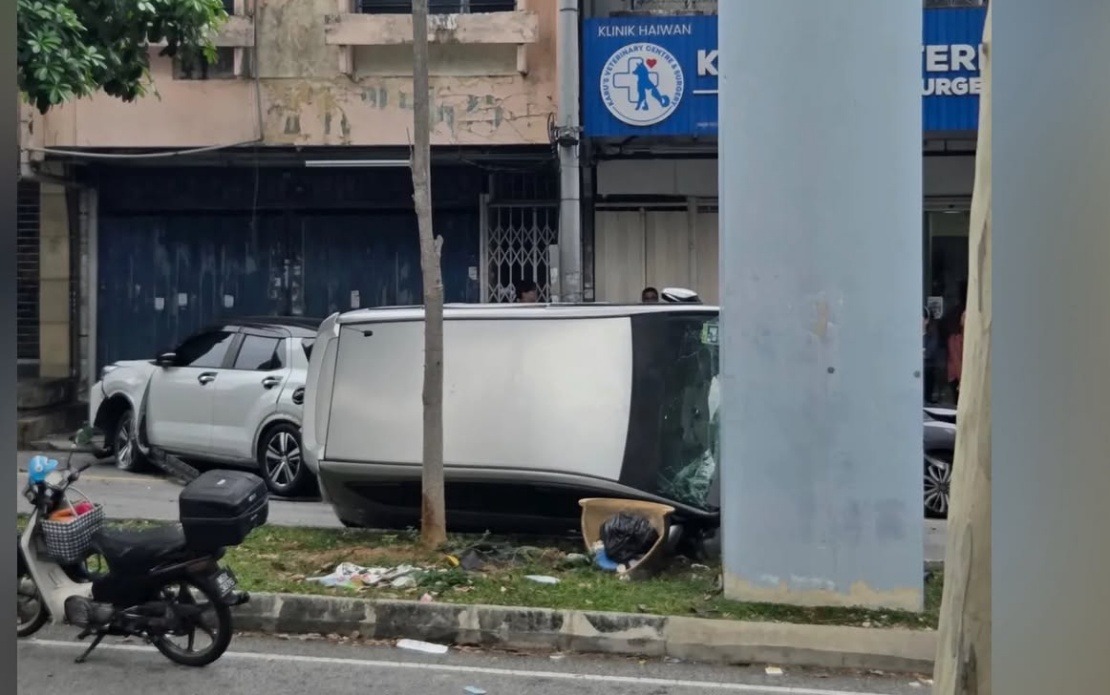
A medical emergency on the road led to a multi-vehicle collision in Cheras this morning when a 28-year-old driver experienced a seizure while operating his BMW 320i. The incident unfolded around 8.30 am along Jalan Midah 1, where the motorist was en route from his residence to his workplace at Taman Midah 1. According to the Kuala Lumpur Traffic Investigation and Enforcement Department (JSPT), the sudden medical episode caused the driver to lose command of the vehicle, which then careened off the roadway and struck six cars parked along the left shoulder of the thoroughfare.
The physical consequences of the collision were confined to vehicular damage, as fortunately none of the parked vehicles contained occupants at the time of impact. The six affected cars belonged to a diverse group of owners: four women ranging from 29 to 43 years of age, one 39-year-old man, and one commercial company vehicle. The absence of passengers or drivers inside these vehicles substantially mitigated what could have been a far more serious incident involving personal injury or fatality.
ACP Mohd Zamzuri Mohd Isa, chief of the traffic enforcement division, disclosed in a formal statement that preliminary investigations had uncovered a significant medical history associated with the BMW driver. The 28-year-old has experienced recurring seizures over the past decade, spanning approximately ten years. This extended medical background raises important questions about driving suitability and whether appropriate medical clearance had been obtained prior to operating a motor vehicle. The revelation of such a prolonged seizure disorder underscores the critical intersection between public road safety and individual health management in urban traffic contexts.
To rule out other potential contributing factors, authorities conducted a breathalyser examination on the driver at the scene. The test returned a zero reading of 0 milligrammes per 100 millilitres of blood, definitively eliminating alcohol impairment as a causative element in the accident. This finding helped establish that the medical episode, rather than substance abuse or intoxication, was the precipitating factor behind the loss of vehicle control. The negative breathalyser result also assisted investigators in characterising the nature and classification of the incident for legal and administrative purposes.
The incident has been formally classified under Rule 10 of LN 166/59, the relevant legal framework governing traffic offences and accidents in Malaysia. This classification reflects the severity assessment and procedural categorisation determined by traffic authorities. The ongoing investigation phase suggests that additional details and evidence gathering continue as police work to establish a comprehensive factual record of the collision. Investigators are examining whether any additional safety measures or administrative actions may be warranted given the circumstances surrounding the seizure and the driver's medical history.
For Malaysian motorists and residents in the Klang Valley, this incident serves as a sobering reminder of the unpredictable hazards that can emerge on public roads. While seizures are relatively uncommon, they represent one of several medical emergencies that can precipitate sudden loss of vehicle control without warning. The fact that no injuries occurred in this instance was largely attributable to circumstance—specifically that the parked vehicles were unoccupied. Had occupied vehicles been struck, or had pedestrians been nearby, the outcome would have been considerably more tragic.
The incident also highlights important questions regarding medical fitness to drive in Malaysia. Individuals with chronic conditions such as epilepsy face complex considerations when deciding whether to hold and retain a driving licence. While modern medication has improved seizure control for many patients, breakthrough episodes can still occur. The regulatory framework governing which medical conditions should result in driving restrictions remains an area of ongoing discussion among road safety authorities and medical professionals across Southeast Asia.
The public appeal issued by the traffic department invites witnesses or individuals with additional information to contact either the Tun H.S. Lee traffic police station at 03-2071 9999 or their nearest police establishment. Such outreach is standard protocol for ensuring thorough investigative completeness, though in this case the circumstances appear relatively straightforward given the medical nature of the precipitating event. The investigation will likely focus on whether any procedural, administrative, or regulatory matters require attention to prevent similar incidents in future.
From a broader perspective, this Cheras collision exemplifies the diverse categories of road accidents that traffic enforcement authorities must address beyond the more commonly discussed causes of speeding, reckless driving, and impaired operation. Medical emergencies affecting drivers constitute a smaller but significant portion of traffic incidents, particularly in urban areas where congestion and high vehicle density amplify the potential consequences. As Malaysia's vehicle population continues to expand and traffic volumes increase throughout the Klang Valley and other metropolitan regions, managing medical emergency-related accidents becomes an increasingly important component of comprehensive road safety strategy.

