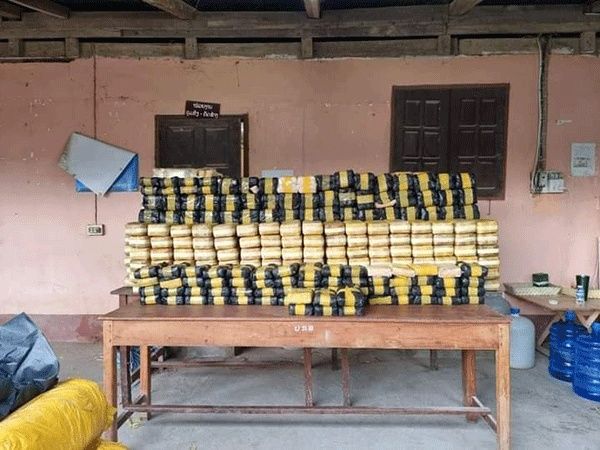
Law enforcement authorities in Xaysomboun Province, in central Laos, have escalated calls for more aggressive action to combat a widening narcotics crisis, with drug-related offences dominating the criminal landscape. During the first six months of this year, drug cases represented nearly 44 per cent of all recorded criminal activity—24 out of 54 total offences logged by the Xaysomboun Provincial Public Security Force. This concentration of drug-related prosecutions underscores how profoundly narcotics trafficking has destabilised the province's security landscape, surpassing traditional crimes as the foremost challenge to public order and stability in the region.
The breakdown of these cases reveals the operational burden facing local police and prosecutors. Of the 24 drug offences identified, only two had been formally concluded and referred to the Public Prosecutor's Office by mid-year, leaving 22 cases still under active investigation. This processing lag reflects both the complexity of drug investigations and the resource constraints facing provincial authorities. When viewed alongside the broader criminal caseload—where only 15 of 54 total offences were successfully resolved, six settled, and four forwarded for prosecution—the statistics paint a picture of an overburdened judicial system struggling to keep pace with crime volume and maintain investigative quality.
The urgency of the drug problem became apparent during an official visit to Xaysomboun on August 7, when Police Lieutenant General Vanthong Kongmany, Laos's Minister of Public Security, met with Police Brigadier General Ouday Insouvanh, head of the provincial force. Police Brigadier General Ouday presented the crime figures as evidence that the province required reinforced security strategies. The minister's response was unequivocal: security forces must redouble efforts to suppress drug trafficking networks and combat the proliferation of new synthetic substances that are complicating enforcement operations. This high-level intervention signals that the central government views the Xaysomboun situation as emblematic of broader national challenges that demand coordinated, intensified responses.
The focus on Xaysomboun reflects a five-year national campaign designated as a government priority to suppress drug manufacturing and trafficking throughout Laos. Prime Minister Sonexay Siphandone reported to the National Assembly last month that nationwide authorities had processed 1,786 drug cases during the same six-month period, resulting in 4,025 arrests including 93 foreign nationals. The scale of confiscations—large quantities of drugs, related paraphernalia, and vehicles—demonstrates that Laotian law enforcement has made seizures a central tactic. Yet the volume of ongoing cases suggests that supply chains remain resilient and that street-level distribution networks continue to operate with considerable impunity, particularly in provinces like Xaysomboun where local resources may be stretched thin.
For Malaysian observers and policymakers, the Xaysomboun drug surge carries significant implications. The Greater Mekong Subregion, of which both Laos and Malaysia are part through various regional frameworks, functions as a single narcotics ecosystem. Drugs manufactured or trafficked through Laos frequently transit toward Thailand, Myanmar, and beyond, reaching Southeast Asian markets including Malaysia. The weakness or ineffectiveness of enforcement in one jurisdiction creates spillover effects for neighbours, as traffickers exploit porous borders and inadequate intelligence sharing. Rising drug volumes in Xaysomboun likely indicate expanding production capacity or shifting transit routes, developments that could ultimately affect Malaysian drug markets and require enhanced cross-border cooperation.
Beyond narcotics, the minister tasked provincial authorities with strengthening action against smuggling, human trafficking, theft, burglary, illegal mining, and gambling operations. Notably, Police Lieutenant General Vanthong also issued explicit instructions to enhance oversight of social media and cybercrime—a directive that expands the security agenda beyond traditional street crime into the digital realm. This integration of cybersecurity into provincial law enforcement priorities reflects recognition that organised criminal networks increasingly operate through encrypted communications, money-laundering apps, and online marketplaces. For Malaysia, monitoring Laotian cybercrime trends is strategically important, as transnational criminal syndicates utilise digital infrastructure without regard to borders, and regulatory gaps in one country can enable fraud, extortion, and drug transactions affecting consumers across the region.
Road safety emerged as a secondary but substantial concern during the ministerial visit. Xaysomboun recorded 60 traffic accidents in six months, resulting in four deaths, 80 injuries, and damage to 109 vehicles worth more than 2.56 billion kip. While traffic accidents are often categorised as administrative or civil matters rather than criminal offences, they represent a form of preventable loss that diverts police and health resources from other priorities. The economic toll—over 2.56 billion kip in vehicle damage alone—compounds the province's economic challenges and suggests that road infrastructure, driver training, and enforcement of traffic laws require parallel investment alongside narcotics suppression.
Immigration and foreign national management constituted another focus area, with the provincial force inspecting 1,698 tourists during the six-month period, of whom 396 were foreign nationals. This supervisory activity serves multiple functions: it generates intelligence on cross-border movements, identifies potential trafficking victims or smugglers, and maintains security registers. The relatively modest number of foreign visitors to Xaysomboun—roughly 66 per month—reflects the province's limited tourism infrastructure and accessibility. However, the presence of international visitors, combined with proximity to international borders, means that even small numbers of foreigners merit careful vetting, as transnational criminal networks sometimes deploy operatives under tourist cover.
Police Lieutenant General Vanthong's remarks to provincial leadership emphasised institutional and personnel development alongside operational intensity. He instructed officers to comply rigorously with Party policies, state laws, and disciplinary codes; to take proactive responsibility rather than passively awaiting orders; and to acknowledge weaknesses in their approach. He also stressed that immigration management and foreign national oversight must operate at professional standards with expertise-based personnel assignment. These injunctions suggest that the minister views institutional culture and professional standards as critical deficiencies—implying that some enforcement failures may stem not merely from resource scarcity but from inconsistent application of rules, lack of initiative, or inadequate training.
The emphasis on legal procedures in investigations, detention, and rehabilitation also warrants attention. By stressing compliance with legal processes, the minister appeared to signal concern about extrajudicial practices or procedural shortcuts that, while potentially expedient in the short term, undermine rule of law and invite international criticism. This is particularly significant given that narcotics enforcement in Southeast Asian jurisdictions has periodically attracted scrutiny from human rights bodies regarding arrest procedures, detention conditions, and interrogation methods. For Malaysian counterparts engaged in cross-border drug cases involving Laotian authorities, these ministerial statements suggest an evolving emphasis on procedural propriety that could facilitate smoother bilateral cooperation.
Looking forward, the Xaysomboun situation exemplifies tensions endemic to drug enforcement in economically disadvantaged, border-adjacent regions. The province's location near international boundaries, combined with limited economic opportunity and relatively sparse state capacity, creates conditions attractive to traffickers and producers. Enforcement alone—even if dramatically intensified—will likely prove insufficient without parallel investments in rural economic development, border infrastructure modernisation, and cross-border intelligence cooperation. For Malaysia and other regional actors, the Xaysomboun challenge underscores the necessity of treating drug enforcement as a multilateral endeavour requiring coordinated strategies, technical assistance, and burden-sharing rather than treating individual jurisdictions as discrete problems.
The appointment of new security directives and the ministerial visit signal that Laotian leadership recognises the urgency of the challenge and is channelling resources toward response. Whether these measures will meaningfully reduce narcotics trafficking or merely manage existing caseloads remains to be seen. What is clear is that Xaysomboun's drug crisis, mirrored across the region in varying degrees, represents a persistent security threat that demands sustained international attention and collaborative policymaking. For Malaysian security and policy communities, tracking developments in Laos—particularly enforcement trends, institutional capacity improvements, and shifts in trafficking patterns—remains an essential component of regional situational awareness and strategic planning.

