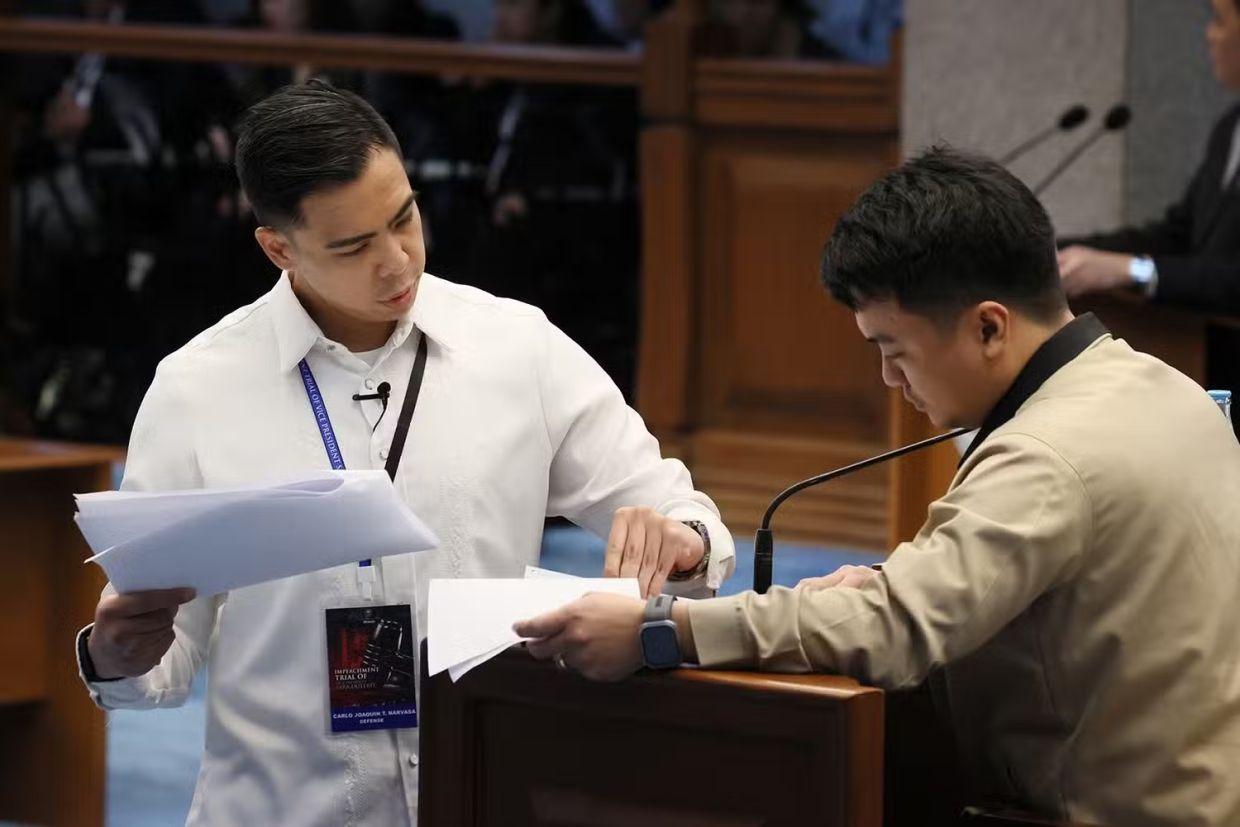
The legal battle over Philippine Vice President Sara Duterte's future took a critical turn on Wednesday as her defence counsel mounted a forceful challenge to the impeachment proceedings against her, fundamentally questioning whether the words she spoke in November 2024 legally qualify as an impeachable offence under the nation's constitutional framework. Appearing before the Senate impeachment court on the third day of formal proceedings, Duterte's lawyers sought to dismantle the prosecution's case by targeting both its evidentiary foundations and the core legal threshold required to remove her from office.
The impeachment complaint centres on statements Duterte made during an online press briefing on November 23, 2024, in which she allegedly made grave threats against President Ferdinand Marcos, his wife Liza Araneta-Marcos, and House Speaker Martin Romualdez. Rather than contest the substance of what was said, defence counsel Mark Vinluan pivoted toward a narrower but strategically important argument: that such remarks, however intemperate, do not rise to the level of "other high crimes" enumerated in Article XI, Section 2 of the 1987 Philippine Constitution. This provision lists impeachable offences as culpable violation of the Constitution, treason, bribery, graft and corruption, betrayal of public trust, and other high crimes—a deliberately vague category that has sparked significant constitutional debate.
Vinluan's cross-examination of National Bureau of Investigation senior agent John Mark Calilung exposed what the defence characterised as fatal weaknesses in the prosecution's investigation. The lawyer repeatedly emphasised that prosecutors had presented no evidence demonstrating Duterte had actually hired or contracted an assassin to harm any of the three named individuals. This distinction proved crucial: the defence argued that without proof of concrete criminal conspiracy or conspiracy to commit violence, merely uttering threats—however serious—cannot constitute a high crime warranting impeachment and removal from the presidency. The prosecution itself acknowledged during earlier questioning by Senator Risa Hontiveros that the video recordings of Duterte's statements did not "100 per cent" establish that she had contracted an assassin, a concession that became central to the defence's strategy.
Critically, Vinluan reframed Duterte's entire conduct through the lens of self-defence and protection of family members. He argued that when Duterte made those statements, she was not acting as Vice President but rather as a private citizen—a wife, mother, daughter, and sister—responding to what he characterised as genuine threats against her family. The defence presented evidence that Duterte's residences in both Davao and Manila had been "profiled" by government operatives, citing classified surveillance reports. Additionally, the defence alleged that trusted security personnel had been removed from their posts, creating legitimate vulnerabilities that would cause any parent to react with alarm. This narrative attempt to contextualise the remarks represents a departure from purely legal arguments and seeks to appeal to emotional and practical considerations that might resonate with the senator-judges evaluating the case.
The defence anchored its contentions in what it described as "Operation Romanov," a purported unauthorised intelligence operation conducted by government agents against Duterte and her family. By invoking this alleged programme, the defence sought to establish that Duterte's controversial statements emerged not from malice or political calculation but from genuine fear for her family's safety. Vinluan and fellow defence counsel Carlo Narvasa emphasised that the government actions against Duterte, including the detention of her chief of staff Zuleika Lopez and proceedings related to confidential funds, had created an atmosphere of what they termed "systematic oppression" directed at the Vice President and her associates. This framing transforms the impeachment trial from a simple assessment of whether certain words were spoken into a broader examination of political persecution.
Narvasa's scrutiny of the NBI investigation revealed procedural irregularities that could undermine the prosecution's case. Calilung acknowledged that neither President Marcos, First Lady Araneta-Marcos, nor Speaker Romualdez had filed formal criminal complaints with the bureau, nor had any of them appeared personally before investigators to provide statements. The investigation proceeded entirely on an ex mero motu basis—initiated by the bureau without a formal complainant—a methodology that defence counsel suggested compromised the investigation's legitimacy and thoroughness. The absence of sworn statements from the three alleged targets of Duterte's threats represented, in the defence's view, a glaring evidentiary gap that prosecutors had failed to adequately address or explain.
Further weakening the prosecution's documentary foundation, Calilung confirmed that the NBI's revised affidavit dated February 10, 2025, did not include statements from the offended parties or from journalists who had attended Duterte's November press briefing. Instead of compiling comprehensive evidence from all relevant witnesses, the NBI relied on an affidavit attesting to minutes from investigators' interviews and certification from the Department of Justice regarding the sufficiency of its preliminary investigation. When Narvasa pointedly asked whether the bureau had truly conducted a thorough investigation, Calilung did not answer, a silence that defence counsel exploited to suggest the investigation's inadequacy.
The proceedings also illuminated fundamental constitutional questions about what conduct justifies the extreme measure of removing an elected vice president. Senator Francis Escudero, the court's presiding officer, noted that the discussion had gravitated toward the central constitutional issue: whether Duterte's acts constitute impeachable offences as defined in the 1987 Constitution. This represents uncharted constitutional territory in the Philippines, as courts and legal scholars have long debated the proper interpretation of "other high crimes" and whether ordinary criminal offences or statements alone can satisfy that standard. Malaysia and other Southeast Asian democracies watching this trial may find its constitutional reasoning relevant, as questions about the proper scope of impeachment powers and the protection of political figures from harassment through such mechanisms remain relevant across the region.
When Senator Hontiveros probed whether the defence was effectively arguing that grave threats could be legally justified by legitimate underlying circumstances, defence counsel Carlo Narvasa initially appeared to accept that proposition before clarifying that this was not the defence's formal position. This exchange revealed the tension inherent in the defence strategy: acknowledging the context in which remarks were made risks conceding a factual basis that prosecutors can manipulate, yet ignoring context eliminates the most persuasive aspect of Duterte's defence. Escudero subsequently cautioned senator-judges against posing questions requiring legal conclusions, reminding them that such matters should be reserved for closing arguments. Hontiveros noted that previous impeachment trials had permitted broader questioning by judges, suggesting that the current trial's procedural strictness might constrain the full airing of constitutional issues.
The defence's strategy reflects a calculated risk: rather than portraying Duterte as innocent or her remarks as benign, the lawyers tacitly acknowledge that provocative statements were made but argue forcefully that the constitutional machinery of impeachment should not be weaponised against such speech, however regrettable. This approach implicitly accepts factual assertions while maintaining that removal from office represents a disproportionate response that should be reserved for demonstrable, concrete abuses of power—treason, bribery, corruption, or clear constitutional violations. By framing the case as one of disputed legal thresholds rather than disputed facts, the defence has shifted the battle to terrain where constitutional arguments, precedent, and the proper scope of impeachment powers become central. For observers across Southeast Asia concerned with the health of democratic institutions, the trial's resolution may carry implications for how impeachment mechanisms can be deployed and the standards required to invoke this ultimate parliamentary sanction.
The trial's trajectory suggests that the Senate's ultimate decision will hinge not merely on whether Duterte spoke the words attributed to her—a fact the defence has scarcely contested—but rather on whether those words, uttered in the political and personal circumstances the defence has outlined, satisfy the Constitution's demanding standard for impeachable conduct. Should the Senate ultimately acquit or dismiss the charges, it would effectively establish that impeachment cannot be used to remove sitting vice presidents for speech alone, absent proof of concrete conspiracy to violence or other clear high crimes. Conversely, conviction would signal that the constitutional term "other high crimes" encompasses serious threats and incitement to violence, regardless of political context. Either outcome will reverberate through Philippine constitutional law and potentially influence how other democracies in the region interpret similar provisions.

